
Kaufland.de: The Second German Marketplace Sellers Keep Missing
Introduktioun
Ask a cross-border seller in Shenzhen, Yiwu or Ningbo which German marketplaces matter, and the answer almost always starts and ends with Amazon.de. Otto and eBay might earn a passing mention. Kaufland.de, the online marketplace run by the Schwarz Group, the same retail group that owns the Lidl and Kaufland supermarket chains, tends to be missed entirely. That is a strange blind spot. ECDB’s marketplace analysis has ranked Kaufland.de as Germany’s sixth largest online marketplace by gross merchandise value, and the platform has only become more ambitious since.
The timing makes this more than a curiosity. Kaufland Global Marketplace now lets a single seller account reach nine countries, after Spain and the Netherlands opened to seller registration on 11 June 2026. The company also reports that gross merchandise value across its marketplaces grew by 11.9 percent in the 2025 financial year, with international revenue up 124 percent. At the same time, the European Union has ended duty-free treatment for small parcels, and Kaufland itself has reportedly tightened its rules on low-priced offers shipped from outside the EU. For anyone moving goods from China to German consumers, these developments collide in the freight plan.
This guide is written from the freight forwarding side of the table. It explains what the marketplace offers, what changed in 2026, how to choose between direct parcels, Mier Fracht, air and rail, how to keep customs and packaging paperwork from stalling a shipment, and how to model landed cost before a single carton leaves the factory. Facts and dates reflect information available in mid-October 2026. Several of the rules described here are still moving, so verify the details with your broker and the Kaufland Seller Portal before committing cargo.
Why Kaufland.de Deserves a Seat Beside Amazon and Otto
Kaufland’s strength is brand familiarity rather than search dominance. The group operates more than 1,600 physical stores across eight countries, and German households know the name from the weekly shop. That trust carries over to the online marketplace, where everyday categories such as home and garden, household goods, consumer electronics, toys and pet supplies tend to suit the audience. Shoppers who might hesitate to buy from an unknown seller on a global platform often feel more comfortable when the checkout page carries a name they recognise from the high street.
The seller economics also differ from Amazon in a way that matters enormously for logistics. Kaufland does not run a universal fulfilment network comparable to Fulfilment by Amazon. Sellers ship orders to the end customer themselves, or they use Kaufland Shipment Solutions, an optional cross-border shipping service available to certain sellers and storefronts. In practical terms, the seller owns the inbound journey, the stock location and the delivery promise.
That is exactly why freight planning, more than listing optimisation, separates the sellers who thrive on Kaufland from those who stall after a promising start.
The numbers behind the platform
Kaufland Global Marketplace works as a multi-marketplace system. One registration and one Seller Portal give access to offers, orders and product data across every country storefront, and the base subscription is charged once even when a seller activates several marketplaces. The table below collects the figures most relevant to a seller planning supply chains, based on information published by Kaufland and by third-party analysts through October 2026.
Table 1. Kaufland Global Marketplace at a glance (October 2026)
| Kuurzmeldung | Aktuell Positioun |
| Länner | Nine storefronts, including Germany, Austria, Poland, Czech Republic, Slovakia, France, Italy, plus Spain and the Netherlands, which opened to seller registration on 11 June 2026 |
| Potential Erreeche | Up to roughly 220 million online shoppers across all nine countries, according to Kaufland |
| Abonnement | Basic plan around EUR 39.95 per month and Plus plan around EUR 59.95 per month, net, one base fee covering all marketplaces |
| Kommissioun | Typically 7 to 16 percent depending on category, calculated on the gross price including VAT and shipping |
| Erfëllung | Seller ships to the customer; Kaufland Shipment Solutions is optional |
| Basic entry rules | Trader status, official EAN or GTIN codes, a returns address inside the EU |
| Reported seller uplift | Average sales increase of about 50 percent after adding further Kaufland marketplaces, a company figure |
Treat the reach and growth numbers as direction rather than promise. Potential shoppers are not the same as active buyers, and uplift percentages come from Kaufland’s own communications. What the figures do show is a platform that is actively recruiting international sellers and investing in cross-border tooling, which is rarely a bad moment to arrive.
Why so many sellers overlook it
Amazon gravity is the first reason. Most Chinese exporters built their European business on Amazon, so the default instinct is to deepen that single channel rather than add another. The second reason is perceived complexity. Kaufland asks for an EU returns address, packaging registration in Germany, product safety contacts for goods made outside the EU, and clean product data. None of that is exotic, yet it feels like a barrier to a seller who has never needed it. ECDB’s analysis notes that seller success on Kaufland depends on factors such as search volume, commission levels and the number of similar products, which hints at the opportunity: fewer competing sellers per product page than on the largest platforms.
The third reason is the freight puzzle. The old playbook of shipping small postal packets straight from Shenzhen to a German buyer no longer works for most products, and sellers who do not understand the new rules assume the channel is closed to them. It is not, but it demands a different logistics model.
What Changed in 2026 and Why Freight Became the Gatekeeper
Three separate changes arrived within a few months of each other, and they reinforce one another. One sits inside Kaufland’s own rulebook, one sits in EU customs law, and one sits in EU packaging law. Together they push cross-border sellers toward a single operating model: import in bulk, clear customs once, hold stock inside the EU and ship locally.
Kaufland’s rule on low-priced offers from outside the EU
A seller-focused study published in October 2026 by a Polish marketplace consultancy, quoting Kaufland’s EU tax page, reports that since 15 June 2026 offers with a net value under EUR 150 that ship from a warehouse outside the EU are deactivated on the marketplace. Under that rule, direct shipping from outside the EU remains possible only for offers of EUR 150 net or more, and those should be delivered duty paid. We could not confirm the wording on Kaufland’s own page during research for this article, so check the current text in your Seller Portal before you build a plan around either interpretation.
The practical consequence is hard to miss. For consumer goods priced between roughly EUR 15 and EUR 80, which is where most marketplace volume sits, the compliant route is to hold stock inside the EU. That turns the question from which parcel service to use into which port, which consolidator and which warehouse.
The EUR 3 duty and the handling fee
On 1 July 2026 the EU ended the long-standing customs duty exemption for low-value consignments. Until a permanent system arrives in 2028, a flat customs duty of EUR 3 applies to goods with an intrinsic value of up to EUR 150 imported from outside the EU. The Council of the EU agreed the measure in February 2026, and it is calculated per product category using six-digit tariff codes rather than simply per parcel. A parcel with three different tariff headings can therefore attract three separate charges.
A second charge is coming. A handling fee of roughly EUR 2 per parcel has been planned for November 2026, intended to cover the cost of customs processing. Its exact content and start date were still under negotiation between EU institutions at the time of writing, and several member states, including France, Italy and Romania, have introduced national handling fees of their own in the meantime.
Behind all of this sits a volume problem. According to European Commission figures cited in trade press, about 4.6 billion low-value parcels entered the EU in 2024, roughly 12 million per day. Authorities now want better data, tighter classification and fewer undervalued declarations, which means more scrutiny of the paperwork attached to every shipment.
Table 2. Key 2026 dates that affect Kaufland.de sellers
| Datum | Héichwaasser | Why it matters for freight |
| 11 Febof 2026 | EU Council agrees the flat EUR 3 duty on low-value parcels | Ends the assumption that small parcels enter duty free |
| 11 Jun 2026 | Spain and the Netherlands open to Kaufland sellers | Pan-European stock planning becomes more attractive |
| 15 Jun 2026 | Reported start of deactivation for offers under EUR 150 net shipped from outside the EU | Direct-from-China parcels no longer work for most items |
| 1 juli 2026 | EUR 3 customs duty starts for consignments up to EUR 150 | Raises the cost of any remaining low-value direct shipping |
| 12 aug 2026 | EU packaging regulation begins to apply | Packaging compliance and labelling need attention before shipment |
| Nov 2026 (planned) | Handling fee of about EUR 2 per parcel | Adds a per-parcel cost to direct B2C imports |
| juli 2028 | Temporary EUR 3 duty due to end | Permanent regime based on standard tariffs takes over |
Read the table as a direction of travel. Every date points the same way: fewer loopholes for individual parcels, more weight on documented, bulk imports with clean paperwork.
Choosing a Shipping Model for Kaufland.de
There is no single correct way to supply Kaufland.de, but there are four realistic options, and the right choice depends on order value, product size, demand predictability and how much working capital you can tie up in stock. Most sellers end up combining two of them, using sea freight for the baseline and a faster mode for peaks and new launches.
Direkt Paketen aus China
Direct shipping still exists, but its role has shrunk. Under the reported Kaufland rule it is limited to higher-value offers, and even then the seller needs to handle duty and VAT so the buyer is not surprised at the door. Returns add a second headache, because the marketplace requires a returns address inside the EU. Direct parcels now suit niche, high-value or made-to-order goods rather than mainstream catalogue items.
Bulk sea freight into EU stock
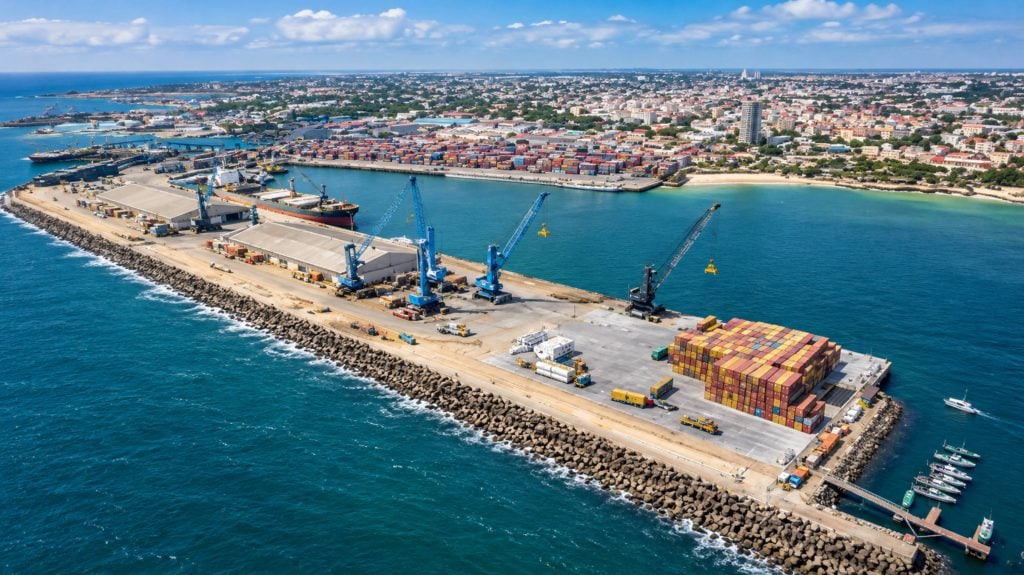
Sea freight is the backbone of most sustainable Kaufland operations. Cartons are consolidated in China, loaded into a container, shipped to a North European port such as Hamburg, Bremerhaven, Rotterdam or Antwerp, cleared through customs once, and then trucked to a warehouse. From that point every consumer order is a domestic or intra-EU shipment, and the flat duty on low-value parcels does not enter the picture, because the goods have already been imported under a standard declaration at their actual tariff rate.
The trade-off is time and cash. Port-to-port transit on Asia to North Europe lanes typically runs somewhere between 30 and 45 days depending on routing and schedule reliability, and clearance, unloading and inland delivery can add another week or so. Stock is paid for months before it sells, so forecasting discipline matters. Sellers who guess wrong either run out of their best sellers or sit on slow-moving inventory.
In return, the delivery promise improves dramatically. German shoppers expect parcels within a few days, and fast, trackable delivery protects conversion rates and review scores. Returns can be inspected and restocked locally instead of being written off.
Air freight and rail for peaks and replenishment
Air freight costs far more per kilogram, but for compact, high-margin or fast-moving products it can pay for itself, especially when a stock-out would cost more than the freight bill. China to Europe rail, with Duisburg as the main gateway into Germany, sits between sea and air on both speed and cost. Typical rail transit is around 18 to 25 days, though schedules and capacity vary by corridor.
Calendar pressure makes this practical today. Black Friday falls on 27 November 2026, so a container booked this week will almost certainly arrive too late for the peak. Best sellers can still be moved by air or rail, while sea freight is better used for post-holiday replenishment and for building stock ahead of the Chinese New Year closures that begin in early February 2027.
Table 3. Shipping models compared for a Kaufland.de seller
| Modell | Typesch Transit | Käschten pro Eenheet | Beschte gëeegent fir | Haaptrisiko |
| Direct parcel | 5 op 15 Deeg | High, plus duty and fees | Offers of EUR 150 net or more | Marketplace rules and duty exposure |
| Sea freight to EU stock | 35 bis 55 Deeg vun Dier zu Dier | Niddregsten | Core catalogue, steady sellers | Forecast error and cash tied in stock |
| Rail to Germany | 20 bis 30 Deeg vun Dier zu Dier | mëttel- | Mid-value goods, urgent top-ups | Capacity and schedule changes |
| Loftfracht | 5 bis 10 Deeg vun Dier zu Dier | Héchst | Launches, peak-season rescue | Cost can erase margin on low-value items |
The transit ranges in the table are planning estimates, not guarantees. Always ask for a current schedule and a buffer allowance when you request a quotation.
A hybrid approach is where many established sellers land. The steady core of the range moves by sea on a regular monthly or six-weekly rhythm, a smaller safety stock of the top ten products moves by rail or air when sell-through accelerates, and anything new is tested by LCL before it earns a full container slot. This pattern keeps average freight cost low while limiting the damage when a forecast turns out wrong, and it gives the warehouse a predictable flow of inbound deliveries instead of occasional floods.
FCL, LCL and the Port Question
Once you decide on sea freight, the next decision is how much of a container you actually need. Full container load, usually shortened to FCL, gives you exclusive use of a 20 foot or 40 foot container. Less than container load, or LCL, places your cartons alongside other shippers’ cargo in a shared container that is consolidated in China and unpacked at a destination freight station.
LCL is the natural entry point. It lets a seller send a few cubic metres to test products, validate the customs documentation and see how the warehouse handles inbound stock, without paying for empty space. The price per cubic metre is higher than FCL, and the extra handling at both ends adds a few days and a little more risk of cartons being damaged or delayed.
As volume grows, the economics flip. Many forwarders see the break-even somewhere between 12 and 18 cubic metres, although it depends on the lane, the season and the carrier’s rates that week, so a sensible habit is to request both an LCL and an FCL quotation every time and compare them side by side.
Table 4. Approximate practical capacity by container type
| Container | Practical loadable volume | Typical use for a Kaufland seller |
| LCL (gedeelt) | Vun 1 CBM erop | Pilot runs, new SKUs, small replenishments |
| 20 Fouss Standard | About 25 to 28 CBM | A single product line or a mixed catalogue of dense goods |
| 40 Fouss Standard | About 55 to 58 CBM | Established sellers moving steady volume |
| 40 Fouss héije Kubus | About 65 to 68 CBM | Bulky, lightweight goods such as home textiles or garden items |
Port choice deserves more thought than it usually receives. Hamburg and Bremerhaven sit closest to German inland destinations, while Rotterdam and Antwerp often offer more frequent services and then connect onward by truck, barge or rail. A lower ocean rate into one port can be wiped out by a longer or costlier inland leg, so compare total door-to-door cost rather than the headline sea freight price.
Reliability matters as much as price. Schedules on Asia to Europe trade lanes have been volatile in recent years, so build a buffer of at least a week or two into any plan that depends on a specific sales date.
Customs and Compliance Paperwork That Stops Cartons at the Port
Most delays on Kaufland-bound cargo are not caused by ships or trucks. They come from missing data, inconsistent documents or products that lack the identifiers the marketplace requires. Fixing these problems at origin costs very little. Fixing them after arrival means demurrage, storage charges and missed selling days.
Classification, valuation and the importer of record
Accurate tariff classification now carries more weight than ever, because the flat duty on low-value consignments is calculated by six-digit tariff code, and standard duty on bulk imports follows the same classification. Vague descriptions such as accessories or gifts invite questions. A precise description, material, function and the correct code protect both the duty calculation and the clearance time.
Valuation is the second pressure point. European authorities have openly described undervaluation as a driver of the low-value parcel problem, so invoices that do not reflect the real transaction price are a risk, and a mismatch between the invoice and the price on the Kaufland listing is easy to spot.
Finally, someone must act as the importer of record. A seller without an EU entity generally needs an EORI number and, for stock held in Germany, a German VAT registration, often arranged through a fiscal representative or a specialist tax adviser. This is not something a forwarder can improvise on the day the container lands, so settle it before booking.
EPR, packaging and product safety
Kaufland requires sellers to upload registration numbers for packaging on the German marketplace, and other numbers apply to electrical equipment and batteries in the relevant categories. Goods made outside the EU also need an identified responsible person in the EU under the General Product Safety Regulation, and CE-marked goods need an authorised representative. Offers that lack these details can be hidden, which is an expensive surprise if the stock is already on the water.
The EU packaging regulation, which began to apply on 12 August 2026, adds harmonised rules on packaging, so check carefully that cartons and retail packaging carry the right labels. From a freight perspective, the useful discipline is to build a document pack before cargo leaves China and to match labels on the carton to the data in the Seller Portal.
Table 5. Pre-shipment checklist for Kaufland.de stock
| Viraussetzung | Trëfft op | Virbereeden ier d'Fracht vu China verléisst |
| EAN or GTIN | All Produkt | Official codes printed on packaging and matching the listing |
| Packaging registration number | Kaufland.de sellers | Registration in Germany completed and number uploaded to the Seller Portal |
| WEEE and battery numbers | Electrical items and batteries | Registration and category assignment confirmed |
| EU responsible person | Goods made outside the EU | Name and address on product or packaging and in the Seller Portal |
| EU returns address | All sellers | Warehouse or partner address ready for customers and carriers |
| EORI and VAT | Importer vu Rekord | Numbers issued and shared with the forwarder and customs broker |
| CE- an Testdokumenter | Regulated product types | Declarations and test reports in the document pack |
Last-Mile Delivery and Returns Inside Germany
After the container is cleared, the job shifts from international freight to domestic parcel logistics. German shoppers are used to quick delivery, tracking links and easy returns, and a marketplace listing that quotes a long delivery time pays for it in lost conversions. A warehouse partner located close to the main German carrier hubs can pick, pack and hand over parcels the same day and meet the delivery times promised in the Seller Portal.
Returns deserve their own plan. Consumers in the EU have a statutory right to withdraw from distance purchases within 14 days, and Kaufland requires a returns address inside the EU. Sending returned goods back to China is almost never economical, so the realistic choice is to inspect, regrade and restock them locally, or to dispose of them responsibly. A warehouse that can handle returns properly protects margin more than a slightly cheaper pick and pack rate.
In short, the warehouse is not an afterthought.
A Landed Cost Illustration: One Product From Factory to German Doorstep
Numbers make the case better than theory. The example below follows a single household product that sells for EUR 49.90 including 19 percent German VAT. All cost figures are assumptions chosen to show the structure of the calculation. They are not quotations, and your own rates will differ by product, volume, season and supplier.
Table 6. Illustrative unit economics for a bulk-imported product sold on Kaufland.de
| Artikel | EUR per unit | Vermutung |
| Selling price including VAT | 49.90 | Consumer price on Kaufland.de |
| German VAT | 7.97 | 19 percent included in the price |
| Nettoakommes | 41.93 | Price less VAT |
| Kaufland commission | 5.99 | Assumed 12 percent of the gross price |
| Ex-factory cost | 9.00 | Supplier price |
| Ozean Fracht | 0.60 | Share of a consolidated container |
| Import Flicht | 0.26 | Assumed 2.7 percent on a customs value of about EUR 9.60 |
| Customs and port handling | 0.15 | Per-unit share of clearance charges |
| Warehouse inbound, pick and pack | 1.40 | Third-party logistics fees |
| Domestic parcel delivery | 4.50 | Average German parcel carrier rate |
| Packaging and EPR fees | 0.15 | Assumed per-unit contribution |
| Retour Dispositioun | 1.80 | Assumed average cost across all orders |
| Maartplaz-Reklamm | 2.52 | Assumed 6 percent of net revenue |
| Gesamtbudget | 26.37 | Sum of the cost lines above |
| Margin before overhead and financing | 15.56 | Ongeféier 37 Prozent vum Nettoakommes |
Two lessons stand out. First, ocean freight is a surprisingly small slice of the cost stack, less than two percent of net revenue in this example, which is why optimising the container rate by a few cents rarely matters as much as avoiding a delayed shipment or a rejected inbound. Second, commission, domestic delivery and returns together dominate the economics, so the logistics partner you choose at the German end has far more influence on profit than the freight rate from China.
A direct-from-China parcel comparison is largely academic for items under EUR 150 net, because the marketplace reportedly no longer allows them to ship that way. Where such shipments remain allowed, a flat EUR 3 duty, a possible EUR 2 handling fee and parcel-rate freight would consume a large part of the margin shown above.
It is worth running a simple sensitivity check on the model above before committing to a purchase order. If the commission rate for your category is 15 percent rather than 12, or if returns run at double the assumed level, the margin falls quickly, while a swing of several cents in ocean freight barely registers. Build these scenarios into a spreadsheet, update them every quarter, and let the weakest assumption tell you where to negotiate or where to gather better data first.
A Practical 90-Day Plan for a China-Based Seller
A phased approach lowers risk, protects cash and gives you real data before you commit to larger orders. The plan below assumes you are starting from scratch and want to be selling at scale by the first quarter of 2027.
Days 1 to 30: paperwork and a pilot
Register on Kaufland Global Marketplace, secure official EAN codes, and arrange your EU returns address, EORI number and German VAT status with a qualified adviser. Complete packaging, electrical and battery registrations where needed, and confirm your EU responsible person for goods made outside the EU. In parallel, choose five to ten products with solid margins, steady demand and straightforward compliance requirements.
Ship a pilot consignment by LCL or, for the best sellers, by air or rail so that you can start selling before the busiest weeks of the year pass entirely. Use the pilot to test everything: document accuracy, carton labels, warehouse receiving times and listing accuracy.
Days 31 to 60: learn from the first orders
Watch conversion, delivery times, return reasons and advertising cost per order. Compare actual landed cost per unit with your model and correct the assumptions that were wrong. Ask your forwarder for FCL and LCL quotes on the same cargo so you know where the volume threshold sits for your products.
Days 61 to 90: scale and prepare for the new year
Place your first replenishment order based on real sell-through rather than hope, and book space early for the period before Chinese New Year. If the products work, consider adding a second Kaufland storefront such as Poland, Austria or the Czech Republic, where the same German-based stock can often serve neighbouring customers with modest extra effort.
Keep a close eye on the November handling fee decision and any updates to Kaufland’s rules for non-EU shipments, and revisit your shipping model if either changes the maths.
Review the document pack after each shipment, because small improvements compound quickly over a year of repeat orders.
Where Topway Shipping Fits Into a Kaufland.de Supply Chain
Since 2010, Topway Shipping, headquartered in Shenzhen, China, has been a professional provider of cross-border e-commerce logistics solutions. The founding team brings more than 15 years of experience in international logistics and customs clearance, with a strong focus on China to US transportation. Its services cover the entire logistics chain, including first-leg transportation, overseas Lagerung, customs clearance and last-mile delivery, and it offers flexible FCL and LCL ocean freight from China to major ports worldwide.
That service chain lines up closely with what a Kaufland.de seller needs. A pilot consignment can move as LCL, and as volumes justify it, the same cargo can graduate to full containers without changing forwarder or paperwork habits. Customs clearance experience helps with classification and valuation, which is the part of the process that has become more sensitive since the July changes. Overseas warehousing and last-mile delivery address the part of the journey that Kaufland leaves entirely to the seller.
A word of candour is useful here. Topway Shipping’s deepest roots lie in the China to US trade, so for a German or wider European programme it makes sense to ask for a lane-specific quotation and confirm the port, warehouse and delivery arrangements at the outset. Sending your HS codes, carton dimensions and weights, target delivery dates, Incoterms preference and returns plan with the inquiry helps any forwarder give a precise and comparable answer, and it makes the first shipment far smoother.
Common Mistakes That Keep Showing Up
The most frequent error is treating Kaufland as a copy of Amazon. Sellers upload their catalogue, expect an FBA-style network to appear, and then discover that stock location and delivery speed are entirely their own responsibility. The second is leaving compliance until a listing is blocked. Packaging numbers, responsible-person details and returns addresses should be ready before the first carton ships.
Some sellers also go too big too soon, filling a 40 foot container before they know what sells, while others stay small for too long and pay premium rates on every shipment. A staged approach avoids both traps.
Choosing a port on the ocean rate alone is a classic mistake, and so is ignoring returns until the first wave of customer complaints. Finally, many sellers rely on advice from a year or two ago. The rules on low-value parcels, packaging and marketplace conditions have changed so quickly in 2026 that anything older than a few months deserves a second look.
Conclusioun
Kaufland.de is easy to overlook, and that is precisely its appeal. It offers access to a recognised German retail brand, a growing multi-country marketplace and a seller base that is still smaller than on the largest platforms. The price of admission has changed, though. Compliance paperwork, EU-based stock and a considered freight plan are no longer optional extras. They are the foundation of any serious cross-border business on the platform.
For sellers moving goods from China, the winning formula in late 2026 looks consistent: bulk shipments by sea, with air or rail used selectively, one clean customs entry, a warehouse partner in or near Germany that handles returns well, and a landed cost model that is honest about commission, delivery and advertising. A forwarder with experience across first-leg transport, customs clearance, overseas warehousing and last-mile delivery, such as Topway Shipping, can shorten the learning curve considerably. Start with a pilot, learn from the data and scale only when the numbers support it.
One final point is worth stressing. The 2026 rule changes are unlikely to be the last. The temporary duty is due to give way to a permanent regime, the handling fee is still being finalised, and marketplaces are adjusting their own conditions as enforcement tightens. Sellers who build flexible supply chains, keep their paperwork in order and review their assumptions regularly will adapt far more easily than those who bet everything on a single route.
FAQs
Q: Can a seller based in China sell on Kaufland.de?
A: Yes. Non-EU sellers can be approved, but they need trader status, official EAN codes and a returns address inside the EU. For most consumer goods priced under EUR 150 net, holding stock inside the EU is now the practical route.
Q: Does Kaufland offer a fulfilment service like FBA?
A: Kaufland does not run a universal fulfilment network. Sellers ship orders themselves, or they use Kaufland Shipment Solutions where it is available to them. Many sellers use a third-party warehouse in Germany.
Q: Does the EUR 3 customs duty apply to containers shipped to an EU warehouse?
A: The flat duty targets low-value consignments of up to EUR 150 sent from outside the EU to customers. Bulk imports are normally declared at standard tariff rates based on classification and value. Confirm the treatment of your goods with your customs broker.
Q: Should I start with LCL or FCL?
A: LCL suits pilots and volumes below roughly 12 to 18 cubic metres. Above that range, request FCL quotations as well and compare the total cost.
Q: When should I book freight before Chinese New Year 2027?
A: Chinese New Year falls on 6 February 2027, and factories often close for weeks around it. Aim to book space in December and have cargo loaded before factories shut down in late January.
