
Vapur miċ-Ċina lejn l-Islanda: Barra l-UE, Ġewwa l-Kumplikazzjonijiet
introduzzjoni
Iceland is easy to overlook on a shipping map. A volcanic island in the North Atlantic with fewer than 400,000 residents hardly looks like a major trade lane. Yet Icelandic retailers, builders, restaurants, tourism operators and online shops import an enormous share of what they sell, from consumer electronics and furniture to construction materials, machinery and spare parts, and China is one of the most important sources of those goods. For exporters in Shenzhen, Ningbo or Shanghai, the question is rarely whether Iceland buys. It is how to get the cargo there without surprises.
The surprises usually begin with a wrong assumption. Because Iceland sits in Europe and belongs to the European Economic Area, many shippers treat it as an extension of the EU. It is not. Iceland is outside the EU customs union, which means every consignment needs its own customs declaration, its own duty and VAT calculation, and a routing plan that usually involves a continental European transshipment hub. A container that is perfectly cleared for Germany can still end up in an administrative maze when it is meant for Reykjavik.
This guide walks through how the China to Iceland lane really works in 2026: the sea, air and express options, realistic transit times, how Icelandic customs treats your goods, what has changed in the EU and the US that affects your planning, and where money is most often lost. The figures in the tables are indicative and drawn from published quotes and public tariff information available at the time of writing, so treat them as planning ranges and always ask for a live quotation before you commit to a shipment.
Why Iceland Is Not Just Another European Destination
Inside the EEA, outside the customs union
Iceland is a member of the European Economic Area and the European Free Trade Association, which is why many product standards, from CE marking to chemical rules, look familiar to anyone who already exports to Germany or France. What Iceland does not share with the EU is the customs union. It runs its own customs tariff, administered by Iceland Revenue and Customs, known locally as Skatturinn, and it charges its own import duties, excise duties and value added tax on arrival. Parcel and courier guides consistently remind senders that Switzerland, Norway and Iceland are not EU members despite their geography, and that shipments to them need proper customs declarations.
For a forwarder, that single fact reshapes the whole job. Cargo that travels through Rotterdam or Hamburg on its way to Iceland cannot simply be cleared in the EU and forwarded like a domestic movement. It has to stay under a transit regime or be re-exported, and the paperwork must follow the goods all the way to Icelandic customs. Shippers who book a cheap port-to-port rate to a European hub without thinking about this often discover that the last leg, and the clearance that goes with it, costs more time and money than the ocean voyage itself.
A small island market with big logistics constraints
Geography adds its own layer. Most of Iceland’s population and commercial activity is concentrated in the capital region around Reykjavik, and that is where the bulk of containers land. Smaller ports serve the east, the north and the Westman Islands, but they receive fewer sailings and often require an extra domestic haul. Inland delivery relies largely on a single ring road and, in winter, on weather that can close mountain passes or delay vessels for days.
The carrier landscape is also thin compared with the great Asia to Europe trunk routes. Deep-sea lines from China rarely call in Iceland directly. Instead, the country is served by a small group of regional operators, Eimskip and Samskip being the best known, running feeder and liner services from northern European ports. That concentration limits schedule choice and gives the operators considerable pricing power, which is one reason a forwarder with strong relationships on the European side can make a real difference to both cost and reliability.
How Cargo Actually Gets from China to Iceland
There is no single Icelandic route. Depending on volume, urgency and cargo type, shipments move by sea with a European transshipment, by air through a hub, or by express courier door to door. Understanding how each option is built makes it much easier to read a quotation and to spot what is missing from it.
Sea freight with a European transshipment
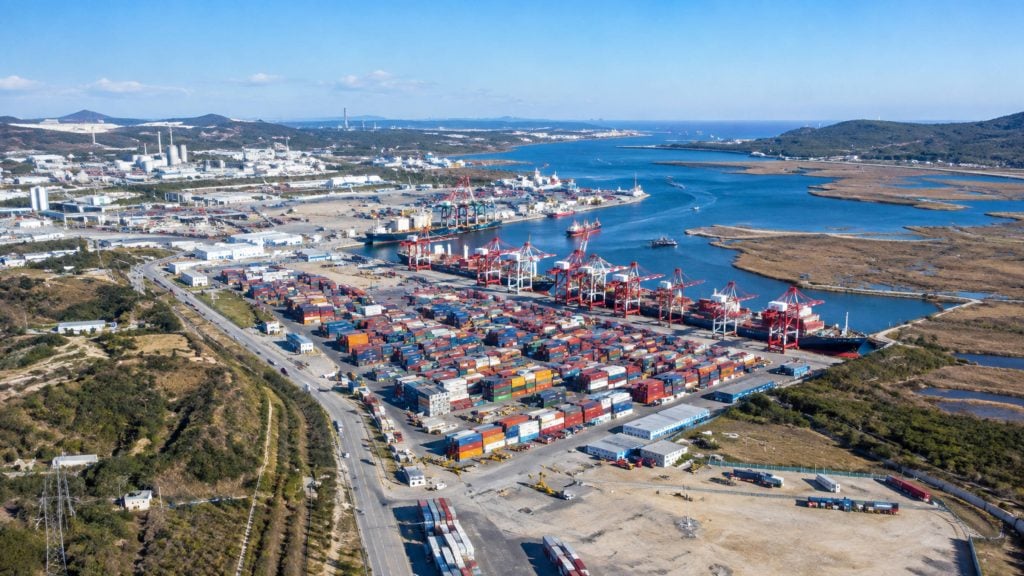
Sea freight is the backbone of Icelandic imports because it is the only mode that makes economic sense for furniture, building materials, machinery, bulky consumer goods and palletised e-commerce stock. Cargo typically leaves a South China or East China port such as Shenzhen Yantian, Shanghai or Ningbo on a mainline vessel bound for North Europe. It is discharged at a hub such as Rotterdam, Hamburg or Antwerp and then loaded onto a feeder or regional liner that crosses the North Atlantic to Reykjavik. Transshipment through Europe is the norm rather than the exception.
Published forwarder listings put the port-to-port transit time from South China to Reykjavik at anywhere between 30 and 60 days, and that range matches what shippers experience. The mainline leg from China to a North European port commonly takes around five weeks, and the feeder leg, waiting time at the hub and unloading in Iceland add anything from one to three weeks depending on the sailing schedule. Once you add trucking to the origin port, export clearance and delivery in Iceland, planning on roughly 45 to 70 days door to door is sensible. The variance is driven mostly by connection timing rather than by sea distance, which is why a sailing with a protected connection matters more than shaving a few days off the first leg.
Winter is the difficult season. North Atlantic storms can delay feeders or force schedule changes, and a missed connection at the hub can cost a full week.
FCL kontra LCL
Full container load makes sense once you have roughly 15 cubic metres of goods or more, because the price per cubic metre falls quickly and the container is sealed at origin and opened only at destination. Twenty-foot and forty-foot containers are both common on this lane, and forty-foot high cube units are popular for light, voluminous cargo. Exclusive use also lowers damage risk, since your goods are never handled alongside anyone else’s.
Less than container load is the answer for smaller volumes. Your cargo is consolidated with other shipments in a China warehouse, shipped in a shared container to the European hub, and then deconsolidated and re-consolidated for the Icelandic leg. One published quote from early 2026 put LCL at about 16,956 Icelandic krona per cubic metre with a two cubic metre minimum. That looks cheap per unit, but LCL adds handling steps, and every step is a chance for delay, damage or a document mismatch. Buyers who ship LCL to Iceland should budget an extra week or two compared with FCL and pack for multiple touches.
A useful rule of thumb from forwarders is that once LCL volume passes ten to twelve cubic metres, it is worth requesting an FCL quote as well. A shared container can end up costing more than a dedicated one, and it will almost certainly take longer.
What a sea freight quote should contain
To give a sense of the price level, one forwarder listing for early February 2026 showed 20-foot containers to Iceland at roughly 232,000 to 260,000 Icelandic krona and 40-foot containers at roughly 273,000 to 342,000 krona across two adjacent validity windows, which works out to something like USD 1,800 to 2,700 at recent exchange rates. The same listing named OOCL as the cheapest carrier and Evergreen as the most expensive. Treat those numbers as a snapshot rather than a benchmark. They show that rates move in short validity windows measured in days, and that carrier choice alone can shift the price meaningfully.
More important than the headline rate is what sits outside it. A complete quotation should state whether origin charges such as terminal handling, documentation and export customs are included, whether the rate is to the European hub or all the way to Reykjavik, and which destination charges the consignee will pay. Bunker adjustments, peak season surcharges and the emissions trading surcharges that carriers now attach to Europe-related legs can all be added later. Ask for the quote on a clear Incoterms basis, and ask what happens if the feeder connection is missed. A rate that is 100 dollars lower but silent on those points is rarely the cheaper option.
Air Freight and Express: When Speed Pays for Itself
Air freight from China to Iceland is a specialist tool. There are very few direct cargo services, so most consignments travel on freighters or passenger belly space to a European or Middle Eastern hub and then onward to Keflavik International Airport. Route planning tools show that the fastest passenger routing from Beijing to Keflavik takes a little over 22 hours, with only one or two departures per week on that pairing, which tells you how thin direct capacity really is.
That is why forwarders treat Iceland air freight as a hub-based product. Cargo consolidates in Shenzhen, Shanghai or Hong Kong, flies to a European gateway such as Frankfurt or Copenhagen, and connects to a flight to Keflavik or is trucked and shipped onward under bond. Door-to-door timing is typically four to ten days, depending on connections and how quickly customs releases the goods.
Express couriers such as DHL, FedEx and UPS shorten that further for small parcels and samples, often delivering in three to seven working days and usually handling Icelandic import clearance themselves. The price per kilogram is the highest of any option, and there is a catch. The courier normally pays the duty and VAT on your behalf and then bills the receiver before or at delivery, together with a handling fee that published guides put at roughly 1,200 to 4,500 krona. If your customer does not expect that bill, refused deliveries follow.
Air is also the only realistic option for time-critical goods such as spare parts for fishing vessels or geothermal plant, product launches, seasonal fashion and replacement components. Lithium batteries, magnets, powders and liquids need oġġetti perikolużi declarations or special handling, and it is far better to declare them at booking than to have a shipment stopped at a transit airport.
Sea, Air and Express Compared at a Glance
The table below summarises how the four main options differ. The time and cost ranges are planning estimates for shipments from South or East China to the Reykjavik area and will vary with season and carrier.
| mod | Ħin bieb bieb | L-iktar adattat għal | Profil tal-ispejjeż | Għassa prinċipali |
| Baħar FCL | 45 għal jiem 70 | Full loads, furniture, machinery, building materials | L-inqas spiża għal kull kilogramma | Feeder delays and winter weather |
| Baħar LCL | 50 għal jiem 75 | Consignments of about 2 to 12 cbm | Low per cbm, with minimum volumes | Extra handling and consolidation cut-offs |
| Merkanzija bl-ajru | 4 għal jiem 10 | Urgent, high-value or seasonal cargo | High, charged on chargeable weight | Limited direct capacity and dangerous goods rules |
| kurrier espress | 3 għal jiem 7 | Kampjuni, pakketti żgħar, ordnijiet tal-kummerċ elettroniku | L-ogħla għal kull kilogramma | Duty, VAT and handling fee billed on delivery |
For most importers the decision comes down to a simple trade-off between working capital and stock-out risk. Sea freight ties up inventory for two months but costs a fraction of air. Many sensible Icelandic buyers therefore split their orders, sending the bulk of a seasonal range by sea and a small emergency top-up by air.
Customs Clearance in Iceland: What Really Happens at the Border
Clearance is where most China to Iceland shipments either run smoothly or fall apart. The system itself is efficient and largely electronic, but it is unforgiving about data quality. What follows is how the process works in practice.
Who can act as the importer
Icelandic rules require the importer to submit import documents to customs before the goods are removed from storage at the transporter, placed in a bonded warehouse or released from a bonded warehouse for domestic use. In practice that declaration is filed electronically, either by the importer itself or by a customs broker acting on its behalf. Companies that import regularly need an Icelandic identification number and VAT registration, and foreign sellers who want to act as importer of record generally need local representation.
The practical consequence is that you should decide before booking who the importer of record is and who pays the charges at destination. Sellers offering delivered duty paid terms take on the tax bill and the risk of misdeclaration, while those using delivered at place terms leave the buyer to settle duty and VAT on arrival. Both work, but confusion between the two is the single most common cause of stuck cargo.
HS codes and the eight-digit tariff
Iceland classifies goods using an eight-digit import tariff code that extends the international six-digit Harmonized System. Duty is calculated on the CIF value, meaning the goods, freight and insurance up to the Icelandic border, and the rate depends on the classification and the country of origin. Many industrial goods and consumer products carry a zero rate, but agricultural products, some food items and certain other categories do attract duty, and excise duties apply to goods such as alcohol, sugar products and vehicles.
Chinese suppliers often supply codes only to six digits, and sometimes they are simply copied from an earlier order. A wrong code can change the duty rate, trigger a customs query, or lead to penalties after the fact. Have your forwarder or broker validate the eight-digit code before the goods ship, not after they arrive.
Duty, VAT and other charges
The standard Icelandic VAT rate is 24 percent, with a reduced rate of 11 percent for items such as foodstuffs and books. VAT is calculated on the CIF value plus any customs duty, which means you pay tax on the freight cost too. There is no low-value exemption for commercial imports either. Public tariff references describe the commercial de minimis threshold as zero krona for both duty and VAT, so even a small parcel is technically taxable.
Beyond tax, expect a senserija doganali fee, terminal and handling charges at the Icelandic port, possible recycling fees on certain products, and the cost of local delivery. Businesses registered for VAT can normally reclaim the import VAT, so for them the burden is mainly one of cash flow. Consumers and unregistered buyers cannot, and that is why the way you present the price at checkout matters so much for e-commerce.
Dokumenti li jkollok bżonn
A clean document set is the cheapest insurance against delay. The table below lists the core items and the mistakes that most often cause trouble.
| Dokument | Għan | Problema komuni |
| Fattura kummerċjali | Declares value, seller, buyer and trade terms | Undervaluation or missing Incoterms |
| Il-lista ta 'affarijiet li se nippakja | Shows pieces, weights and volumes | Figures that do not match the invoice |
| Bill of lading jew air waybill | Contract of carriage and proof of title | Wrong consignee or notify party details |
| Ċertifikat ta 'oriġini | Proves origin and supports any preference claim | Wrong form or missing signature |
| Product certificates and permits | Shows CE, test reports or food authority approvals | Not prepared until the goods have already shipped |
| Dikjarazzjoni ta' oġġetti perikolużi | Required for batteries, aerosols and similar items | Goods shipped undeclared |
The China and Iceland free trade agreement
China and Iceland have had a free trade agreement in force since July 2014, the first that China concluded with a European country. It can allow preferential duty rates on qualifying goods when the correct proof of origin is presented. Because Iceland already applies low or zero duty to many industrial products, the benefit is most noticeable where a duty would otherwise apply, so it is worth checking for your specific tariff line rather than assuming.
What Changed in 2026 and Why It Matters for Your Shipments
Several developments this year affect anyone moving Chinese goods towards Europe, even when the final destination is outside the EU.
The most visible is the European Union’s new duty on low-value parcels. EU finance ministers agreed in December 2025 to set a flat customs duty of 3 euros per item type on small e-commerce parcels, applying from 1 July 2026 until a permanent solution replaces the old de minimis exemption for purchases under 150 euros. The stated aim was to curb cheap imports from platforms such as Shein and Temu. Parcel guides updated this month confirm that, since 1 July, EU-bound consignments up to 150 euros attract the flat duty on top of VAT, whichever VAT scheme is used.
Iceland is not in the EU, so that duty does not apply to goods legitimately moving under transit to Reykjavik. It does matter in three situations. If you sell into both the EU and Iceland from the same stock, your cost model has changed for the EU side. If your goods are stored in an EU warehouse before going to Iceland, you need to be certain they never leave the transit or bonded regime. And if a shipment is accidentally released for free circulation at a European port, you will create duty, paperwork and delay that did not need to exist. Ask your forwarder to confirm in writing how the cargo is moving.
Another shift comes from the United States, which has ended its own de minimis exemption for low-value imports. Many Chinese sellers have been redirecting inventory and marketing effort to other regions as a result, and forwarders report more scrutiny of e-commerce flows everywhere. In this environment, incomplete or vague commercial invoices are more likely to be questioned, not less.
Finally, remember that the EU’s import VAT one-stop shop, known as IOSS, is an EU scheme and does not cover Iceland. Sellers who are used to collecting destination VAT at checkout for European customers need a separate plan for Icelandic buyers, either by quoting delivered duty paid prices or by making clear that duty and VAT will be collected on delivery.
A Worked Landed Cost Example
Consider an Icelandic importer buying goods worth USD 10,000 FOB Shenzhen and shipping them as LCL to Reykjavik. Freight and handling come to USD 1,500 and marine insurance to USD 300. The table shows the import charges in two scenarios, one where the tariff line carries no duty and one where it carries 5 percent.
| Oġġett tal-linja | Scenario A: 0 percent duty | Scenario B: 5 percent duty |
| Goods value, FOB Shenzhen | USD 10,000 | USD 10,000 |
| Freight and handling | USD 1,500 | USD 1,500 |
| Assigurazzjoni | USD 300 | USD 300 |
| Valur CIF | USD 11,800 | USD 11,800 |
| Dazju doganali | USD 0 | USD 590 |
| VAT base (CIF plus duty) | USD 11,800 | USD 12,390 |
| VAT ta' 24 fil-mija | USD 2,832 | USD 2,973.60 |
| Imposti totali fuq l-importazzjoni | USD 2,832 | USD 3,563.60 |
| CIF plus import charges | USD 14,632 | USD 15,363.60 |
Two things stand out. First, a five point difference in the duty rate changes the tax bill by more than USD 700 on a modest consignment, which is why classification accuracy is worth real effort. Second, VAT is charged on freight and insurance as well as goods, so a freight saving reduces your tax as well as your invoice.
The figures exclude brokerage fees, Icelandic port and handling charges, inland delivery and any excise or recycling fees. They also ignore the fact that a VAT-registered importer will normally recover the VAT later. Build all of those into your own landed cost sheet before you set a selling price.
Insurance, Storage and the Last Mile
Ocean cargo on this lane changes hands several times, from the origin trucker to the mainline carrier, the hub terminal, the feeder operator and finally the Icelandic port, and carrier liability under standard bills of lading is modest compared with the value of most consignments. Assigurazzjoni tal-merkanzija covering the whole journey from the supplier’s door to the consignee’s warehouse is inexpensive relative to the risk, and it is particularly worthwhile for LCL, where damage from neighbouring cargo is a genuine possibility.
Storage is the other cost that catches importers out. Once a container is discharged in Iceland, free time at the terminal is limited, and delays in clearance or in arranging delivery turn quickly into storage and demurrage charges. Importers who lack their own warehouse near Reykjavik should arrange a delivery slot or a bonded storage option before the vessel arrives, and should make sure the customs declaration is ready to submit as soon as the discharge is confirmed. In remote regions, allow extra days for the domestic haul and remember that winter road closures can delay even a perfectly cleared container.
Product Compliance, Labelling and Restricted Goods
Because Iceland applies most EU single market product legislation through the EEA, goods sold there generally need to meet the same technical requirements as goods sold in the EU. Electronics need CE marking and supporting test reports, restricted substances rules apply to electrical equipment and chemicals, and toys, cosmetics and other regulated categories need the documentation that their EU equivalents require. A supplier that has only ever sold to the domestic Chinese market may not have any of this ready.
Food and agricultural products deserve extra care. Imports of foodstuffs, animal products and plants are controlled by the Icelandic Food and Veterinary Authority, and import of some categories is restricted or requires permits. Iceland is also protective of its animal health status, so raw meat, dairy and certain feed products face rules much stricter than most importers expect. Never book food cargo before you have confirmed the requirements for your exact product.
Labelling is another quiet source of problems. Certain consumer products, and food in particular, need Icelandic-language labels or safety information, and retailers may reject goods that arrive without them. Wooden pallets and crates should be heat treated and marked to the ISPM 15 standard, and batteries, aerosols and similar goods need correct classification for both transport and customs. Fixing these points in China is cheap. Fixing them in a Reykjavik warehouse is not.
Mistakes That Quietly Inflate Your Costs
The first and most common mistake is choosing a carrier or forwarder on the headline freight rate alone. A low port-to-port rate to a European hub frequently leaves the Icelandic leg, the transit paperwork and the destination charges to be arranged later at whatever price the market then demands. Compare full door-to-door quotes on identical terms, not partial ones.
The second is inaccurate declarations. Undervalued invoices, generic product descriptions such as “spare parts” or “gift items”, and mismatched weights between the invoice and packing list are all red flags for customs. They may not cause a problem on the first shipment, but they build a risk profile that slows every shipment that follows.
Third, importers underestimate the importance of the feeder connection. Booking a cheap mainline sailing that arrives at the hub just after a feeder has closed can leave containers waiting for a week, incurring storage and demurrage. Ask specifically about cut-off times and the next available Iceland sailing.
A fourth trap is ignoring seasonality. Icelandic retailers order heavily ahead of summer tourism and before Christmas, and space on the Icelandic legs tightens accordingly. Booking six to eight weeks ahead rather than two makes a visible difference in both price and reliability.
Last, many sellers forget to tell the buyer what to expect on arrival. Whether it is a courier duty invoice or a broker bill for clearance, a surprise charge damages the relationship far more than the same charge stated clearly at the time of order.
Building a Realistic Timeline
A shipment plan works best when it is built backwards from the date you need the goods on shelves. The table below breaks a typical FCL movement into stages so that you can see where time is spent and where buffers belong.
| Traineeship | Tul tipiku | Where delays occur |
| Trucking to origin port and export clearance | 3 għal jiem 6 | Missed cut-off or export document errors |
| Waiting for vessel departure | 2 għal jiem 7 | Nuqqas ta' spazju fl-aqwa staġun |
| Ocean transit from China to a North European hub | 28 għal jiem 35 | Port congestion and weather |
| Hub dwell and feeder connection | 4 għal jiem 10 | Missed connection or limited sailings |
| Feeder crossing to Iceland | 5 għal jiem 8 | North Atlantic winter storms |
| Icelandic clearance and local delivery | 1 għal jiem 4 | Incomplete data or product queries |
Add these stages together and you arrive at the 45 to 70 day range quoted earlier. If your business cannot tolerate the upper end of that range, either order earlier, move part of the volume to air, or hold safety stock in Iceland.
How Topway Shipping Supports China to Iceland Shipments
Since 2010, Topway Shipping, headquartered in Shenzhen, has been a professional provider of cross-border e-commerce logistics solutions. The founding team has more than 15 years of experience in international logistics and customs clearance, with a strong focus on China to US transportation. That background matters on a lane like Iceland, because the discipline that keeps a US shipment moving, namely accurate classification, consistent documents and control of every handover, is exactly what a non-EU destination with its own customs system demands.
A full chain rather than a single leg
Topway Shipping’s services cover the entire logistics chain, including first-leg transportation, overseas warehousing, customs clearance and last-mile delivery. For Icelandic importers and for Chinese sellers supplying them, this means one team can coordinate pickup from your supplier, consolidation in Shenzhen, export formalities, and the onward movement through a European hub, rather than leaving you to piece together several separate providers who each own a fragment of the risk.
Topway also offers flexible full container load and less than container load ocean freight from China to major ports worldwide. Buyers with a full 20-foot or 40-foot load can ship exclusively, while smaller importers can consolidate cargo from several suppliers into a single LCL movement. Because the two services sit with the same provider, it is straightforward to compare them on cost and time and to switch as volumes grow.
What to prepare before requesting a quote
To receive an accurate proposal for Iceland, send the product descriptions with the eight-digit tariff codes if you have them, the invoice value, the number of cartons or pallets with weights and dimensions, the pickup location in China, the Icelandic delivery address, and the Incoterms you have agreed with the buyer. State whether any batteries, liquids or food items are involved. With that information a forwarder can quote door to door, flag compliance issues early and advise on the right balance of sea, air and express for your calendar.
konklużjoni
Shipping from China to Iceland is not difficult, but it is unforgiving of assumptions. Iceland is in Europe, yet it is outside the EU customs union, so every shipment brings its own declaration, its own tariff and a 24 percent VAT that applies from the first krona. Sea freight through a European hub remains the workable answer for most cargo, air and express cover urgent and small consignments, and the real cost and timing depend far more on documents, connections and classification than on the ocean rate.
The developments of 2026, including the EU’s new duty on low-value parcels and the wider tightening of e-commerce rules, make careful planning more valuable rather than less. If you agree the terms early, prepare compliant paperwork, protect the feeder connection and work with a forwarder who takes responsibility for the whole chain, Iceland becomes a predictable market instead of a costly exception.
FAQs
Q: How long does it take to ship from China to Iceland by sea?
A: Published listings quote 30 to 60 days port to port, and door to door you should plan for roughly 45 to 70 days, because most cargo is transshipped through a North European hub before the feeder crossing to Iceland.
Q: Do I have to pay VAT on small parcels sent to Iceland?
A: Yes. Public tariff references describe a commercial de minimis threshold of zero, so VAT at 24 percent, or 11 percent on certain goods, applies to all commercial imports regardless of value. Duty may be zero for many products.
Q: Does the EU 3 euro parcel duty apply to shipments to Iceland?
A: No, not to goods that move under proper transit to Iceland, because Iceland is outside the EU customs union. It can become relevant if goods are released for free circulation in the EU or sold into EU markets from the same stock.
Q: Is LCL or FCL better for Iceland?
A: LCL suits small volumes of roughly 2 to 12 cubic metres but adds handling and time. Once volume approaches a container, an FCL quote is usually cheaper per cubic metre and safer for the cargo.
Q: Can Topway Shipping handle both ocean freight and customs coordination for Iceland?
A: Topway Shipping provides FCL and LCL ocean freight from China to major ports worldwide, together with first-leg transport, customs clearance support, overseas warehousing and last-mile delivery. Contact the team with your cargo details for a route and quotation specific to your shipment.
