
Nordia Loĝistiko: Kial Sendo al Skandinavio Ĉiam Kostas Pli
Enkonduko
Ask any freight forwarder who has quoted the same 20-foot container to Rotterdam and to Gothenburg, and you will hear the same observation: the Scandinavian quote comes back higher, often by a margin that surprises first-time importers. On paper the ocean rate looks only modestly different. By the time the cargo has changed vessels at a continental hub, cleared customs, crossed a bridge toll or a ferry, and reached a warehouse in Oslo or Helsinki, the gap has turned into a genuine budget problem.
The premium is not a mystery, and it is not a conspiracy. It is the sum of structural factors: a small consumer base spread across a very long map, trade volumes too thin to justify many direct vessel calls, strict environmental rules in the Baltic and North Sea, some of the highest labour costs in the world, a patchwork of customs regimes, and a climate that punishes schedules every winter. In 2026 the stack grew taller, with the end of the EU’s €150 duty exemption on 1 July and a full year of carbon pricing on shipping emissions.
This article walks through each layer of cost in the order that cargo meets it, uses current public data wherever it exists, and closes with practical ways to bring the bill down. Along the way we explain how a forwarder such as Topway Shipping approaches Nordic-bound freight that starts in China. Figures labelled as indicative are planning ranges rather than quotes, because rates move week to week.
The Cost Stack: Where the Scandinavian Premium Comes From
It helps to stop thinking of freight as a single price and start thinking of it as a stack of layers. A container bound for Stockholm does not simply pay more ocean freight than one bound for Hamburg. It pays an extra handling event at a feeder port, a different set of environmental surcharges, a higher inland trucking rate, a different VAT rate, and often a more expensive final delivery. Each layer looks tolerable on its own, but together they compound.
| Kosta tavolo | Kio pelas ĝin | Who feels it most |
| Ocean and feeder freight | Few direct calls, transshipment at North European hubs | FCL and LCL importers |
| Environmental charges | EU carbon pricing, low-sulphur fuel zones, ice and winter operations | Every ocean shipment |
| Terminal and port charges | Two handling events instead of one, higher local wage levels | Containers moved by feeder |
| Customs, VAT and compliance | Mixed EU and non-EU regimes, brokerage fees, new 2026 duty rules | Vendistoj de e-komerco, unuafojaj importistoj |
| Enlanda transporto | Long distances, tolls, bridges, ferries, fuel surcharges | Cargo bound outside the Gothenburg, Copenhagen and Stockholm belt |
| Lasta-mejla livero | Low population density, high labour cost, winter conditions | B2C parcels and bulky goods |
Table 1: The main cost layers on a China to Nordic shipment
The sections below take these layers one at a time. The aim is not to excuse the premium but to show which parts of it are fixed, which parts are negotiable, and which parts a good forwarder can design away before the cargo even leaves the origin port.
Geography and Market Size
A Small Market on a Long Map
Denmark, Finland, Iceland, Norway and Sweden together have roughly 27 to 28 million residents, fewer than the Netherlands and Belgium combined. Rotterdam and Antwerp, by contrast, sit within a few hundred kilometres of enormous industrial and consumer hinterlands in Germany, France and the Benelux. A carrier loading at those ports can fill trucks, barges and trains in every direction. A carrier loading at a Nordic port is serving a market that is a fraction of the size and spread over distances that are hard to appreciate on a standard map. The drive from Malmö in southern Sweden to Kirkenes in northern Norway is well over two thousand kilometres.
This matters because freight pricing follows density. Where cargo is concentrated, fixed costs such as vessel time, terminal equipment, drayage and warehousing are spread across many boxes. Where cargo is dispersed, every unit carries a larger share of those fixed costs.
Why Mainline Carriers Rarely Call Directly
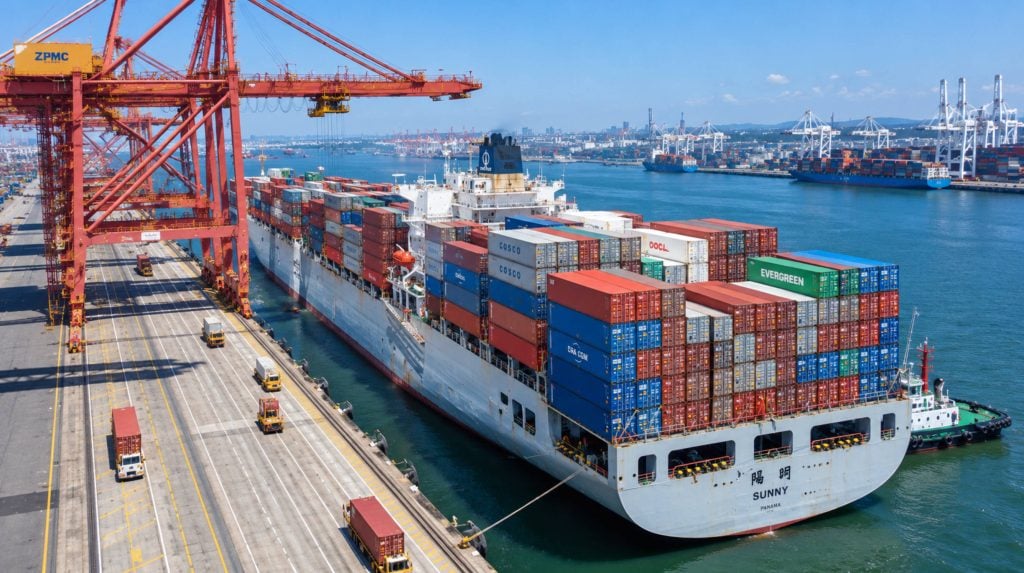
The big Asia to Europe services use vessels of 20,000 TEU and more, and their port rotations are built around the largest cargo pools: Rotterdam, Antwerp, Hamburg, Bremerhaven and a handful of others. Most Nordic ports cannot generate enough volume to justify a call from such a ship, and many cannot physically accommodate one. Gothenburg is the notable exception, with a limited number of direct deep-sea services, but even there much of the cargo reaches the region by feeder from a continental hub.
The consequence is transshipment. A box from Shenzhen or Ningbo typically arrives at a North European hub, is discharged, waits for a feeder slot, and is loaded again for the second voyage to Aarhus, Helsinki, Oslo or another regional port. That second voyage has its own freight rate, its own terminal handling charges and its own schedule risk, none of which exist when cargo is discharged directly at the final port of destination.
The Imbalance Problem
A large share of what the Nordic region exports, such as timber, paper, ore and energy products, moves in bulk vessels or specialised equipment rather than in standard containers. Containers that arrive full with consumer goods and machinery therefore have less natural return cargo than they would at a manufacturing hub. Carriers must either reposition empties at their own cost or price that repositioning into the inbound rate. In practice, it is the importer who ends up paying for the empty journey back.
The Ocean Leg: Feeders, Surcharges and Environmental Rules
The ocean leg is where the Scandinavian premium first becomes visible on an invoice. Understanding which line items are genuinely regional and which are general market charges makes quotes much easier to compare.
Transshipment and Terminal Handling
Every extra lift of a container costs money. When cargo is discharged at a hub, stored briefly, and reloaded on a feeder, the importer effectively pays for two port stops. Terminal handling charges at Nordic ports reflect local wage levels, which are among the highest in the world, and storage rules are strict, with free days that run out quickly if documents or customs release are delayed.
Transshipment also adds variability. A missed connection at the hub can cost several days, and during congestion in North European ports the wait for a feeder slot can stretch well beyond the published schedule. For time-sensitive cargo this unpredictability is a cost in itself, even if it never appears as a line item.
Detention and demurrage deserve a mention here too. When a box is delayed at a hub or held for a customs query, free days at the port and with the shipping line keep running. A container that would have been cleared in a single day at a well-prepared destination can easily accumulate several days of storage and equipment charges, and those charges are billed daily at rates that escalate after the first week. Experienced forwarders plan the clearance sequence so that documents are ready before the vessel arrives, not after.
Carbon Pricing and Fuel Rules
Since 2024 the EU Emissions Trading System has applied to large ships calling at EU ports, with the share of reported emissions that must be covered rising in stages to 40 percent for 2024, 70 percent for 2025 and 100 percent for 2026. Voyages between an EU port and a non-EU port are generally counted at half of their emissions, while voyages between two EU ports are counted in full. A Nordic-bound box that travels from Asia to Rotterdam and then by feeder to a Swedish or Danish port therefore touches the system on both legs. The FuelEU Maritime regulation, which has applied since January 2025, adds a further requirement to lower the greenhouse-gas intensity of the fuel used.
Carriers recover these costs through surcharges. DHL Global Forwarding, for example, publishes an EU emissions trading surcharge for Danmar Lines shipments that applies to bills of lading dated from 1 January 2024 and is reviewed at least quarterly, with the amount depending on the trade lane. Importers sometimes see this as an arbitrary add-on, but it follows a published regulatory timetable and is not specific to any one forwarder.
The Baltic and North Sea are also designated sulphur emission control areas, meaning ships must burn cleaner and more expensive fuel when operating there. That is good for air quality and a genuine cost for the carrier, and it is reflected in bunker adjustment factors on feeder services.
Winter, Ice and Schedule Risk
In the northern Baltic, ice can form in the Gulf of Bothnia and the Gulf of Finland during cold winters. Ports there rely on icebreaker support and ice-strengthened vessels, and carriers may add winter or ice-related surcharges and accept longer rotations. Further north and west, storms in the North Sea and Norwegian Sea can delay both ocean and coastal services. None of this is dramatic in a normal year, but it means that Nordic services need extra buffer time and extra vessel capacity, and that cost is priced in.
| ŝarĝi | Tipa ellasilo | Praktika noto |
| Bunkra alĝustiga faktoro | Fuel price movements, low-sulphur fuel requirements | Often higher on feeder legs in emission control areas |
| EU emissions surcharge | EU ETS and FuelEU Maritime obligations | Reviewed regularly, depends on trade lane and carrier |
| Kosto de terminala manipulado | Port handling at origin and destination | Paid again on the feeder leg when cargo is transshipped |
| Aldonaĵo por pinta sezono | Seasonal demand surges on Asia to Europe lanes | Typically announced weeks in advance |
| Winter or ice surcharge | Ice conditions in northern Baltic ports | Applies mainly to Finland and northern Sweden |
| Obstrukciĝa krompago | Delays at hub ports | Can appear with short notice |
Table 2: Common ocean-side surcharges on Nordic-bound containers
What the Market Looks Like in Autumn 2026
The base rate picture has actually been softer lately. A September 2026 market update from a China-based forwarder reported that China to Sweden sea pricing fell as carriers responded to weak Asia to Europe demand and to typhoon disruption in Northeast Asia, with the July peak-season surcharge round largely unwound and air rates dropping sharply. That is welcome news for importers, but it illustrates an important point: a cheaper ocean rate does not automatically produce a cheaper landed cost, because the layers that follow the ocean leg do not fall with it.
Carriers are also becoming more explicit about how they pass costs along. MSC, for example, announced new freight rates and mandatory surcharges on its trade from Northwest Europe and Scandinavia or the Baltic to North America from 1 October 2026, an increase of around 450 US dollars per TEU covering bunker, emissions and Panama Canal fees. That move is on the outbound lane rather than the inbound one, but it shows the direction of travel: environmental and operating costs are being itemised and passed to the cargo owner rather than absorbed in the base rate.
Customs, VAT and the 2026 Rule Changes
Three Customs Territories in One Region
Sweden, Denmark and Finland are members of the European Union and share its customs rules. Norway and Iceland are in the European Economic Area but outside the EU customs union, so they run their own customs systems with their own tariffs, declarations and brokers. A shipment that arrives at Rotterdam and is destined for Oslo normally has to move under a transit procedure and be cleared at the Norwegian border or at an inland location, which means a second round of paperwork and a second set of brokerage fees compared with a shipment cleared once in the EU.
Even within the EU, a simple import is rarely free of administrative cost. Importers need an EORI number, an accurate commodity code for every product, correct customs value declarations, and in many cases a pre-arrival safety and security filing. A mistake in any of these can produce a hold, a demurrage bill or a penalty.
Norway deserves particular attention because its import regime has features that surprise newcomers. Goods arriving from the EU side are not covered by a single market for customs purposes, so the declaration, the customs value and the tax treatment must be handled in Norwegian systems, usually through a local customs agent. For B2C sellers, Norway also operates its own VAT collection arrangement for low-value goods, which means that a seller serving both Norwegian and Swedish consumers needs to understand two parallel processes rather than one. Many of the delays that Norwegian importers complain about are really the result of cargo moving through an EU port without a clear plan for the Norwegian leg.
The End of the 150 Euro Exemption
The most significant recent change landed on 1 July 2026. According to the European Commission, the EU introduced a temporary customs duty of 3 euros on low-value parcels imported from outside the EU, mainly through e-commerce. The duty applies per item category based on tariff classification rather than quantity, so five identical T-shirts attract a single 3 euro charge, while three T-shirts and a watch attract 6 euros. The seller or importer is responsible for declaring and paying the duty as part of the customs process.
Swedish Customs explains that the measure applies to all countries outside the EU, not only China, and that it is temporary: it is due to be replaced by a percentage-based customs duty from 1 July 2028. Goods ordered by businesses with a value up to 150 euros are now also subject to ordinary duty based on commodity codes and customs value, and Finnish Customs notes that an additional handling fee for low-value consignments is planned for late 2026. FedEx has similarly reported that the Commission proposed an EU-wide handling fee expected by 1 November 2026. The gift exemption for items worth up to 45 euros remains in place.
For Nordic e-commerce sellers the practical effect is twofold. First, small parcels that used to enter duty-free now carry a cost, and that cost multiplies for baskets with many different product types. Second, product data must be accurate at line level, because the duty is applied per tariff line. Sellers who do not register for the Import One-Stop Shop, or whose carriers cannot collect duty and VAT in advance, may see their customers asked to pay at the door, which damages conversion and increases returns.
VAT: High Rates and Cash Flow
Value added tax in the Nordic countries is among the highest in the world. The standard rate is 25 percent in Sweden, Denmark and Norway, and Finland raised its standard rate to 25.5 percent in 2024. For comparison, Germany charges 19 percent and the Netherlands 21 percent. For a VAT-registered importer the tax is normally recoverable, but it must be paid or guaranteed at the border, so it sits on the balance sheet until it is reclaimed.
| Lando | Norma AVI | Dogana unio | Planada noto |
| Svedio | 25% | EU | Sweden’s customs authority states that the new 3 euro duty applies to all non-EU origins |
| Danio | 25% | EU | Same EU duty rules; ensure line-level product data |
| Finlandia | 25.5% | EU | Customs notes that a handling fee for low-value goods is planned |
| Norvegio | 25% | Outside EU, in EEA | Own customs system; transit and separate clearance often required |
| Islando | 24% | Outside EU, in EEA | Island logistics add ocean feeder dependence |
Table 3: VAT and customs territory by country (verify rates before invoicing)
To see how this works in practice, consider an illustrative consignment of machine parts valued at 20,000 euros, with 2,500 euros of freight and insurance and a duty rate of 4 percent. The customs value is 22,500 euros, the duty is 900 euros, the VAT base is 23,400 euros, and VAT at 25 percent comes to 5,850 euros. The importer must find nearly 6,750 euros in taxes and duties before the goods are released, even though most of it will be reclaimed later.
| objekton | Ŝtono | Sumo (EUR) |
| Varvaloro | fakturo | 20,000 |
| Freight and insurance to the EU border | citaĵo | 2,500 |
| Dogana valoro (CIF) | Goods plus freight and insurance | 22,500 |
| Customs duty at 4% | 22,500 × 4% | 900 |
| VAT-bazo | CIF plus imposto | 23,400 |
| Importa AVI je 25% | 23,400 × 25% | 5,850 |
| Cash due at clearance | Imposto plus AVI | 6,750 |
Table 4: Illustrative import calculation for a Swedish or Danish importer
This example is simplified and excludes brokerage, storage and local fees, but it shows why cash flow is such a recurring complaint among small Nordic importers. Where local rules permit, it is worth asking your broker whether import VAT can be accounted for through the periodic VAT return rather than paid up front.
Inland Haulage and Last-Mile Delivery
Once the container has cleared customs, a new set of costs begins. Trucking in the Nordic countries is expensive, driven by high driver wages, strict working-time rules, high fuel prices and, in several places, tolls and crossings that do not exist on a typical German or Dutch route. Moving a container from Gothenburg to Stockholm is a manageable domestic run; moving the same container to a warehouse in the north of Norway or Finland is a different order of cost.
Water crossings are a clear example. The Øresund and Great Belt links carry tolls, and some routes still rely on ferries. Stena Line’s published 2026 freight surcharges for the Gothenburg to Frederikshavn route, quoted one way and excluding VAT, give a sense of the ancillary charges a haulier or forwarder must absorb or pass on.
| Service or surcharge | Charge (EUR) | Aplikiĝas al |
| Container lift, on request | 85 | Per lift |
| Administration charge, if not prepaid online | 12 | Per booking |
| Danĝeraj varoj, 1 to 4,999 kg | 56 | Po sendaĵo |
| Heating or cooling connection on board | 47 | Po unuo |
| Roller trailer hire, 20 ft | 25 | Unudirekta |
| No-show charge | 167 | Po unuo |
Table 5: Selected Stena Line freight surcharges, Gothenburg to Frederikshavn, 2026
Fuel is another volatile element. DHL Global Forwarding’s published Danmar Lines surcharge sheet lists a Swedish fuel surcharge of 44.5 percent on LCL and FCL shipments, valid from 1 April 2026. As with most percentage-based surcharges, it is applied on top of an underlying charge, so it magnifies whatever inland rate you start with. When comparing quotes, always check whether the fuel component is built into the inland rate or shown separately.
The Last Mile
Parcel delivery in a sparsely populated country is inherently more expensive than in a dense one. A delivery van in the Netherlands may complete well over a hundred stops in a day; in rural Norway or northern Sweden, the same van may make a fraction of that number because of the distances between addresses. Add high wages, winter driving conditions and, in many areas, a reliance on parcel lockers and pickup points to compensate for failed home delivery, and the final leg often costs more than the ocean freight on a small shipment.
This is also why the biggest regional carriers have built dense locker and pickup networks. These are efficient for the carrier but they impose requirements on shippers, including strict label standards, size and weight limits, and accurate recipient data.
Warehousing completes the picture. Rents for logistics space near Stockholm, Oslo and Copenhagen are high compared with the large distribution parks around Rotterdam or the Ruhr, and labour for picking, packing and returns is expensive. Many overseas sellers therefore avoid setting up Nordic fulfilment altogether and ship from a continental hub, accepting a longer delivery promise in exchange for lower fixed costs. The right balance depends on order volume and how much customers value next-day delivery.
Why Small Shippers Pay the Highest Premium
Fixed costs hit small shipments hardest. A customs entry, an import safety declaration, a delivery order and a documentation fee cost roughly the same whether the shipment is one cubic metre or twenty. On a full container those costs are spread thin. On an LCL shipment they can account for a large share of the total bill, and in the Nordic region, where brokerage and inland rates are already high, the effect is magnified.
LCL has another structural weakness in this region: consolidation depends on enough cargo being available for the same destination at the same time. Weekly consolidation services to a handful of Nordic gateways are common, but departures to smaller ports are less frequent, so cargo can sit in a container freight station waiting for a box to fill. That waiting time is another hidden cost.
Returns add a further burden for B2C sellers. Nordic consumers are accustomed to easy returns and high service standards, and a returned parcel from Stockholm to a seller in China is rarely worth the freight, which is why many sellers write off low-value returns or set up a local returns address. Either choice has a cost that should be built into the pricing model from the beginning, not discovered after the first season.
| reĝimo | Indika pord-al-porda tempo | Relativa kosto | Plej taŭga por |
| Maro FCL | 35 al 55 tagoj | Plej malalta po unuo | Full container loads and steady replenishment |
| Mara LCL | 40 al 60 tagoj | Malalta ĝis meza | Smaller replenishment orders, flexible volumes |
| Rail via continental Europe | 25 al 40 tagoj | mediumo | Higher-value goods needing a faster ocean alternative |
| Aerŝipo | 5 al 10 tagoj | alta | Urgent, high-value or seasonal items |
| rapida kuriero | 3 al 7 tagoj | Plej alta po kilogramo | Specimenoj, malgrandaj pakaĵoj, urĝaj mendoj |
Table 6: Mode comparison for China to Nordic freight (indicative planning ranges, not quotes)
The right choice depends on the value density of the goods and on how much a stock-out would cost. A pallet of high-margin electronics can justify air freight; a container of furniture almost never can.
Practical Ways to Reduce the Premium
Choose the Gateway by the Final Destination
Many importers default to the nearest or cheapest port without comparing the full door-to-door cost. For Swedish and Danish consignees, Gothenburg or a continental hub with an efficient onward link may be the best choice. For Finland, a Baltic-bound feeder service to Helsinki may beat a long road haul from the west. For Norway, a gateway that allows efficient transit into Oslo or a western port will usually beat clearing in Rotterdam and trucking north. The right answer depends on the commodity, the volume and the delivery address, and it is worth testing two or three options before committing.
Kunsolidigu kaj Planu Antaŭen
Larger, less frequent shipments almost always cost less per unit than smaller, more frequent ones. Consolidating several purchase orders into a single FCL container, or moving from weekly small parcels to a monthly pallet shipment, can cut the per-unit landed cost significantly. The trade-off is working capital and storage, so the numbers should be modelled rather than assumed.
Planning around the calendar also helps. Booking before peak-season surcharge announcements, avoiding the weeks immediately around Chinese New Year and the autumn rush, and allowing for winter weather in the northern Baltic all reduce the chance of expensive last-minute changes.
Faru la Paperlaboron Ĝuste la Unuan Fojon
The cheapest customs entry is one that is correct. Use accurate commodity codes, make sure invoices describe goods precisely, keep certificates of origin where preferential treatment may apply, and confirm that product identifiers required under the new EU low-value rules are included where relevant. Corrections after arrival cost time, storage and sometimes fines.
Compare Quotes Line by Line
A quote that looks 20 percent cheaper is often simply a quote that leaves things out. Ask every forwarder to separate origin charges, ocean freight, environmental surcharges, destination terminal handling, dogana kurtado, transit fees, local haulage and final delivery. Ask which charges are fixed and which are subject to change, and what happens if the vessel is delayed or the container is held for inspection.
Also check the validity period. In a market where carriers adjust surcharges quarterly, a quote valid for thirty days is worth more than one valid for a week. Finally, confirm who is responsible for duties and VAT, because the difference between delivered duty paid and delivered at place terms can change the effective price by tens of percent on a single consignment.
Think Regionally About Stock
Some importers find that holding stock in a single well-located hub and distributing regionally by road is cheaper than shipping to each country individually. Others find the reverse. The deciding factors are order size, delivery speed promises and returns volume. What matters is that the decision is made deliberately, with landed-cost data from each option, rather than by default.
How Topway Shipping Supports Nordic-Bound Freight
Since 2010, Topway Shipping, headquartered in Shenzhen, China, has provided cross-border e-commerce logistics solutions. The founding team brings more than 15 years of experience in international logistics and customs clearance, with a strong background in China to U.S. transportation, and that experience of managing complex, multi-leg, multi-jurisdiction shipments translates directly to the layered structure of a Nordic import.
The company’s services span the entire logistics chain, including first-leg transportation, overseas warehousing, customs clearance and last-mile delivery, and it also provides flexible full container load and less than container load ocean freight from China to major ports worldwide. For a Nordic-bound shipment, this means Topway Shipping can build the route backwards from the consignee’s address: selecting the right gateway port, choosing between FCL and LCL according to the actual cargo volume, coordinating customs clearance, and arranging the onward leg in a way that matches the delivery promise.
Where the cargo is destined for Norway or Iceland, which sit outside the EU customs union, Topway Shipping can help plan the transit and clearance sequence so that paperwork is prepared in advance rather than discovered at the border. Where the cargo is B2C e-commerce, it can help sellers organise line-level product data for the new EU duty rules and consider consolidated flows that reduce the number of separately declared parcels. Importers who want a precise comparison are advised to ask for a landed-cost quote that shows each layer separately, from origin handling and ocean freight through to customs, local haulage and final delivery.
konkludo
Shipping to Scandinavia costs more because the region is expensive to serve at every step, not because of one hidden charge. Low population density and long distances raise inland and last-mile costs. Thin volumes push cargo through continental hubs and onto feeders, adding a second voyage and a second round of terminal fees. Environmental regulation, from EU carbon pricing to low-sulphur fuel rules, adds real costs that carriers pass on. Customs regimes differ between EU and non-EU countries, VAT is high, and since 1 July 2026 even small parcels carry a duty.
The good news is that much of the premium is controllable. Choosing the right gateway, consolidating volumes, getting customs data right and planning around the calendar can all take a meaningful bite out of the total. The most important step is to compare quotes on a landed-cost basis rather than on the ocean rate alone. A forwarder that understands the full chain, from the factory in China to the doorstep in Scandinavia, such as Topway Shipping, is better placed to show where the money is going and where it can be saved.
FAQs
Q: Is shipping to Scandinavia always more expensive than shipping to the rest of Europe?
A: Not always at the base ocean rate, which can be similar or even lower in soft market periods. The premium usually appears in feeder legs, customs, inland haulage and last-mile delivery, so the landed cost is typically higher than for a hub-adjacent destination such as Germany or the Netherlands.
Q: Does the new EU 3 euro duty apply to shipments to Norway?
A: The 3 euro duty applies to imports into the EU, so it affects Sweden, Denmark and Finland. Norway is outside the EU customs union and has its own rules, but cargo routed through an EU port must still be handled under the correct transit or customs procedure.
Q: Which is cheaper for small orders, LCL or express courier?
A: It depends on weight and urgency. LCL is usually cheaper per kilo but slower and carries fixed per-shipment fees, while express is faster but costly. A landed-cost comparison for your exact cargo is the only reliable way to decide.
Q: Can Topway Shipping handle both FCL and LCL shipments to Nordic ports?
A: Topway Shipping offers flexible FCL and LCL ocean freight from China to major ports worldwide, together with customs clearance, overseas warehousing and last-mile support. Contact the team with your cargo details for a route and cost proposal.