
Bawo ni idamu oju ojo ṣe n fi awọn ọjọ kun si gbigbe ọkọ oju omi rẹ ni China
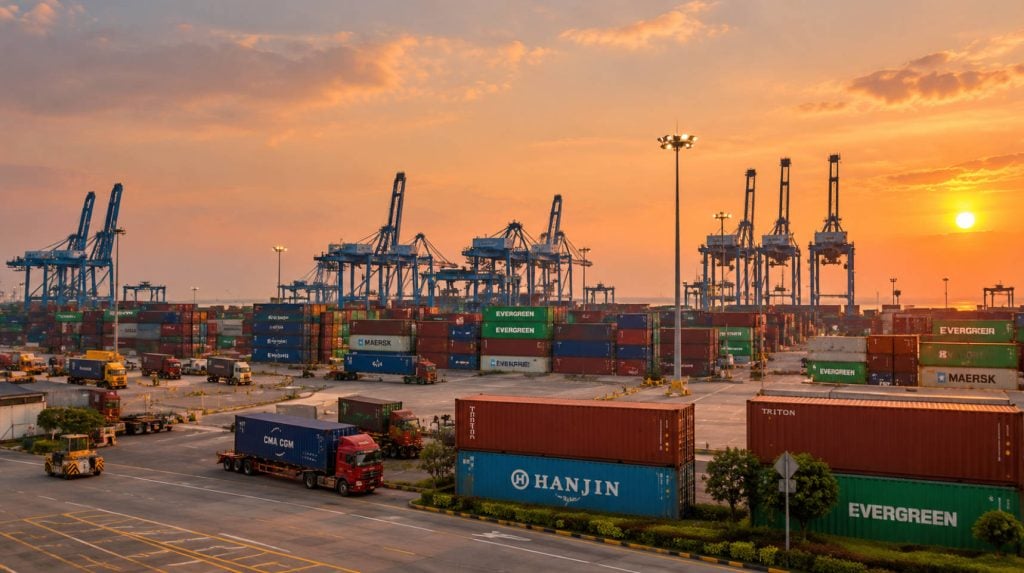
Somewhere off the coast of Zhejiang, a container ship is sitting at anchor, engines idling, waiting for a berth that will not open for another week. Nobody planned for this. The purchase order was placed on time, the factory finished production on schedule, and the booking was confirmed weeks in advance. Yet the shipment is going to arrive late, and the reason has nothing to do with paperwork, customs, or carrier reliability in the way most importers imagine it. The reason is weather, and in 2026 it has become one of the most underestimated variables in China-origin logistics.
Freight forwarders talk about typhoons the way pilots talk about turbulence: as a known risk that everyone accepts and few people actually plan around. That casual attitude is starting to look expensive. Over the past two months, three separate tropical storms have struck China’s east coast, each one closing major terminals for days and each one leaving a backlog that took far longer to clear than the closure itself. This article breaks down exactly how that happens, what it costs shippers in real transit time, and what a smarter freight strategy looks like when the weather refuses to cooperate.
The 2026 Typhoon Season Has Been Unusually Active
China’s east coast, ile to the world’s busiest container gateways, sits directly in the path of the Western Pacific typhoon corridor every year between June and October. Most seasons bring a handful of storms that graze the coastline, force a day or two of precautionary closures, and fade from memory within a week. This season has not followed that pattern. Typhoon Bavi struck in mid-July, Typhoon Dolphin followed in early August with sustained winds near 90 miles per hour, and Typhoon Saudel arrived in late August, closely trailed by Typhoon Krovanh. Three major storms in roughly five weeks is an unusually tight cadence, and container shipping analysts have been blunt about the consequence: each new storm was landing on top of a backlog that the previous one had not yet cleared.
The compounding matters more than any single storm. A port that closes for three days and then reopens into calm seas can usually work through the backlog within a week or so. A port that closes for three days, reopens, absorbs a partial recovery, and then gets hit again before the yard has emptied out is a different problem entirely. That is roughly what happened at Ningbo and Shanghai this season, and it is why terminal operators started introducing additional berthing controls and transshipment dwell-time caps rather than simply waiting for conditions to normalize.
From a Closed Gate to a Ten-Day Wait: How the Delay Compounds
It helps to separate the two very different things that happen during a typhoon. The first is the closure itself, which is short and predictable: ports typically suspend operations 24 to 72 hours before landfall as a safety precaution, vessels move out of the anchorage to open water, and cranes are locked down against the wind. That part is routine and well rehearsed. The second, and far more consequential, part is what happens after the all-clear is given.
When a terminal reopens, it does not simply resume its normal rhythm. Every vessel that was scheduled to arrive during the closure window is now trying to berth at once, alongside the vessels that were already due. Yard density spikes as containers pile up faster than trucks and barges can clear them. Chassis and equipment become scarce. Feeder and transshipment schedules, which depend on tight connection windows, start missing their slots and rolling cargo to the next available service. By the time the dust settles, a 48-to-72-hour closure has often produced a berth wait of seven to ten days, and in the worst pockets of this season’s congestion, waiting times at specific Shanghai terminals stretched beyond nine days even after operations had technically resumed.
Trade press coverage this season captured the scale well: at the start of September, seven-day average vessel waiting times stood at roughly five days at Shanghai and over three days at Ningbo, with yard occupancy at some Ningbo terminals running between 92 and 95 percent. Industry trackers estimated that close to 3.9 million TEU of shipping capacity, more than a tenth of the global container fleet, was tied up in the congestion at various points. Those are not abstract statistics for an importer with a container on the water. They translate directly into a delivery date that keeps sliding.
Storm Impact Snapshot, July–September 2026
The table below summarizes the storms that have disrupted China’s east coast ports this season and the approximate scale of the disruption each one produced. Figures are drawn from port authority notices, carrier advisories, and shipping analytics firms, and should be read as planning ranges rather than fixed guarantees, since every storm behaves a little differently.
| Storm / Period | Awọn ibudo ti nso | Reported Closure | Downstream Berth Wait |
| Typhoon Bavi, mid-July 2026 | Shanghai, Ningbo, Qingdao | Multi-terminal suspension | 72–144 hours reported around Shanghai |
| Typhoon Dolphin, 8–9 Aug 2026 | Shanghai, Ningbo | Three-day terminal closure | 2.4 million TEU stranded across North Asia |
| Typhoon Saudel, late Aug–early Sep 2026 | Shanghai, Ningbo-Zhoushan | Rolling closures, phased reopening | Up to roughly 10 days at peak; 3.92 million TEU held up globally |
| Cumulative season effect, Jul–Sep 2026 | East China coast, hinterland trucking | Three storms in five weeks | Yard occupancy near 90–95% at several terminals |
Why a Short Closure Can Cost Weeks, Not Days
The mechanism behind this compounding effect is worth understanding, because it explains why forwarders keep telling clients to add buffer time even after a storm has already passed. A container terminal operates close to its practical capacity most of the year, which is efficient when everything runs on schedule but leaves almost no slack to absorb a shock. When dozens of vessels bunch up outside a reopened port, berths become the bottleneck first, then yard space, then landside trucking capacity, and finally inland rail and barge connections. Each of those layers has its own recovery time, and they do not recover in parallel; they recover in sequence, one constraint clearing just enough to expose the next one.
This is also why carriers have started making structural adjustments rather than simply waiting out the season. Several major lines rerouted vessels through longer alternative passages this year to protect fixed arrival dates on transpacific strings, effectively trading extra sailing days for schedule certainty. Others introduced port omissions, skipping a congested call entirely and shifting that cargo to a later sailing. Both moves are rational for the carrier’s overall network, but they mean an individual shipper’s container can end up on a different vessel, a different routing, or a later week than originally booked, often with little advance notice.
The Ripple Effect Beyond the Port Gate
Congestion at the terminal is the most visible symptom, but it is rarely the only one. Trucking capacity around Shanghai and Ningbo has been under real pressure this season, with queued trucks re-entering terminal access roads as soon as gates reopen and waiting surcharges climbing as a result. Barge availability, which many transshipment cargoes rely on to move between terminals, has also tightened, and terminals have responded by giving lower berthing priority to vessels with heavy inter-terminal transfer volumes. None of this shows up on a basic tracking number until it already has.
Inland factories have not been immune either. The same storm systems that closed the ports also dropped heavy residual rainfall over manufacturing regions further inland, in provinces such as Fujian, Jiangxi, and Hunan, causing localized flooding that slowed factory pickups before cargo ever reached the coast. A shipment can lose days before it even arrives at the port gate, which is easy to overlook when everyone’s attention is fixed on vessel schedules.
Air Freight Is Not a Reliable Escape Hatch
When ocean transit times stretch, the instinctive reaction for many importers is to shift urgent cargo to air. That instinct is reasonable, but it comes with its own weather exposure. Typhoon winds close or restrict operations at Shanghai Pudong, Shenzhen Bao’an, and Hong Kong airports just as readily as they close seaports, delaying both freighter and belly-cargo capacity during the storm itself. Then, once conditions clear, the second wave hits: a rush of shippers trying to blitz-shift cargo from ocean to air at the same time creates a sudden capacity spike, and spot air rates tend to jump sharply in the days immediately following a major typhoon. Air freight can absolutely rescue a time-critical shipment, but it works best when it is planned as a pressure valve in advance, not scrambled together after a storm has already made the decision for you.
What This Means for Supply Chain Planning
The practical takeaway for importers is straightforward, even if it is not always comfortable to hear: if a quoted lead time from Shanghai or Ningbo to a U.S. West Coast port does not include meaningful buffer during typhoon season, that lead time is optimistic at best. Some analysts have gone as far as recommending an extra two weeks be added to standard transit estimates for sailings departing through mid-September this year, and pulling forward any Q4-critical bookings by several weeks to absorb the delay risk. Whether or not a shipper adopts those exact numbers, the underlying logic holds: the congestion this season has been structural rather than a one-off event, and it is unlikely to fully unwind until the typhoon season itself winds down.
This is also a good moment to reconsider how a shipment is monitored once it leaves the factory. A quoted transit time is only useful if someone is actively watching for the moment it stops being accurate. Waiting for a carrier’s own schedule updates, which tend to lag real conditions, means an importer often finds out about a problem well after the point where an alternative could still have been arranged.
How Topway Shipping Helps Shippers Stay Ahead of Weather Risk
This is precisely the gap that a hands-on freight forwarding partner is meant to close. Topway Shipping, headquartered in Shenzhen and serving cross-border e-commerce and B2B shippers since 2010, was built around the China-to-U.S. lane where this season’s disruption has been most acute. Because the founding team carries more than 15 years of combined experience in international logistics and customs clearance, the company’s operations desk tracks port conditions, vessel positions, and carrier advisories on a daily basis rather than reacting only when a client asks.
In practice, that means a shipment booked through Topway Shipping is covered across the full chain rather than handed off at the port gate: first-leg trucking from the factory, ocean freight booking with both full-container-load and less-than-container-load options to major ports worldwide, customs clearance on both ends, overseas ikojo, and final last-mile delivery. When a typhoon closes a terminal or a carrier reroutes a vessel, that visibility lets the team re-plan a routing, rebook space on an alternative sailing, or shift priority cargo to air, before the delay has fully cascaded downstream to the client’s warehouse or fulfillment deadline. For importers who have spent this season watching quoted lead times quietly slip, that kind of proactive coordination is often the difference between a shipment that arrives a few days late and one that arrives weeks behind schedule.
It is worth pausing on one more consequence that rarely makes the headlines: the effect on smaller shippers who do not have the scale to negotiate priority space with a carrier directly. Large retailers with dedicated service contracts often get first access to whatever capacity opens up after a closure, while smaller importers booking through the spot market can find themselves pushed to the back of the queue repeatedly. This is one more reason the choice of forwarding partner matters more during a disrupted season than during a calm one, since a forwarder with strong carrier relationships and consolidated volume can often secure space that an individual small shipper could not get on their own.
Building a More Resilient Booking Strategy
None of this means shippers are powerless against the weather; it means the old assumption of a fixed, reliable transit time needs to be replaced with a slightly more flexible planning approach. The table below lays out the main levers available and when each one is most useful.
| Planning Lever | Ohun Tí Ó Ṣe Lóòótọ́ | Ti o dara julọ Ti a Lo |
| Buffer days in the quote | Adds realistic slack to transit time estimates so a 5-to-10-day berth wait does not blow up the delivery promise | Jul–Oct booking |
| Earlier cut-off booking | Secures space before carriers blank sailings or roll cargo to the next available vessel | Peak season, pre-storm windows |
| Port and route diversification | Spreads exposure across Shanghai, Ningbo, Shenzhen and secondary gateways instead of one congested node | High-volume, recurring shippers |
| Daily vessel tracking | Flags roll-overs and schedule changes early enough to adjust downstream trucking or warehouse labor | Aago-kókó eru |
| Air-ocean hybrid contingency | Splits urgent SKUs onto air while bulk stock rides ocean, softening the impact of a single mode’s disruption | Critical or seasonal SKUs |
None of these levers works in isolation, and none of them is free. Buffer days cost money in inventory carrying costs, earlier bookings can mean committing to space before full order details are locked in, and air-ocean hybrid strategies require SKU-level planning that many teams simply do not have bandwidth for during peak season. That is exactly why so many importers lean on a forwarder rather than trying to manage each lever manually. A partner with daily visibility into port conditions, carrier scheduling changes, and inland weather can decide in real time which lever is worth pulling for a given shipment, rather than applying the same blanket buffer to everything and eating the cost either way.
Looking Ahead: Q4 Peak Season Risk
The timing of this year’s disruption is what makes it especially painful for importers. Typhoon season overlaps almost exactly with the run-up to Q4 peak shipping, when retailers and e-commerce brands are pushing the largest volumes of the year toward holiday shelves and fulfillment centers. A delay that would be merely annoying in a slower month becomes a genuine revenue risk in September and October, when missing a key restock window can mean lost sales that are never recovered later in the season.
There is also a longer-term structural question sitting underneath the seasonal one. Analysts have noted that carriers shifting capacity back through the Suez Canal on Asia-Europe lanes could materially change global fleet deployment patterns heading into 2027, which in turn affects how much spare vessel capacity is available to absorb a bad typhoon season on the transpacific trade. In other words, this year’s congestion is not happening in a vacuum; it is layering on top of broader shifts in how carriers allocate ships across trade lanes, and shippers who treat 2026 as a one-off anomaly may find themselves under-prepared again next year.
None of this is a reason for importers to panic, but it is a reason to treat weather risk as a standing line item in freight planning rather than an occasional surprise. Building a habit of checking port advisories, keeping open communication with a forwarder’s operations desk, and reviewing booking cut-offs a few days earlier than usual during storm-prone months costs very little and can meaningfully soften the impact when the next system starts forming over the Pacific.
ipari
Weather disruption at Chinese ports is not a rare, headline-grabbing event anymore; it is a recurring seasonal cost that shows up in berth waiting times, trucking surcharges, and slipping delivery dates, whether or not a shipper ever hears the word typhoon mentioned in their tracking updates. The 2026 season has made that cost unusually visible, with three major storms in five weeks pushing berth waits at Shanghai and Ningbo into double digits and tying up millions of TEU of capacity across North Asia. The shippers who come through this kind of season with the least damage are rarely the ones who got lucky with routing. They are the ones who built realistic buffer into their planning, kept a close eye on vessel and weather conditions, and worked with a forwarding partner able to adjust a routing before a delay became unrecoverable. That is the quiet, unglamorous work that keeps a supply chain running when the sky does not cooperate, and it is worth investing in well before the next storm forms.
FAQs
Q: How many extra days should I plan for during China’s typhoon season?
A: Based on this season’s pattern, a single port closure typically adds three to ten days directly, with knock-on congestion adding another one to two weeks in the worst cases. Many forwarders are currently advising an extra two weeks of buffer on Shanghai and Ningbo sailings through mid-September.
Q: Which Chinese ports have been most affected in 2026?
A: Shanghai and Ningbo-Zhoushan have absorbed the bulk of the disruption this season, with Qingdao also affected during Typhoon Bavi. Shenzhen-area gateways have generally fared better, which is part of why route diversification is a useful planning lever.
Q: Is switching to air freight a reliable fix during typhoon season?
A: Not on its own. Airports in the region close during the storm itself, and rates tend to spike right after as shippers rush to shift cargo from ocean to air. Air works best as a planned contingency for specific urgent SKUs, not a last-minute universal fallback.
Q: How does Topway Shipping help reduce weather-related delays?
A: Topway Shipping monitors port and vessel conditions across the full logistics chain, from first-leg trucking and FCL or LCL ocean booking to customs clearance, overseas warehousing, and last-mile delivery, so routing or mode adjustments can be made early rather than after a delay has already compounded.
Q: Does port congestion also affect inland factory pickups?
A: Yes. The same storm systems bring heavy rainfall well inland, and provinces such as Fujian, Jiangxi, and Hunan have seen localized flooding this season that delayed factory pickups before cargo even reached the coast.
