
Ọkọ̀ ojú irin láti China sí Latvia: Ìjápọ̀ Reluwe Riga sí China, Àlàyé
When organising a shipment from China to Europe, the majority of goods forwarders do not immediately think about Latvia. Situated between Estonia and Lithuania, this small Baltic market with less than two million residents seldom ranks as a top destination, unlike Germany, the Netherlands, or Poland. However, Riga, the capital and principal port city of Latvia, holds a truly vital place on the map of Eurasian logistics, and cargo owners who ignore it frequently miss a route that can be significantly less expensive than air travel and faster than ocean freight.
Geographical factors and railway history are the main causes. The broad-gauge rail system that Latvia inherited was constructed in accordance with the same 1520mm standard that was utilised throughout Russia, Belarus, Kazakhstan, and a large portion of the former Soviet Union. Because of this one technical quirk, containers leaving China on the China-Europe Railway Express can frequently arrive in Riga without the gauge change that causes shipments going to Poland or Germany to trip. With direct train connections to the larger Baltic and Nordic markets, an ice-free deep-water port, and an EU-regulated customs system, Riga has quietly emerged as a significant alternative gateway for importers seeking speed without having to pay afẹfẹ ọkọ ofurufu owo.
This guide explains how the China-to-Latvia rail corridor actually operates in practice, including the actual route that cargo travels, how rail transit times and costs compare with sea and air, the customs and VAT regulations that apply once goods land in Latvia, and the geopolitical risk factors that any shipper using this corridor in 2026 needs to be aware of. We also examine the role of a logistics partner like Topway Shipping for importers who want to have routing decisions made for them rather than stitched together from several vendors.
This isn’t just academic. With air freight continuing to be a premium option regardless of market conditions and ocean freight rates on several lanes swinging sharply through 2026, forwarders who can provide clients with a true third path—one with predictable pricing and a transit time about half that of a typical sea shipment—have a significant competitive advantage. The key to turning that edge from a talking topic into a dependable component of a routing strategy is knowing precisely how the Riga corridor functions and where its boundaries are.
Why Riga Sits at the Center of the China-Europe Rail Map
Underground, or more accurately, at rail level, is where Riga’s advantage begins. The conventional network of the European Union employs 1435mm gauge, whereas Latvia, along with Russia, Belarus, and the other former Soviet republics, uses a 1520mm broad gauge track. Containers or complete bogies must be moved from one gauge to the other whenever the two systems converge, adding time, handling expenses, and a site of congestion. Before the cargo moves west on standard gauge waggons, that gauge break usually occurs at the Belarus-Poland border, at stations like Brest and Malaszewicze, for freight headed far into Western Europe.
On the other hand, cargo headed for Latvia can, in many cases, remain on broad gauge track for nearly the whole land voyage from China through Kazakhstan, Russia, and Belarus; a gauge transition is only necessary if the cargo must proceed into Lithuania, Poland, or further west. Riga has evolved into a regional distribution hub rather than just an end destination in large part because this reduces one of the typical friction points of Eurasian ẹru oko ojuirin.
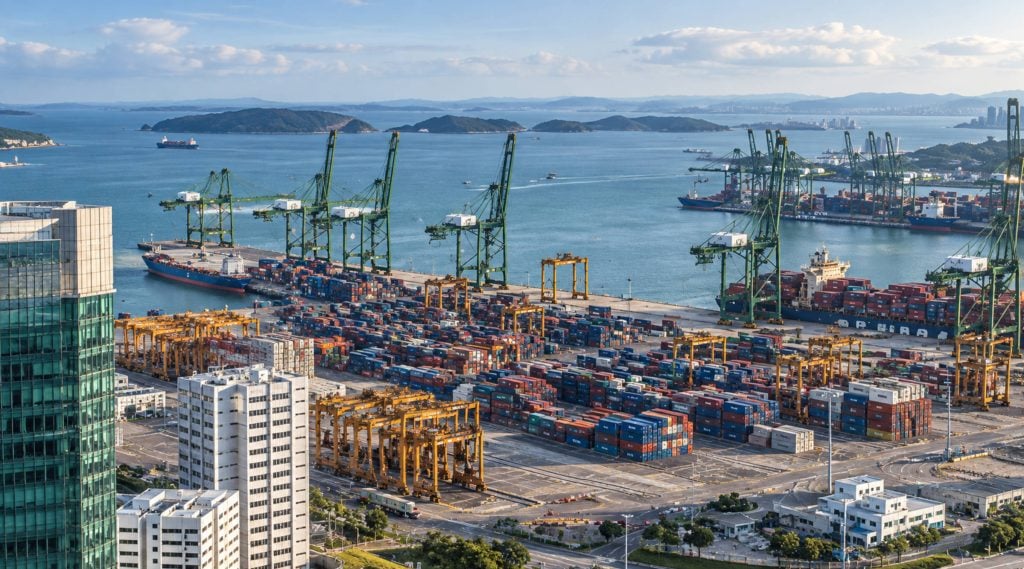
The benefit is further enhanced by Latvia’s locati0n at the intersection of Eurasian land routes and Baltic Sea shipping lanes. Riga Freeport is located near Vilnius and Tallinn, operates year-round without ice restrictions, and has spent the last ten years expanding its container handling capacity specifically to act as a transshipment point between rail-borne cargo from Asia and subsequent sea or road distribution throughout Northern Europe. The combination of broad-gauge rail connectivity and an ice-free port makes Riga more than just a footnote for a goods forwarder creating route possibilities for a customer.
Additionally, it implies that Riga serves as a destination for more than one market. Some importers utilise it as a regional distribution point instead of a final destination address because unloaded cargo can travel to Lithuania, Estonia, or even beyond into Scandinavia via road or short-sea feeder. In reality, a shipment that is ostensibly headed for Riga may actually be the first stop in a larger Baltic and Nordic distribution plan, adding value to the path that extends beyond the Latvian market.
How a Container Actually Travels from China to Riga
The actual trip usually starts at one of the busiest inland rail hubs in China, such as Xi’an, Chengdu, Chongqing, Zhengzhou, or Yiwu, where containers are loaded onto block trains run by China Railroad Express. A new direct route between Xi’an and Riga was introduced in November, making it the eleventh international rail line to operate out of Xi’an since 2013. This was the first time that the city’s annual total of rail journeys between China and Europe exceeded one thousand. As volumes increase, direct city-pair services like this one are more prevalent, which lessens the requirement for goods to be consolidated and reconsolidated en route.
Trains from China travel through Kazakhstan, Russia, and Belarus, where Minsk, along with Moscow and Almaty, has emerged as a major hub city for the network. The Belarusian Railway’s terminal network, which includes a recently renovated transshipment facility at Brest with 1.2 kilometres of rail infrastructure and storage for almost a thousand containers, is designed specifically to keep this corridor moving. The railway reports handling more than thirty container trains daily at a route speed exceeding 1,200 kilometres per day. Bypassing the gauge-change bottleneck in Poland that cargoes heading to Western Europe must pass through, cargo headed for Riga travels north on a broad-gauge rail straight into Latvia from Belarus.
Forwarders are progressively incorporating options because not every train takes that precise route. In order to avoid the Belarus-Poland border entirely, some services now pass through St. Petersburg with a brief sea leg across the Baltic. This routing has gained popularity as the risk of border closure on that frontier has become a regular occurrence rather than an isolated incident. When the conventional Brest crossing is clogged or closed, trains have also been rerouted through the Kaliningrad exclave and then through Lithuania. These detours are less significant for a shipment that ends in Riga rather than going further west because the goods arrives at its destination before the more contentious network legs even enter the picture.
What Kind of Cargo Actually Suits the Rail Corridor
Not all product categories gain from rail in the same way. Goods that are reasonably durable, somewhat dense, and not so urgent that a few extra days matter but not so inexpensive that the cost of goods surpasses the value of speed are most suited for the corridor. A significant portion of what actually travels on China-Europe trains is made up of electronics components, automotive parts, machinery, furniture, and textiles. Chinese customs data on the larger network confirms this: Europe ships back machinery, electrical equipment, precious metals, medical equipment, food, and alcohol, while vehicles and components, machinery, and electronics dominate the westbound flow.
Because not all trains have reefer or high-cube capacity on every departure, temperature-sensitive and fragile cargo can also be transported by rail, although it usually requires specific container types and more cautious planning. In an indication that the corridor’s operators are aggressively broadening the types of goods they can consistently handle rather than viewing it solely as a dry-container network, Belarus has even started testing dedicated meat export trains in the opposite direction.
Anything that requires same-week delivery, when only air freight or express courier services can actually make the deadline, or anything so low in value that even the slight premium above ocean freight erodes profit tend not to perform well on rail. One of the easiest ways to control landing cost on this lane is to match cargo type to mode accurately instead of defaulting to whichever option a shipper chose last time.
Transit Time: Rail Compared with Sea and Air
Timing is the primary factor that shippers take into account when considering the train option. Since Riga does not receive many direct mainline vessel calls from Asia, ocean freight from Chinese ports to Riga usually takes five to seven weeks once transshipment at a European hub port is taken into account. The fastest alternative by far is air freight, which typically arrives at Riga International Airport in three to ten days, depending on the origin airport and whether the shipment passes through a hub like Hong Kong. However, the cost of air freight is only reasonable for high-value or urgent cargo. Rail is in the middle, and that’s exactly what makes it appealing.
Depending on the beginning locati0n, the precise route, and the amount of time wasted at each border crossing, a China-Europe rail service to the Baltic region often takes sixteen to twenty-five days door to terminal. Regular, planned shipments of moderate value, such as electronics components, furniture, machinery parts, and textiles, are increasingly routed this way instead of defaulting to ẹru ọkọ oju omi okun out of habit because that is about half the transit time of ocean freight while usually operating at a fraction of air freight cost per kilogram.
| Ipo Sowo | Typical Transit Time to Riga | Ti o dara julọ Ti o baamu Fun |
| Ẹru omi okun (FCL/LCL) | Ọjọ́ 35–50, láti ibudo sí ibudo | Large volume, low urgency, lowest cost per unit |
| China-Europe iṣinipopada | 16–25 days, terminal to terminal | Regular mid-volume cargo needing speed without air pricing |
| Ẹru ọkọ ofurufu | 3–10 days, airport to airport | Awọn ẹru iyara, iye-giga, tabi awọn ọja ti o ni imọra akoko |
| International express (DHL/FedEx/UPS) | Ọjọ́ mẹ́ta sí méje, láti ẹnu ọ̀nà dé ẹnu ọ̀nà | Awọn apo kekere, awọn apẹẹrẹ, awọn iwe aṣẹ |
Current Freight Rates and What Drives Them
Throughout the first half of 2026, prices on the China-Latvia line have been anything but consistent. June saw a dramatic increase in ocean freight into Riga, with FCL prices for a typical 20-foot container rising by over 60% month over month to a range of roughly $2,700 to $3,400 and 40-foot containers moving to roughly $4,300 to $5,300. The rerouting around the Cape of Good Hope and the ongoing closure of the Strait of Hormuz shipping lane, which has tightened equipment availability across Northern European ports generally, contributed to the surge, which was caused by a wide, multi-region ocean capacity squeeze rather than anything unique to the Baltic trade.
The fact that air and LCL rates were relatively stable throughout the same time frame is instructive in and of itself. It indicates to a shipper that the current volatility in FCL pricing is due to ocean capacity rather than fuel or demand, which affects all modes equally. Despite significant fluctuations in container rates, LCL consolidation has been operating at approximately $52.50 per cubic metre, air freight at approximately $5.36 per kilogram, and express services at approximately $9.65 per kilogram.
Rail prices typically follow their own path, influenced more by fixed train-slot economics, fuel surcharges, and terminal handling fees at each gauge-change or customs stop along the route than by spot-market panic. It is appealing to shippers transferring multiple pallets or a partial container load who require speed but cannot afford an air freight invoice because it usually comes in above ocean LCL prices on a per-cubic-meter basis but far below air freight. The majority of seasoned forwarders advise treating any estimate as valid for only two to three weeks and double-checking prices around the actual booking date because rates on this lane can vary quickly in either direction.
| Apakan iye owo | Typical Range (June 2026) | awọn akọsilẹ |
| FCL 20GP (ocean) | $ 2,700 - $ 3,400 | Sharp increase versus May 2026 due to broad capacity squeeze |
| FCL 40GP (ocean) | $ 4,300 - $ 5,300 | Same driver; confirm validity window at booking |
| LCL (òkun) | ≈ $52.50 / cbm | Held steady through the ocean rate spike |
| Ẹru ọkọ ofurufu | ≈ $5.36 / kg | Stable; best for urgent, lower-volume cargo |
| KIAKIA (DHL/UPS/FedEx) | ≈ $9.65 / kg | Fastest door-to-door option, priced accordingly |
The Belarus-Poland Bottleneck and Why the Baltic Route Matters
The Belarus-Poland border is the single largest structural risk in the China-Europe rail freight corridor, and it cannot be ignored in an honest conversation. This bridge is used by almost all rail cargo from China to Europe that is headed for Western Europe, and it is no longer just an operational chokepoint but also a recurrent point of geopolitical influence. Poland utilised the threat of limiting goods travel in 2024 as part of a larger diplomatic campaign linked to pressure from migrants on its eastern border. More recently, trains were stuck in Belarus for a long time due to a border closure brought on by security concerns over military drills in the area. There was no prior notice of when crossings would reopen, and freight forwarders reported that clients were frantically switching their cargo back to ocean freight.
This is the exact point at which a shipment headed for Riga has a structural advantage over one headed for Germany or France. Cargo ending in Riga is not dependent on that particular chokepoint clearing because Latvia is located on a broad-gauge track that may be reached directly from Belarus without going via Poland. Although it eliminates one layer of danger that goods moving further west cannot escape, it is not impervious to disruption elsewhere on the route—a complete shutdown of the Belarus-Russia border, for example, would still be an issue.
Despite the political hubbub, Belarus has continued to invest in its portion of the corridor, including a modernisation of the Brest-3 container terminal that increased storage capacity to almost a thousand containers and simplified gauge-transfer operations. Even while individual cargoes are occasionally caught in transient political delays, such infrastructure spending indicates that the corridor’s operators expect it to stay relevant for years to come.
Riga Freeport, Customs Clearance, and VAT
Cargo joins the EU customs union upon arrival in Latvia, whether by air, sea, or rail, and is subject to the same regulations as other commodities entering the bloc. Riga’s port functions as a free port, which gives importers some leeway in terms of timing if they are not prepared to clear cargo right away upon arrival. This allows products to be kept, consolidated, and occasionally lightly processed before duties and import VAT are formally assessed.
The customs value of the goods, products items, insurance, and any applicable duties are all subject to the standard Latvian import VAT of 21%. Due to the fact that duty rates are based on the product’s HS code and follow the EU’s common external tariff schedule, two shipments of comparable value may have substantially different total landed costs depending on categorisation. Businesses can frequently postpone the cash impact of import VAT rather than paying it upfront at the border by registering for VAT in Latvia or using the EU’s postponed accounting systems where applicable. This is important for cash flow for larger or more regular shipments.
A commercial invoice, packing list, bill of lading or rail waybill, and, depending on the product type, certificates of origin, conformity markings like CE certification, or import licenses unique to the goods are all typical documentation needed for imports into the EU. Working with a forwarder or customs broker who regularly handles Baltic clearances tends to move shipments through more quickly than routing paperwork through a generalist agent who is not familiar with local procedure because Latvia’s customs administration is smaller than that of Germany or the Netherlands.
Choosing the Right Mode for Your Latvia Shipment
Three factors typically determine whether to choose rail, sea, air, or express: the urgency of the cargo, its weight in relation to its worth, and the shipper’s demand for a predictable timeframe. Because a delay costs more than the freight bill itself, high-value electronics or fashion items with a launch date typically justify air freight, even at its premium price. On the other hand, bulk, low-value items with no set delivery deadline are typically best serviced by ocean freight, where the per-unit cost advantage over rail or air is still significant for big volumes despite the current rate volatility.
For shipments that fall between those two extremes—regular replenishment orders, mid-value commodities, or cargo where a forty- to fifty-day ocean journey would tie up too much working capital but air freight pricing does not make commercial sense—rail earns its position. Even taking into consideration the rare border disruption mentioned above, locking in rail as the default mode and reserving air solely for true emergencies tends to produce the best predictable landing cost over a full year for a corporation operating periodic shipments into the Baltic or Nordic markets.
Rather than dedicating every cargo to a single mode, it is worthwhile to arrange for redundancy. Compared to shippers who rely solely on one channel, those who split volume between rail and ocean freight or maintain a standing relationship with an air freight option for emergencies are significantly better positioned to withstand a sudden border closure or rate surge.
How Topway Shipping Supports China-to-Latvia Shipments
Most importers don’t want to piece together rail routing, customs clearance, and last-mile delivery across the EU vendor by vendor, which is where a seasoned logistics partner makes their money. With a founding team with over fifteen years of expertise in international freight forwarding and customs clearance, Topway Shipping, which has its headquarters in Shenzhen and has been in operation since 2010, has focused its operations on cross-border e-commerce logistics.
Although the company’s origins and most profound knowledge are in China and the United States. transportation, its business model includes the whole logistics chain required for a shipment heading to Latvia, regardless of the destination: first-leg pickup and consolidation in China, international warehousing, arrival customs processing, and last-mile delivery to the final consumer. Topway also provides flexible full-container-load and less-than-container-load ocean freight service from China to major ports worldwide for importers weighing rail versus ocean freight into the Baltic region. This gives shippers a single point of contact to compare rail and sea options instead of negotiating separately with a rail forwarder and an ocean carrier.
When something goes wrong, such as a border delay, a customs inquiry, or a missing certificate, the end-to-end structure is crucial because a shipper working with a single logistics partner throughout the entire chain has one point of accountability instead of multiple suppliers pointing at one other. That kind of continuity is frequently more valuable to companies that are new to the China-Latvia corridor than cutting a few bucks off a single leg of the trip.
Looking Ahead: Rail Baltica and the Long-Term Shape of the Corridor
Shippers developing long-term supply chain strategies around this corridor should keep an eye on the Rail Baltica project because Riga’s existing broad-gauge advantage is temporary. With service on some sections beginning as early as 2028, the initiative seeks to connect Estonia, Latvia, and Lithuania to the European standard-gauge network by approximately 2030. Earlier this year, regional rail operators announced a framework procurement for the new standard-gauge passenger fleet. Although the project’s main goal is passenger connection, the region’s rail infrastructure will gradually change over the next ten years due to the larger push toward standard-gauge integration throughout the Baltic republics.
Since converting freight-grade broad-gauge lines is a much larger undertaking than the passenger corridor currently under construction, that shift is likely to occur slowly and unevenly for freight. Additionally, Latvia’s cargo network is expected to continue operating on 1520mm gauge for the foreseeable future due to the significant amount of regional freight traffic that still depends on direct compatibility with Russia and Belarus. However, rather than assuming that the routing logic of today will continue permanently, forwarders with multi-year contracts or fixed infrastructure investments linked to the Baltic route should consider a gradual standard-gauge transition in long-range planning.
Practical Checklist Before Booking a China-Latvia Rail Shipment
Shippers who successfully navigate this corridor are distinguished from those who are caught off guard by its volatility by a few tendencies. Given how quickly both ocean and, occasionally, train prices can fluctuate on this lane, it is important to confirm rate validity at the time of booking rather than depending on a quote provided weeks in advance. Another is to factor in a buffer of a few days beyond the quoted transit time because border-crossing delays, even brief ones, are frequent enough on the Belarus corridor that treating the fastest-case transit time as the expected outcome tends to cause avoidable stress for downstream customers waiting on delivery.
Additionally, it is more cost-effective to verify the HS code classification and any product-specific certification requirements prior to the cargo’s shipment rather than after it reaches Riga. This is because it is more time-consuming and expensive to correct a customs classification error once the goods are in the free port. Lastly, if the rail corridor encounters one of its sporadic disruptions, having a backup routing option on hand—whether it be a standing ocean freight booking or an air freight contact for true emergencies—gives a shipper actual flexibility instead of leaving the shipment stranded with no backup.
ipari
The rail connection between Riga and China will not be able to compete with air freight in terms of sheer speed or take the place of ocean freight as the primary means of transporting vast amounts of low-value commodities. Instead, it provides a genuinely helpful middle option with transit times that are about half that of sea freight, prices that are significantly lower than those of air, and a structural advantage that protects cargo headed for Riga from at least one of the corridor’s most persistent risk points: broad-gauge track that extends directly from Belarus into Latvia. The Riga route is a legitimate tool worth having in the routing toolkit rather than a niche curiosity for shippers who comprehend both the opportunity and the geopolitical fragility built into the larger China-Europe rail network, and who incorporate the customs and VAT planning that comes with any EU import.
FAQs
Q: Is rail freight from China to Latvia actually faster than ocean freight?
A: In general, the answer is yes. When transshipment at a European hub port is taken into account, rail cargo usually arrive in Riga in sixteen to twenty-five days, whereas ocean freight takes between thirty-five to fifty days. The particular origin city in China and the level of congestion at the border crossings at the time of shipment determine the precise difference.
Q: Does cargo to Latvia avoid the Belarus-Poland border problem entirely?
A: It avoids one significant risk layer, but not completely. Cargo ending in Riga does not need to travel through Poland, where the majority of politically motivated border restrictions on this sector have taken place, because Latvia employs the same 1520mm broad gauge as Belarus and Russia. A shipment headed for Riga may still be impacted by delays elsewhere on the route, such as at the border between Belarus and Russia.
Q: What VAT and duty apply to goods imported through Riga?
A: The customs value of goods plus goods goods, insurance and any applicable duties are subject to Latvia’s application of the EU’s standard import VAT rate of 21%. Accurate classification directly affects the overall landing cost because duty rates are based on the product’s HS code and follow the EU’s common external tariff.
Q: Is rail freight cheaper than air freight for shipments to Latvia?
A: Under normal market conditions, rail freight is more expensive than ocean LCL or FCL rates, but it is generally much less expensive than air freight on a per-kilogram or per-cubic-meter basis. It is ideal for mid-value, somewhat urgent cargo because it is purposefully positioned in the middle of the price range.
Q: Can a single logistics provider handle both the rail routing and the ocean freight option for a Latvia shipment?
A: In general, using a forwarder who provides both is more effective than dealing with several providers. For instance, in addition to its more comprehensive first-leg transportation, warehousing, and customs clearance services, Topway Shipping offers flexible FCL and LCL ocean freight from China to key international ports. This allows shippers to compare and switch between modes without switching logistical partners.
Q: What happens to a shipment if the Belarus-Poland border closes while cargo is en route?
A: Until the border reopens, trains that are already in Belarus are usually halted, which might add days or weeks with little notice. Shipments ending in Latvia are less vulnerable to this particular interruption than freight continuing on to Germany or other Western European destinations because Riga-bound goods does not need to transit into Poland, though delays may still happen elsewhere on the route.