DAP испорака од Кина до Франција: Процес на царинење и такси
Вовед
If you sell to customers in France, or you ship stock to a French buyer, the Incoterms rule on your quote decides who spends the next three days chasing a customs broker. Under DAP (Delivered at Place), the seller moves the goods from the factory in China to an agreed place in France, but stops short of paying for import clearance. Everything that happens after the truck arrives at the named address, including the customs declaration, duties, import VAT and any new parcel fees, belongs to the buyer.
That sounds simple until the rules move under your feet. Over the past twelve months the EU has ended its long-standing €150 duty exemption for low-value goods, France has introduced its own €2 small parcel fee, and a harmonised EU-wide handling fee is scheduled to start on 1 November 2026, only days from the date of this article. A DAP quote that looked complete in spring can now leave the buyer with a bill nobody expected, and a surprised buyer is a buyer who disputes the invoice or refuses delivery.
This guide walks through the DAP clearance process step by step, from EORI numbers and DELTA declarations to worked duty-and-VAT calculations and indicative port charges. It also shows where shipments typically get stuck and how an experienced freight forwarder such as Topway Shipping can keep the DAP promise honest for both sides. The regulatory information reflects official announcements and trade reporting available in October 2026. Rates and start dates can still change, so always confirm against the EU TARIC database and the French customs website before you fix a price.
What DAP Really Means on a China to France Shipment
Under Incoterms 2020, DAP places the seller’s delivery obligation at a named destination, with the goods placed at the buyer’s disposal on the arriving means of transport, ready for unloading. The seller pays for and carries the risk of the main carriage, which is usually ocean or воздушен товар from China, and handles export formalities in China. What the seller does not take on is the cost or risk of import clearance in the destination country. On a France-bound shipment, that means French import duties, import VAT and the local customs formalities are for the buyer.
Compared with DDP (Delivered Duty Paid), where the seller also clears the goods and pays every import charge, DAP is lighter on the seller. It is the preferred term for exporters who do not want to register for VAT in the EU, and for French buyers who already have a customs broker and a VAT number. It is common on B2B pallet and container shipments, and it is also the default on many cross-border e-commerce parcels, where the carrier collects charges from the consignee at the door.
DAP is also where most misunderstandings live. A French buyer who has never imported before may read the word “delivered” and assume that everything is paid. A seller may name the wrong delivery place, for example a port terminal instead of the buyer’s warehouse, which silently changes who pays for pre-carriage and unloading. Writing the exact delivery place, the unloading responsibility and the clearance responsibility into the sales contract and onto the commercial invoice removes most of these arguments before they start.
Table 1. Who is responsible for what: DAP versus DDP
| Задача | ДАП | ДДП |
| Извозно царинење во Кина | Продавачот | Продавачот |
| Main carriage from China to France | Продавачот | Продавачот |
| Карго осигурување | Not mandatory, agree in contract | Not mandatory, agree in contract |
| Истовар на наведеното место | Купувачот | Купувачот |
| Import customs declaration in France | Купувачот | Продавачот |
| Царина | Купувачот | Продавачот |
| ДДВ за увоз (стандардна стапка од 20%) | Купувачот | Продавачот |
| New 2026 fees (flat duty, handling fees) | Купувачот | Продавачот |
| Трансфер на ризик | At the named place, ready for unloading | At the named place, ready for unloading |
The 2026 Rules Every Importer into France Needs to Know
Anyone quoting DAP to France in late 2026 is working under a rulebook that is very different from the one used in 2024. Three changes matter most, and each lands directly on the party who clears the goods, which under DAP is the buyer.
The €150 duty exemption has ended
Until 30 June 2026, goods in consignments with an intrinsic value of €150 or less entered the EU free of customs duty, although VAT was always due. From 1 July 2026, a temporary measure formally adopted by the Council on 11 February 2026 applies a flat €3 customs duty to goods in small parcels valued under €150. The duty is charged per item category, meaning per tariff line, rather than per parcel. A parcel holding a t-shirt, a toy and a phone charger can therefore trigger three separate €3 charges.
The Council designed the rate mainly for sellers registered in the Import One-Stop Shop (IOSS), which it says covers roughly 93% of e-commerce flows into the EU. It is an interim solution that runs until July 2028, when the EU Customs Data Hub is due to go live and normal tariff rates based on product classification will replace the flat rate. The European Commission published guidance notes on the launch on 2 June 2026, and commentators note that the duty is generally not refunded if the buyer later returns the item, unless the goods were faulty.
France’s €2 small parcel fee
France moved ahead of the rest of the EU. From 1 March 2026, the Taxe Petit Colis (TPC) charges €2 per declared item, again counted by customs tariff number, on low-value consignments up to €150 that are cleared in France. French VAT at 20% is reported to apply on top of the fee itself. Postal and express operators collect it through their normal channels, and on DAP shipments to non-IOSS recipients the consignee is the one who ends up paying.
Where the parcel is cleared matters a great deal. If a carrier clears the goods in another EU country first and then trucks them onward to France in free circulation, the French fee is not triggered because import clearance did not take place in France, although that other country’s own fees and VAT treatment then apply. French customs has described the TPC as temporary, and market commentary expects it to fall away once the EU-level handling fee begins.
The EU handling fee and what follows
The next step is a flat €2 handling fee per line item on e-commerce goods released for free circulation in the EU, targeted for 1 November 2026. It would apply on top of, not instead of, ordinary customs treatment, and it depends on implementing acts being published in time. As of 22 October 2026, anyone shipping now should assume it will apply to goods released in France from early November, and should ask the broker to confirm the exact treatment in writing. Reports also suggest that sellers who ship from warehouses inside the EU may qualify for a lower fee, which is a point worth remembering for later.
Further out, extended liability for platforms acting as importers is expected from November 2027, and the EU Customs Data Hub should launch on 1 July 2028 with standard tariffs for e-commerce goods. The table below summarises the timeline.
Table 2. Key dates affecting low-value imports into France
| датум | Мерка | Опсегот |
| 1 Март 2026 | French TPC: €2 per declared item, plus 20% VAT on the fee | Consignments up to €150 cleared in France |
| 1 Јули 2026 | EU flat customs duty of €3 per tariff line | Goods in parcels under €150, mainly IOSS flows |
| 1 ноември 2026 година (се очекува) | EU handling fee of €2 per line item | E-commerce goods from non-EU countries |
| Ноември 2027 (очекувано) | Extended importer liability for platforms | Distance sales from non-EU sellers |
| 1 Јули 2028 | EU Customs Data Hub, flat duty replaced by standard tariffs | Стока за е-трговија |
Who Can Clear Goods in France: EORI, VAT and Representation
Every business that files a customs declaration in the EU needs an EORI number. A French company’s EORI takes the form FR followed by its nine-digit SIREN number, and registration is free. Non-EU businesses can obtain one from the customs authority of the first member state where they lodge a declaration. Under DAP the French buyer normally uses its own EORI, and a missing, expired or mistyped number is one of the most common reasons a container sits on the quay waiting for paperwork.
VAT is the second pillar. The standard French rate is 20%, with reduced rates of 10%, 5.5% and 2.1% for specific product groups. Since 1 January 2022, VAT-registered importers in France apply autoliquidation: instead of paying import VAT to customs in cash, they declare it on their periodic VAT return (the CA3) and deduct it in the same return. This requires an active French VAT registration, but it removes the cash-flow burden that used to hit importers for 30 to 60 days. For a B2B DAP buyer, it is one of the strongest arguments for DAP over a seller-managed DDP flow.
Things work differently for private consumers. A consumer has no EORI and no VAT number, so the carrier or its broker acts as the declarant on the consignee’s behalf, advances the duty, VAT and fees, and then recovers them at the door together with a disbursement or administration charge. If the seller is registered in IOSS and quotes the IOSS number on the shipment, the VAT has already been collected at checkout, and the consumer should not be asked to pay VAT again on delivery.
Finally, most buyers do not file declarations themselves. They appoint a licensed customs broker, known in France as a commissionnaire en douane agréé, through a power of attorney. In direct representation the broker acts in the importer’s name and the importer remains fully liable. In indirect representation the broker acts in its own name and shares liability, which is why many brokers ask for a guarantee or a prepayment before they release high-duty cargo.
Documents You Need Before the Cargo Arrives
Clearance speed depends far more on document quality than on port congestion. Customs systems compare the invoice, the transport document and the declaration automatically, and any mismatch can send a shipment into manual review. The documents below are the core set for a standard commercial DAP shipment from China to France.
Table 3. Core clearance documents and the errors that cause delays
| Документ | цел | Типична грешка |
| Комерцијална фактура | Proves transaction value, parties and Incoterm | Missing Incoterm, vague descriptions, understated value |
| Листа за пакување | Lists quantities, weights, packages and marks | Weights or carton counts that differ from the invoice |
| товарен лист или авионски товарен лист | Договор за транспорт и документ за сопственост | Consignee name or address does not match the buyer |
| HS код и опис на производот | Basis for tariff, duty and restrictions | Wrong subheading, generic wording such as “goods” |
| Compliance documents (CE, REACH, battery, safety tests) | Shows the product may legally be sold in the EU | Missing or expired declarations of conformity |
| Полномошно | Authorises the broker to act for the importer | Unsigned or wrong entity name |
| EORI и ДДВ броеви | Identify the importer and enable VAT treatment | Number missing, inactive or mistyped |
| Сертификат за осигурување | Supports the CIF value declared | Cost omitted from the customs value |
Chinese-origin goods generally do not benefit from a preferential trade agreement with the EU, so a certificate of origin is usually not needed for duty reduction, although non-preferential origin proof is sometimes requested, especially where anti-dumping measures exist. Wooden pallets and crates must also comply with ISPM 15 fumigation marking, a small detail that causes surprisingly expensive rejections.
Процесот на расчистување чекор по чекор
The route from a Chinese factory gate to a French loading dock contains six moments where something can go right or wrong. Understanding them lets you plan buffers and know exactly who must act at each stage.
Step 1: Pre-arrival data and ICS2
Before goods are loaded in China, the carrier or other responsible party must file advance cargo data with EU customs under the ICS2 system. Descriptions must be specific enough to identify the product, and the consignee details must be complete. Entries such as “consolidated cargo” or “spare parts” can be rejected or flagged for risk assessment. Under DAP, the seller or its forwarder in China controls this data, so a clear briefing of the booking party on product descriptions is the cheapest way to avoid problems later.
Step 2: Arrival and release from the terminal
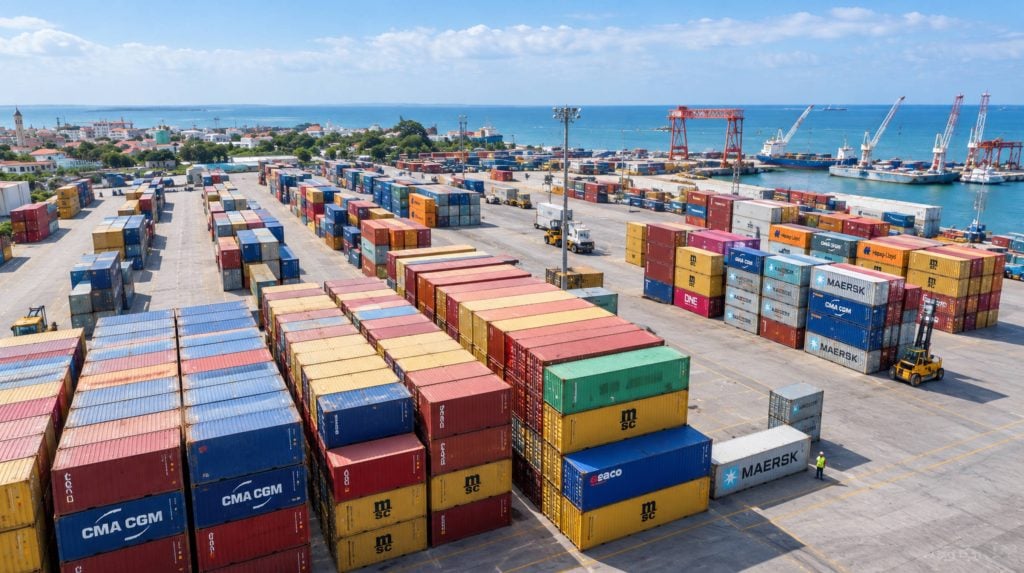
Ocean containers for France usually discharge at Le Havre, Marseille-Fos or Dunkirk, though many also arrive at Antwerp or Rotterdam and move on by truck, rail or barge. Once the vessel is discharged, the shipping line issues a delivery order after freight and destination terminal charges are settled. From this moment the free time for storage and container detention starts to run, so the customs file should already be nearly ready.
Step 3: The customs declaration in DELTA
French customs declarations are lodged electronically in the DELTA system. For most commercial shipments the broker files a standard import declaration for release for free circulation, entering the HS code, customs value, country of origin, quantities, weights, the Incoterm and the importer’s EORI. Low-value consignments up to €150 can use the simplified H7 dataset, which is the route used by most e-commerce parcels and the one to which the €3 duty and the TPC attach.
If the goods are only passing through France to another EU country, the declaration may use a procedure with VAT exemption for the onward supply, commonly known as procedure 42. This requires the buyer to have a valid VAT number and proof of the movement, and it is worth discussing with a broker before the cargo arrives rather than after.
Step 4: Assessment and payment
Once the declaration is accepted, customs assesses the duty based on the TARIC rate and the declared value. Duty and any fees are settled through the broker, often using the broker’s guarantee or a deferred payment arrangement, and are then re-invoiced to the importer. If the importer qualifies for autoliquidation, no VAT is paid in cash, and the VAT is instead reported in the next return.
Step 5: Risk analysis and possible inspection
Declarations are screened automatically. Most are released within a day. A smaller share is selected for a document check, an X-ray scan or a physical examination, which can add several days and extra handling costs for moving and unpacking the container. Selection is based on risk, not on penalties, but accurate classification and valuation clearly lower the chance of being picked.
Чекор 6: Ослободување и конечна испорака
When customs is satisfied, it issues the release note, known as the bon à enlever. The broker or forwarder can then collect the container, truck it to the named place, and the buyer unloads and returns the empty equipment within the free time. Keeping the empty return in mind is important, because a single day of delay often costs more than the customs fees themselves.
How Duties, VAT and Fees Are Calculated
The logic is simple even if the numbers are not. The customs value is built on a CIF basis, which means the transaction value plus freight and insurance to the EU border. Duty is the CIF value multiplied by the rate for the HS code in TARIC. Import VAT is then charged on the CIF value plus the duty plus other charges up to the first destination in the EU, such as inland transport, if that destination is known at the time of import. Under DAP the invoice price already contains the freight to the named place, so any costs after the EU border should be itemised separately to avoid overstating the customs value.
Duty rates vary widely by product. The table below gives indicative conventional rates for common China-origin categories, but these are only a starting point. Some Chinese goods also face anti-dumping or countervailing duties, so every HS code should be checked in TARIC before pricing.
Table 4. Indicative EU duty rates for common product groups (verify in TARIC)
| Група производи | HS area | Indicative duty |
| Mobile phones and many consumer electronics | Глава 85 | често 0% |
| Памучни маички | 6109 | Околу 12% |
| Обувки | 6402 да 6405 | Roughly 8% to 17%, depending on type |
| Мебел | И 9401 9403 | често 0% |
| Играчки и игри | 9503 | често 0% |
| Велосипеди | 8712 | About 14%, plus possible anti-dumping duties |
To see how the numbers combine, consider a 40-foot container of homeware sold DAP Le Havre for €32,600, a price that includes ocean freight and insurance. Assume a 6% duty rate and €700 of inland trucking to the buyer’s warehouse, which is added to the VAT base only.
Table 5. Worked example: FCL shipment cleared in France
| Линија | износ |
| DAP invoice price to Le Havre (customs value, CIF basis) | €32,600.00 |
| Царинска давачка од 6% | €1,956.00 |
| Inland trucking to buyer’s warehouse (VAT base only) | €700.00 |
| VAT base (32,600 + 1,956 + 700) | €35,256.00 |
| ДДВ за увоз од 20% | €7,051.20 |
| Total duty and import VAT assessed | €9,007.20 |
| Cash cost if the buyer uses VAT autoliquidation | €1,956.00 duty only |
Parcels follow a different arithmetic. Imagine a French consumer ordering a t-shirt and two mugs for €45, with €8 shipping, from a seller registered in IOSS. The parcel contains two tariff lines, so the flat duty and the per-item fee are both counted twice.
Table 6. Illustrative low-value parcel (two tariff lines, IOSS, cleared in France)
| Линија | износ |
| Goods €45.00 plus shipping €8.00 (excluding VAT) | €53.00 |
| VAT at 20% collected through IOSS | €10.60 |
| EU flat duty: 2 tariff lines × €3 | €6.00 |
| French TPC: 2 items × €2 = €4.00, plus 20% VAT on the fee | €4.80 |
| Total import-related charges | €21.40 |
If the same parcel were DAP without IOSS, the carrier would collect VAT at the door and normally add an administration fee. From 1 November 2026, the French fee is expected to give way to the EU handling fee, with a broadly similar order of magnitude per line item.
Typical Clearance and Port Fees Under DAP
Duty and VAT are only part of the picture. Under DAP, the buyer also faces a series of service charges from brokers, terminals and carriers, and many of them do not appear in the seller’s quote. The ranges below are indicative market levels for морски товар into France, not tariffs. They change with port, provider, volume and season, so treat them as budgeting guidance and ask each provider for a written quotation.
Table 7. Indicative buyer-side charges on a DAP container shipment
| Полнење | Who normally bills it | Индикативен опсег |
| Customs declaration (one tariff line) | Царински брокер | € до € 40 100 |
| Each additional tariff line | Царински брокер | € до € 5 15 |
| Ракување со дестинациски терминал | Линија за испорака или шпедитер | €150 to €350 per container |
| Delivery order and documentation | Линија за испорака или шпедитер | € до € 50 120 |
| Disbursement fee on advanced duty and VAT | Царински брокер | 1% to 3%, with a minimum of €15 to €30 |
| Trucking Le Havre to Paris region | Превозник | €450 to €800 per container |
| Scanner or physical examination | Terminal, broker | €100 to €900, depending on type |
| Storage, demurrage or detention after free time | Terminal, shipping line | €30 to €150 per day per container |
Two lines deserve extra attention. The first is the disbursement fee, which many importers forget when they compare brokers on declaration price alone. A cheap declaration with a 3% fee on €9,000 of advanced charges is not cheap. The second is time-based charges, because a delay of a single week can exceed every other charge in the table combined.
Sea, Air, Rail and Express: How Clearance Differs by Mode
The transport mode changes both the timing and the place where clearance occurs. The table gives typical planning values, but actual transit times depend on routing, carrier schedules and seasonal congestion.
Table 8. Typical timing and clearance points by transport mode
| режим | Типичен транзит | Where clearance usually happens | Најдобро одговара за |
| Море FCL | 28 до 40 дена од порт до порт | Le Havre, Marseille-Fos, Dunkirk, or another EU port | Large volumes, stock replenishment |
| Морски LCL | 35 до 50 дена, вклучувајќи консолидација | Port, then container freight station | Smaller B2B loads |
| Авионски превоз | 4 до 8 дена од врата до врата | Paris CDG, Lyon or an EU hub | Итна или стока со висока вредност |
| експресен курир | 3 до 7 дена | Carrier hub, sometimes outside France | Пакети и примероци |
| Железнички | 18 до 28 дена | EU entry terminal, then transit or clearance in France | Mid-urgency cargo |
Clearing in a different EU port such as Rotterdam, Antwerp or Hamburg and then moving the goods to France is a legitimate strategy, and it is frequently cheaper when the vessel calls there first. The trade-off is that duty is collected in the clearing member state and the onward movement must be documented correctly for VAT purposes, usually via procedure 42 and an intra-EU supply. It also changes whether the French TPC applies. This is not something to improvise at the last minute, so decide the clearance location when you build the quote, not when the vessel is already at sea.
Common Mistakes That Create Delays and Extra Costs
The first and most expensive mistake is wrong classification. A product that is sold as a “gift set” may in reality be made of several items with different HS codes, and French customs can challenge both the code and the declared origin. Misclassification does not just change the duty. Since the €3 duty and the per-item fees count tariff lines, it also changes the number of times those charges apply, and an audit after clearance can add penalties on top of the recovery of unpaid amounts.
Undervaluation is the second. Sellers sometimes show a lower invoice value to reduce the buyer’s duty, or split the invoice between product and freight in a way that does not match the transport document. Customs systems cross-check prices against databases of comparable goods, and repeated low values draw attention quickly. The risk is entirely the buyer’s under DAP, because the buyer is the importer of record.
The third mistake is neglecting the consignee data. A bill of lading that names the wrong entity, an EORI that has not been activated, or a VAT number that does not match the consignee name can freeze a container. The fix is trivial, but only if it is found before arrival rather than at the terminal gate.
Fourth comes product compliance. CE marking, safety testing, labelling in French, battery regulations and packaging rules can all trigger holds. Goods that cannot legally be placed on the EU market may be re-exported or destroyed at the importer’s expense. Fifth, there is the pricing blind spot: a DAP quotation that ignores the new 2026 duty and fees, and that does not say who pays them, invites disputes. The sixth is time. Free days at the terminal are short, and a container that waits for a missing signature accumulates charges every day.
DAP or DDP: Which Term Works Better for France?
There is no universal answer. DAP works well when the buyer is a registered French business with a broker and VAT autoliquidation, because the buyer controls classification, pays duty directly and recovers VAT on the same return. It also protects the seller from exposure to French VAT registration and customs penalties. DDP is more attractive for consumer sales, small buyers and marketplaces where the customer expects a single all-in price and a fast delivery without surprise invoices at the door.
A practical middle path is to agree DAP in the contract but name a specific broker, share the HS code and customs value in advance, and put the expected duty, VAT and fees in a pro forma estimate that the buyer approves before shipment. The incoming 2026 charges are small per parcel but significant per container of mixed goods, so making them visible early protects the relationship.
How Topway Shipping Supports DAP Shipments to France
Since 2010, Topway Shipping, headquartered in Shenzhen, China, has been a professional provider of cross-border e-commerce logistics solutions. The founding team has more than 15 years of experience in international logistics and customs clearance, with a strong focus on China to U.S. transportation, and that background in demanding customs environments carries over to the documentation discipline required for EU imports.
Topway Shipping’s services span the entire logistics chain: first-leg transportation from Chinese factories and consolidation points, overseas warehousing, customs clearance, and last-mile delivery. For ocean freight, the company offers flexible full container load and less than container load services from China to major ports worldwide, which gives French importers a choice between a dedicated container for large orders and shared space for smaller replenishments.
On a DAP shipment, the value of a forwarder lies in what happens before the vessel sails. Topway Shipping can help sellers prepare invoices and packing lists that match, check product descriptions for ICS2 filing, confirm the consignee’s EORI and VAT details with the buyer, and coordinate with a local customs broker so that the declaration is ready when the cargo reaches France. For sellers who want to move beyond parcel-by-parcel exposure to the new per-item fees, the overseas warehousing and last-mile services can also support a stock-in-the-EU model, where goods travel in bulk and are distributed locally.
Practical Ways to Keep DAP Costs Predictable
Start with classification. Agree the HS code for every product before the first shipment, document the reasoning, and keep it consistent across invoices. Consistency shortens clearance, and it makes the per-line fees predictable. For e-commerce sellers, a small review of product bundles can show how many distinct tariff lines a typical order generates and what the new fees therefore add per order.
Next, price the whole journey. A good DAP quotation shows freight, insurance, the buyer’s expected duty, VAT treatment, broker and terminal charges, and a note about the 1 November handling fee. Even a rough estimate, clearly labelled, is better than silence. Where volumes justify it, shipping stock in bulk to a French or EU warehouse and delivering locally can replace dozens of small cross-border parcels with one container clearance, which spreads fixed fees and can reduce the per-item burden.
Last, build a buffer into every schedule. Add two to three days for clearance and another few for possible inspection, and keep the buyer’s broker informed of the vessel’s ETA changes. The cheapest delays to fix are the ones that were anticipated.
Заклучок
DAP remains a sensible term for shipments from China to France, but only when both sides understand that the buyer carries the clearance. The 2026 changes, including the €3 flat duty, the French €2 small parcel fee and the EU handling fee expected from 1 November 2026, have turned what used to be a mostly VAT conversation into a per-item cost calculation. Clear contracts, accurate documents, a valid EORI and VAT setup, and a broker who knows DELTA are the ingredients of a smooth clearance.
If you are planning a France-bound shipment, now is the time to review your quotes, classification and delivery places. Topway Shipping can support the process from the first leg in China to final delivery, helping both shippers and French importers avoid the surprises that turn a competitive DAP price into a costly one.
Најчесто поставувани прашања
Q: Who pays import VAT under DAP when shipping to France?
A: The buyer does. A VAT-registered French business normally declares the VAT through autoliquidation on its VAT return, so no cash payment is made at the border. A private consumer pays through the carrier at delivery, unless the seller has already collected the VAT through IOSS.
Q: Is the €150 duty exemption still available?
A: No. From 1 July 2026, goods in parcels under €150 are subject to a flat €3 customs duty per tariff line, and the exemption is fully replaced by standard tariffs when the EU Customs Data Hub is due to start in July 2028.
Q: Do I need an EORI number to receive a DAP shipment in France?
A: Yes, if you act as importer on a commercial shipment. French companies receive an EORI based on their SIREN number. Private consumers do not need one, because the carrier files the declaration for them.
Q: How long does customs clearance in France usually take?
A: Many declarations are released within one to three days when documents are accurate. Shipments selected for inspection can take several additional days, and storage or detention charges may apply during that time.
Q: Can Topway Shipping help with DAP shipments to France?
A: Yes. Topway Shipping offers FCL and LCL ocean freight from China, together with first-leg transportation, overseas warehousing, customs clearance support and last-mile delivery, and can coordinate with the buyer’s broker so that documents and charges are clear before the cargo ships.