
ต้นทุนที่ซ่อนเร้นของการกระจายความเสี่ยง: สิ่งที่บริษัทต่างๆ ไม่ได้บอกคุณเกี่ยวกับการย้ายฐานการผลิตออกจากประเทศจีน
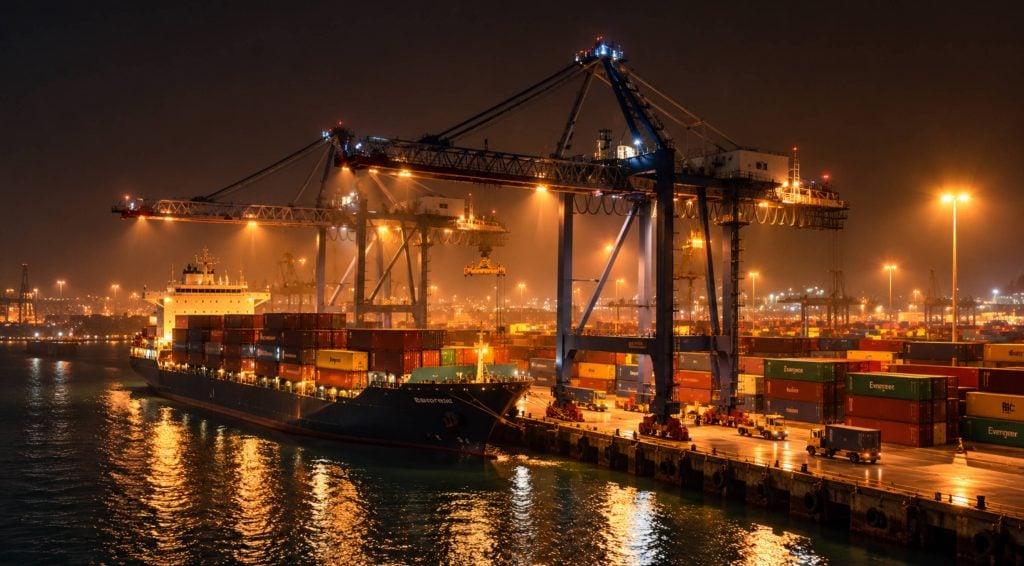
Every procurement meeting in 2026 seems to circle back to the same question: should we move production out of China? The pressure is real. Tariff schedules keep shifting, transshipment enforcement has sharpened, and boardrooms want a resilience story to tell shareholders. Vietnam, Mexico, and India are presented as the obvious answer, and on a spreadsheet, the math often looks clean.
What rarely makes it into the spreadsheet is everything diversification costs beyond the factory quote. Freight forwarders who work these lanes every day see a different picture than the one painted in strategy decks: hidden customs delays, origin-compliance risk, duplicated inventory, and a logistics network that has to be rebuilt almost from scratch. This article looks at what companies are not being told about moving away from China, using current trade data and freight realities, and where a logistics partner like Topway Shipping actually changes the outcome.
None of this is an argument against diversification. Tariff exposure, geopolitical risk, and single-source vulnerability are all genuine problems that a second manufacturing base can help solve. The point is narrower: the companies that get the most out of a Plus One strategy are the ones that price the logistics side of the move honestly from the start, instead of discovering the true cost one delayed shipment at a time.
The Diversification Story Sounds Simpler Than It Is
On paper, China Plus One is a straightforward hedge: keep part of production in China, add a second base somewhere else, and reduce the risk of depending on a single country. That framing has driven a genuine shift in trade flows. Between 2022 and 2025, China’s share of US imports fell by roughly 16 percentage points, while Vietnam’s share climbed 38 percent and Mexico’s rose 52 percent, according to US International Trade Commission figures cited in recent sourcing analysis.
It is worth noting that the pace of this shift is not slowing down. New investment exceeding 10.2 trillion Indian rupees is flowing into Southeast Asia and India this year alone, and in a recent industry survey, 72 percent of trade professionals named tariff volatility as the single biggest threat to their margins for 2026. Those two facts together explain why so many companies feel they cannot afford to wait, even when the execution details are still being worked out.
The problem is that most teams treat diversification as a factory decision rather than a supply chain decision. Sourcing managers compare unit prices between a Chinese supplier and a Vietnamese or Mexican one, pick the cheaper quote, and assume the job is done. In practice, each market has different supplier density, different port infrastructure, different documentation standards, and a completely different freight network. What looks like a simple relocation on a spreadsheet becomes, in execution, a rebuild of the entire logistics chain.
A 2024 survey of 180 listed EU manufacturers found that 91 percent had already written a China Plus One strategy into their sourcing policy. Very few of those same companies had mapped what that strategy would actually cost once freight, customs, and compliance were factored in alongside the factory price.
The Raw Material Dependency Trap
The most common surprise companies run into after they move is what sourcing teams now call the raw material dependency trap. A product stamped “Made in Vietnam” does not necessarily mean the supply chain has left China at all. In electronics, textiles, furniture, and consumer goods, the components, fabrics, and sub-assemblies feeding a Vietnamese or Indian factory frequently still originate from Chinese suppliers.
A Vietnamese factory may handle final assembly while every meaningful input, from LED chips and drivers to aluminum extrusions and wiring harnesses, still arrives from China. That means a Chinese supply disruption still ripples through the new production base, and it means the freight bill has not shrunk, it has multiplied: one shipment from China to the assembly country, then a second shipment from the assembly country to the end market. Companies budgeting for a single ocean freight leg often find themselves paying for two, plus the inland trucking and customs clearance that comes with each one.
There is also a certification cost that rarely appears in a sourcing quote. Any product carrying safety certifications such as CE, UL, SAA, TUV, or ATEX has to be requalified for every new manufacturing source. Factory audits, new test reports, and updated certification files are a real, one-time cost that needs to be weighed against whatever tariff savings the move is chasing.
Rules of Origin: Where the Real Risk Sits in 2026
The single biggest hidden cost in 2026 is not freight, it is origin compliance. US enforcement has moved decisively from spot checks to systemic scrutiny. Since Section 122 of the Trade Act of 1974 became the operating legal authority for tariff enforcement in February 2026, following the Supreme Court’s ruling in Learning Resources, Inc. v. Trump, US Customs has applied a 40 percent transshipment penalty, with no mitigation or remission available, to any shipment determined to be routed through a third country to dodge China-origin duties.
To legally qualify as Vietnamese-origin, a product must undergo substantial transformation there under 19 C.F.R. § 134.1(b), emerging with a new name, character, or use. Simple assembly or relabeling of Chinese components does not meet that bar, and the documentation that proves substantial transformation has to exist before the shipment ever sails, not after a customs officer asks for it.
Mexico carries a parallel version of the same risk. Bank of Mexico data shows Mexican imports from Vietnam more than doubled in the first half of 2026 to 18.4 billion US dollars, a jump that trade officials read as a sign that Chinese goods are increasingly being passed off as Vietnamese before re-export toward the United States. Washington has already flagged Mexico as a Tier 1 country in what it calls a shadow transshipment network, meaning US-bound shipments from Mexico now draw closer scrutiny even when the underlying trade is entirely legitimate.
The table below summarizes where things stand for the three most common Plus One destinations.
| ปลายทาง | US tariff exposure (2026) | Origin risk profile | กรณีการใช้งานทั่วไป |
| เวียดนาม | 20% reciprocal rate on Vietnam-origin goods; 40% penalty on flagged transshipment | High — under active CBP enforcement; strongest for products with genuine local value-add | Final assembly, electronics, textiles, furniture |
| เม็กซิโก | USMCA preference for qualifying goods; up to 40% risk exposure on non-qualifying flows | High — flagged as a Tier 1 transshipment hub; capacity and lead times tightening | Labor-intensive assembly, USMCA-qualifying goods, US-bound freight |
| อินเดีย | Reciprocal tariff framework; PLI incentives supporting new manufacturing | Moderate — earlier-stage supply base, less transshipment scrutiny so far | Larger-scale manufacturing, longer-term capacity building |
None of this means Vietnam or Mexico are the wrong choice. It means the tariff arbitrage that looked attractive eighteen months ago now comes with a compliance workload that has to be built into the freight plan from day one: bills of materials, supplier declarations, and HS code documentation that can withstand a CBP audit.
India sits in a different position for now. Its supply base is earlier-stage and less integrated into Chinese component networks than Vietnam’s, which means it draws less transshipment scrutiny, but it also means the local supplier ecosystem, tooling, and sub-component manufacturing that Vietnam has spent a decade building are still catching up. The Production Linked Incentive scheme is actively recruiting foreign manufacturers and drawing genuine new investment, but companies choosing India as a Plus One destination are generally signing up for a longer capacity-building timeline in exchange for a cleaner compliance position, not a faster or cheaper one.
There is also a documentation cost that is easy to underestimate: origin claims are not a one-time filing. CBP can, and increasingly does, request updated bills of materials and supplier declarations well after a shipment has cleared, which means the paperwork built to support a Vietnamese or Mexican origin claim has to be maintained on an ongoing basis, not archived once the container leaves the port.
The Infrastructure Gap Nobody Puts in the Budget
Freight rates are the cost everyone models. Infrastructure downtime is the cost almost nobody does. Emerging manufacturing hubs are growing fast, but their port systems, bonded คลังสินค้า, and customs processes are still catching up to the volume being routed through them. Two-week customs bottlenecks in some emerging markets are common enough that experienced logistics teams now build them into safety stock planning as a matter of course, rather than treating them as exceptions.
That delay has a real financial shape. Extra inventory sitting in transit or in a warehouse waiting on customs clearance ties up working capital, and every additional week of buffer stock is a week of carrying cost that was never in the original sourcing comparison. Lead times for new manufacturing sites in Mexico have stretched to as long as 18 months as capacity tightens, which pushes some of the quick-win timeline that diversification plans promise well past a single fiscal year.
Labour cost inflation compounds the picture. Average manufacturing wages in China have roughly tripled since 2010, according to ILO data, which is exactly the trend that made diversification attractive in the first place. But wages in the newer hubs are rising too, and the cost advantage that justified the move can erode faster than expected once freight, compliance, and inventory carrying costs are added back in.
Port congestion adds another layer that is easy to miss when comparing hubs on paper. China’s major ports, Shenzhen, Ningbo, and Shanghai among them, have decades of throughput behind them and freight forwarders who know exactly how to route around a delay when one occurs. A newer hub with rapidly growing export volume does not yet have that depth of institutional experience, so the same size of disruption, a customs system outage, a strike, a weather event, tends to take longer to clear simply because fewer people on the ground have handled it before.
What the Hidden Costs Actually Add Up To
It helps to lay the comparison out plainly, because the individual line items rarely get compared side by side until a finance team is already unhappy with a quarter’s landed cost.
| หมวดต้นทุน | What the sourcing quote usually shows | What often gets missed |
| ค่าระวาง | Single ocean freight leg, factory to port | A second leg if components still originate in China; added inland trucking at both ends |
| ตามมาตรฐาน | Not itemized | Certification requalification, origin documentation, audit preparation, broker fees |
| สินค้าคงคลัง | Not itemized | Extra safety stock to cover 1–2 week customs delays in newer hubs |
| ความเสี่ยงด้านศุลกากร | Not itemized | Exposure to transshipment penalties if origin documentation cannot be proven |
| ปฏิบัติการ | Factory ramp-up schedule only | New-site lead times of 12–18 months before full capacity is reached |
None of these items is a reason to abandon diversification. They are reasons to plan the logistics side of the move with the same rigor as the manufacturing side, ideally before the first container is booked rather than after the first customs delay.
Where a Logistics Partner Changes the Outcome
This is the part of the diversification conversation that sourcing teams often underestimate: the freight forwarder is not a downstream vendor filling in paperwork after the sourcing decision is made. Handled well, the forwarder is the one party that can see the entire landed cost picture across origin documentation, dual-leg freight, warehousing, and last-mile delivery, and can flag where a lower-priced factory quote is quietly adding cost somewhere else in the chain.
Topway Shipping has been working China–US logistics since 2010, and the firm’s approach reflects exactly the gaps described above. Headquartered in Shenzhen, Topway’s founding team brings more than 15 years of experience in international logistics and customs clearance, with particular depth in China–US transportation, which is the exact corridor most exposed to the tariff and transshipment shifts covered in this article. Rather than handling a single leg of the journey, Topway covers the full logistics chain: first-leg transportation from the factory, overseas warehousing, customs clearance, and last-mile delivery, along with flexible full-container-load and less-than-container-load ocean freight from China to major ports worldwide.
For a company running a China Plus One model, that end-to-end structure matters in a very practical way. If components are still moving from China to a Vietnamese or Indian assembly site before the finished product heads to the US or Europe, Topway’s coverage of first-leg transportation and customs clearance keeps that intermediate leg from becoming an unmanaged black box. Overseas warehousing gives companies a buffer against the customs delays and lead-time stretch discussed above, without having to build that capacity themselves from scratch. And because the FCL and LCL options are flexible, smaller or mid-sized shippers testing a new sourcing lane are not forced into full-container commitments before volumes justify them.
None of this replaces the sourcing and origin-compliance work a company has to do internally. But it does mean the freight side of a diversification plan does not become its own source of hidden cost, which, based on the data above, is exactly where many companies get caught out.
This matters just as much for companies that are not diversifying at all. Plenty of importers are choosing, for good reasons, to keep production concentrated in China and manage tariff exposure through pricing, product design, or trade compliance rather than relocation. For that group, the value of working with a forwarder that has specialized in the China–US corridor since 2010 is different but just as real: deep familiarity with the ports, customs processes, and documentation standards on that single lane, rather than a thinner layer of expertise spread across several new geographies at once.
FCL or LCL: The Freight Decision Nobody Plans For
There is a smaller, more tactical decision that sits underneath every diversification plan, and it rarely gets discussed until a shipment is already late: whether a new lane should run full-container-load or less-than-container-load in its first months. Companies that commit to FCL bookings on an unproven lane, before they know how consistent the factory’s output will be or how reliable customs clearance is at the new origin port, often end up either paying to ship partially empty containers or holding cargo back to wait for a full load, both of which quietly erase the savings the move was supposed to deliver.
LCL freight solves that problem for the first several months of a new sourcing relationship, letting a company move smaller, more frequent shipments while it builds confidence in a supplier and a lane, then switch to FCL once volumes are predictable enough to justify it. The trade-off is that LCL costs more per unit and involves more handling at consolidation points, so it only works as a bridge if the freight partner running it also has the warehousing and customs capability to keep transit times tight. This is exactly the kind of decision where a forwarder’s flexibility, rather than its lowest quoted rate, ends up determining whether the first year of a new lane is profitable.
Building a Resilient Network Without Losing Control
The companies handling this transition well tend to share a few habits. They audit at the component level, not just the factory level, so they know exactly which inputs still trace back to China before they promise a customer or a customs officer a different country of origin. They build documentation, bills of materials, supplier declarations, substantial-transformation evidence, before a shipment ships, not after a query arrives. And they treat their freight forwarder as a source of visibility into landed cost, not just a booking service.
The broader trade environment is not getting simpler. Regional trade agreements such as RCEP are opening new lanes, but enforcement against transshipment is tightening at the same time, and that tension is likely to define sourcing decisions for the next several years rather than resolve quickly. Diversification remains the right long-term direction for most companies with meaningful China exposure. The mistake is assuming it is a factory decision with a logistics footnote, when in reality the logistics plan often determines whether the diversification actually pays off.
สรุป
Moving production out of China is rarely as clean as the strategy slide suggests. The tariff savings are real, but so are the hidden costs: components that still trace back to Chinese suppliers, certification requalification, customs bottlenecks in newer manufacturing hubs, and origin-compliance risk that can trigger penalties far larger than any freight saving. None of that is a reason to stay put. It is a reason to plan the logistics side of a diversification strategy with the same care given to the factory decision, and to work with a freight partner that can see the whole chain rather than just one leg of it. Companies that map their true landed cost before they move tend to end up with a supply chain that is genuinely more resilient, not just relocated.
คำถามที่พบบ่อย
Q: Does moving a factory to Vietnam or Mexico automatically remove Chinese-origin tariffs?
A: No. If the product does not undergo substantial transformation in the new country, US Customs can still treat it as Chinese-origin and apply a transshipment penalty, which in 2026 can reach 40 percent with no mitigation available.
Q: What is the raw material dependency trap?
A: It refers to a product being labeled as made in a new country while its key components or raw materials still originate in China, which keeps freight costs, customs exposure, and supply risk tied to China even after final assembly moves.
Q: Which country offers the lowest tariff exposure for US-bound goods right now?
A: It depends on the product and whether it genuinely qualifies under local origin rules. Mexico offers USMCA preference for qualifying goods, Vietnam offers a lower reciprocal rate than China but faces active transshipment enforcement, and neither is automatically the cheaper option once compliance and freight costs are included.
Q: How can a freight forwarder help manage diversification risk?
A: A forwarder that covers the full chain, first-leg transport, warehousing, customs clearance, and last-mile delivery, such as Topway Shipping, can give a company visibility into landed cost across every leg of a diversified supply chain rather than leaving each leg to be managed separately.
Q: Should smaller companies wait before diversifying away from China?
A: Not necessarily, but they should map component-level dependencies and documentation requirements before committing, and consider flexible LCL freight options while volumes in a new lane are still being tested.