
Gdansk: Poland’s Fast-Rising Alternative to Rotterdam
Introduction
For most of the container era, one question has had a stubbornly consistent answer: where should a box from Asia land in Northern Europe? For decades the reflex reply was Rotterdam, with Hamburg and Antwerp as the usual alternates. That reflex made sense when Europe’s biggest ports offered the deepest water, the densest liner networks and the most dependable barge and rail links. It remains a sensible default for a large share of cargo. But in 2026 a growing number of forwarders, importers and carriers are asking a sharper question: does every container bound for Poland, the Baltic states or Central Europe really need to pass through the Rhine delta first?
The Port of Gdansk is the reason that question has become urgent. Its container throughput rose 23 per cent in the first half of 2026 to nearly 1.6 million TEU, while Rotterdam’s container volumes were flat. Baltic Hub, the port’s main container terminal, has completed a large deep-water expansion, and a 30-year lease signed on 4 August 2026 clears the way for a second rail facility designed for 750-metre trains. Gdansk is not about to dethrone Rotterdam, which still handled around 7 million TEU in the same six months. What it offers is something more practical for freight forwarders: a credible direct-call alternative for a specific and expanding set of trade lanes.
This article takes a forwarder’s view of the shift. It lays out the verified numbers, explains what the new infrastructure changes in operational terms, compares Gdansk with Rotterdam on the factors that actually decide routing choices, and closes with a playbook you can apply to your next booking, including how Topway Shipping approaches China-to-Europe consolidation and ocean freight. The goal is a set of decision rules, not just another port-rankings story.
Why Gdansk Is Moving From Footnote to Front Page
Gdansk has been a trading city for centuries, but its modern container story is surprisingly short. The deep-water terminal now called Baltic Hub opened on 1 October 2007, and it has grown into the largest container terminal in Poland and the only deep-water container facility in the Baltic Sea, according to the operator. For years it was treated as a regional destination, a place Asian cargo reached after a first stop in Hamburg, Bremerhaven or Rotterdam and a second voyage on a smaller feeder ship. The decisive change was the arrival of direct ocean services from the Far East, which allowed cargo to skip the intermediate port altogether.
That shift matters because every transhipment adds cost, handling risk and unpredictability. A box discharged in Rotterdam and reloaded onto a feeder, or sent by truck across Germany, passes through an extra terminal gate, an extra round of storage charges and an extra chance of missing a connection. When a deep-sea vessel calls in Gdansk instead, the container lands within a few hundred kilometres of many final consignees. For forwarders who serve Polish and Central European customers, that is the difference between a supply chain with one handoff and one with three.
A Port Built Around Deep Water
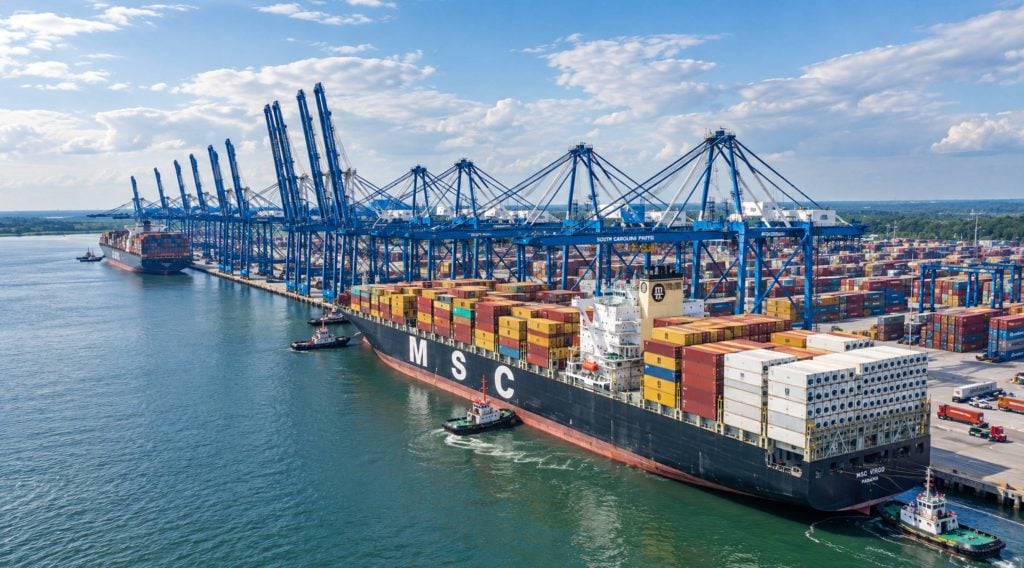
Physical depth is the foundation of the story. Older descriptions of the Northern Port, where Baltic Hub sits, cite drafts of up to 15 metres, enough for very large bulk and tanker traffic. More recent works have gone further. The newest T3 quay is 717 metres long and 17.5 metres deep, designed to take the largest container ships in service, and the Gdansk port authority and maritime office have widened and deepened the Northern Port approach channel to 18 metres. Cranes installed on T3 can work vessels of roughly 400 metres in length, which puts the terminal in the same operational class as the Western European giants for ship size, if not for sheer volume.
A Market Pulling Cargo Eastward
The second driver is demand geography. Poland is a large consumer market and a major manufacturing base, and its logistics networks reach well beyond its borders into the Czech Republic, Slovakia and Ukraine. The port authority’s president, Dorota Pyc, has explicitly framed the 2026 rail project as a way to improve access to those markets while moving more cargo off roads. For an importer in Lodz, Poznan or Warsaw, a vessel that unloads in Gdansk can mean days saved on the inland leg compared with a Rotterdam discharge followed by a long trunk haul through Germany.
The Baltic rim adds a third pull. Baltic Hub’s own network map shows feeder links to Helsinki, Kotka, Tallinn, Riga, Klaipeda and several Swedish ports. A forwarder with cargo for Finland or the Baltic states can use Gdansk as a hub, consolidating Asian volumes on one mainline call and redistributing them by short-sea services. That model is the original reason the terminal calls itself a hub, and it is gaining relevance as more mainline ships choose to call there.
The Numbers Behind the Rise
A rising port story is only worth acting on if the data holds up, so it is worth stating the figures plainly. Total cargo at the Port of Gdansk reached 80.4 million tonnes in 2025, nearly 4 per cent above the 77.4 million tonnes recorded in 2024. Container volume for the year stood at around 2.77 million TEU, of which Baltic Hub handled about 2.7 million. Those are solid numbers, but the real acceleration came in 2026, when growth moved from single digits into the twenties for containers.
| Indicator | Figure | Period |
| Total cargo | 80.4 million tonnes (2024: 77.4 million) | Full year 2025 |
| Container volume, port | About 2.77 million TEU | Full year 2025 |
| Container volume, Baltic Hub | About 2.7 million TEU | Full year 2025 |
| Total cargo | 20.9 million tonnes, up 13.6% | Q1 2026 |
| Containers | 761,896 TEU, up 22% | Q1 2026 |
| Total cargo | 41.7 million tonnes, up 9% | H1 2026 |
| Containers | Nearly 1.6 million TEU, up 23% | H1 2026 |
| Baltic Hub cargo tonnage | 13.8 million tonnes, up 18% | H1 2026 |
| Baltic Hub design capacity after T3 | 4.5 million TEU a year | From late 2025 build-out |
Sources: Port of Gdansk and Baltic Hub results as reported by Port Technology International, Container News and WorldCargo News.
Two details in that table deserve attention. First, the container growth rate is well ahead of overall cargo growth, which means boxes are taking a larger share of the port’s mix, even though liquid fuels remain the largest single segment at around 45 per cent of tonnage in the first half of 2026. Second, general cargo, the category that contains containers, grew 17 per cent to 15.2 million tonnes, and Baltic Hub’s own tonnage grew 18 per cent. The container story is not a rounding error inside a bulk port; it is the fastest-moving part of the business.
The first-half import and export split offers a further clue. Imports totalled 27.8 million tonnes against exports of 8.3 million, with transit cargo adding 5.6 million. Much of that import weight is fuel, but the 5.9 million tonnes of general cargo exports and the sizeable transit figure indicate that Gdansk is increasingly a gateway for flows moving onward to other countries, not only a Polish port.
Gdansk Versus Rotterdam in the First Half of 2026
Putting the two ports side by side shows why the comparison is suddenly fashionable. Rotterdam remains many times larger, but its container business stood still while Gdansk’s surged.
| Indicator, H1 2026 | Gdansk | Rotterdam |
| Total cargo | 41.7 million tonnes (+9%) | 212.0 million tonnes (+0.4%) |
| Container throughput | Nearly 1.6 million TEU (+23%) | About 7.02 million TEU (-0.1%) |
| Container tonnage | Baltic Hub 13.8 million tonnes (+18%) | 98.5 million tonnes (-2.6%) |
| Transhipment | Not separately reported in sources reviewed | Down 20% on capacity constraints |
| Capacity outlook | 4.5 million TEU at Baltic Hub after T3; second rail facility planned | Extra terminal capacity expected from end of 2026 |
Sources: Port of Rotterdam Authority half-year results and Container News; Port of Gdansk half-year results. Figures are not like-for-like in every row and are presented as reported.
The Rotterdam picture is not one of failure. The Port Authority reported stable finances, record-level activity in some bulk categories and limited direct exposure to the closure of the Strait of Hormuz, since direct container traffic with Persian Gulf countries accounts for only about 1 per cent of its volume. The point is narrower. A port that is near its practical terminal capacity cannot grow its container volumes, and shippers who need predictable service have reason to look at alternatives that still have room.
Infrastructure: What T3, the New Channel and the Rail Lease Actually Change
Infrastructure announcements tend to blur together, so it helps to translate each one into a forwarder’s language: what does it change about transit time, reliability, cost or reach?
T3: Capacity for the Largest Ships
The T3 terminal was built on a 36-hectare artificial peninsula linked to the existing terminals. When fully completed it lifts Baltic Hub’s annual capacity by 1.5 million TEU to 4.5 million TEU, and its 717-metre quay with 17.5 metres of depth is built for ultra-large container vessels, including the largest class operating in the Baltic. The first MSC services were scheduled onto T3 precisely because the new quay and cranes could handle ships of around 400 metres. In practical terms, that means carriers can deploy their efficient mainline ships to Gdansk instead of splitting cargo onto smaller vessels.
For forwarders the benefit shows up in two places. Larger ships bring more weekly slot capacity, which reduces the rolling and cut-off problems that plague congested periods. And a terminal with spare yard and berth capacity tends to deliver steadier vessel waiting times, which is the quiet variable that determines whether an ETA in a quote is realistic.
The 18-Metre Approach Channel
A deep quay is of limited use if the channel leading to it constrains draft. The approach to the Northern Port has been widened and deepened to 18 metres, and the port authority has rebuilt or constructed more than 7 kilometres of roads and 10 kilometres of railway in the Northern Port area. These works are the unglamorous side of the expansion, yet they decide whether a fully laden ship can arrive on schedule and whether a container can leave the terminal gate without queuing.
The 2026 Rail Lease and the 750-Metre Train
The most recent milestone is the lease signed on 4 August 2026 between the Port of Gdansk Authority and Baltic Hub. It gives the terminal a 30-year right to a 27-hectare site next to the T2 deep-water terminal, where it will build an intermodal rail and container handling area, a new rail siding capable of receiving 750-metre trains, and additional container storage. Reports describe a phased build with several parallel tracks. Baltic Hub was the sole bidder, and the site already benefits from rail access and port designation, which makes it a pragmatic place to add a second rail facility.
Rail capacity may prove the most commercially important item in this whole list. Road remains the dominant way containers leave Polish ports, and trucking is exposed to driver shortages, fuel costs and congestion. A terminal that can marshal 750-metre trains moves more boxes per path, cuts per-container emissions and gives forwarders a more predictable inland product. Poland’s rail manager has already modernised more than 70 kilometres of track and 13 road-rail crossings on the approach corridors, so the track and the terminal investment are moving in step.
Who Is Calling at Gdansk: Services and Alliances
A port is only as useful as the schedules that call there. Gdansk’s direct Asia connectivity has been shaped by the reshuffling of global carrier alliances in 2025, and the changes are worth understanding because they determine which of your suppliers’ bookings can route through Poland without a transhipment.
| Carrier group | Service or network | What it means for shippers |
| Ocean Alliance (CMA CGM, COSCO, Evergreen, OOCL) | AEU1, LL1, FAL5, NE1 | Long-established Asia to North Europe loops with Gdansk in the rotation |
| CMA CGM | FAL1 | Additional weekly Asia-Europe call |
| MSC | Britannia and Albatros | Added Gdansk in 2025; operated on the new T3 quay; covers China, Korea, Vietnam, Singapore and several Northern European ports |
| Maersk (Gemini Cooperation with Hapag-Lloyd) | Two weekly shuttles | Links Polish ports with Bremerhaven and Wilhelmshaven; a network connection rather than a direct Asia call |
Source: Baltic Hub service announcements and trade press. Rotations change frequently; always confirm current schedules with the carrier before booking.
The OOCL LL1 loop is a useful concrete example. Its published rotation runs from Shanghai, Ningbo, Xiamen and Yantian through Singapore to Felixstowe, Zeebrugge, Gdansk, Wilhelmshaven and Piraeus, which tells you two things at once. Gdansk sits inside a mainstream Asia-North Europe string, not on an isolated detour, and cargo from South China loads at Yantian, close to Shenzhen. That is a very direct fit for the type of consolidated and full-container cargo that Chinese exporters send into Europe.
The alliance reshuffle also shows how fast the picture can change. Baltic Hub reported that Maersk’s step back from direct Asia calls in Gdansk was quickly filled by MSC, its former 2M partner, which added the port to two Asia-Europe services. A forwarder should therefore treat service availability as a living variable. The sensible practice is to review the current rotation each quarter instead of assuming last year’s schedule still applies.
There is also a booking-behaviour angle that forwarders sometimes overlook. A shipper who books a direct Gdansk loop is committing to a specific string, with its own cut-off, free-time terms and equipment availability. Container availability at Chinese origin ports and the free days offered at the Polish terminal can differ from what the same carrier offers at a Western European port, so these terms should be read in the quote and not assumed. A short checklist before confirming a booking saves arguments later: confirm the vessel and voyage, the last receiving date at the origin terminal, the free time at destination, and the inland haulage options that the carrier or the forwarder will honour.
Rotterdam’s Capacity Squeeze and What It Means for Routing
Rotterdam’s first-half 2026 numbers explain a lot about why Gdansk is gaining attention. Container throughput slipped 0.1 per cent in TEU and 2.6 per cent by weight, while transhipment volumes fell around 20 per cent because of capacity constraints at the terminals. The port authority has said that new capacity is due to come online at several container terminals from the end of 2026, which implies that the constraint is genuine and that relief is expected but not yet delivered.
For forwarders, a constrained terminal shows up in the day-to-day product as longer berth waits, tighter yard conditions and more volatile pickup windows. Barge and rail connections inland from Rotterdam are among the best in Europe, yet they are not a substitute for terminal fluidity. When a ship waits for a berth, everything downstream waits with it, and a cargo owner with a hard delivery date to a Polish plant bears the consequences.
It would be wrong to read this as a signal to abandon Rotterdam. For cargo going to the Benelux, the Rhine corridor, France or the UK, Rotterdam’s connectivity is still hard to beat, and its roll-on roll-off business grew on UK demand. The lesson is about matching port to destination. Cargo bound for Poland and its neighbours has a growing set of reasons to avoid the longest possible inland leg.
External shocks sharpen the argument. Higher energy prices and the closure of the Strait of Hormuz have unsettled international markets in 2026, although Rotterdam has said the direct effect on its operations has been limited. Disruptions of that kind reward supply chains that have more than one viable gateway. A forwarder who can quote and book through either port can reroute faster when one side tightens.
Hinterland Reach: Poland, Central Europe and the Baltic Rim
A deep-sea call only matters if the cargo can reach its final destination at a sensible cost. Baltic Hub’s published transport network shows rail terminals and logistics parks across Poland, with onward links into Central Europe and feeder services around the Baltic Sea.
| Destination market | Typical role of Gdansk | Main inland or onward mode |
| Northern and central Poland | Primary deep-sea gateway | Road and rail |
| Warsaw, Lodz, Poznan, Wroclaw regions | Direct import and export gateway; rail terminals on the Baltic Hub network include Warsaw, Lodz, Poznan, Wroclaw, Kutno, Radomsko and Lublin | Rail shuttles, with road for final delivery |
| Czech Republic and Slovakia | Competes with German and Dutch gateways; direct rail to Ostrava has been launched by an intermodal operator | Rail |
| Ukraine | Transit gateway; access is a stated focus of the 2026 rail project | Rail and road |
| Finland, the Baltic states and Sweden | Hub for feeder redistribution | Short-sea feeder |
Source: Baltic Hub transport network map (2026), Port of Gdansk Authority statements and trade press.
The table makes one point clear: Gdansk’s competitive zone is not the whole of Europe but a rough arc running from the Baltic coast south through Poland and into the Czech and Slovak markets, with feeder reach into Scandinavia and the Baltic states. Inside that arc, the combination of a direct deep-sea call and a short inland leg is often hard for a Western European gateway to match on total door-to-door cost.
Outside that arc, the advantage fades. A container bound for southern Germany or Austria will usually be better served through a North Sea or Mediterranean port, and a forwarder who pushes Gdansk beyond its natural catchment risks proving the wrong lesson to a customer.
Cost and Transit: A Practical Comparison
Quoting between ports is hard because the cheapest ocean rate is not always the cheapest landed cost. The right comparison adds the sea leg, port charges, inland haulage, storage risk and the cost of delay. The matrix below frames those factors qualitatively. Actual rates change weekly with carrier, season, equipment and fuel, so treat it as a structure for building a real quote, not as a price list.
| Factor | Direct call at Gdansk | Rotterdam plus inland to Poland | Rotterdam plus feeder to Baltic |
| Ocean transit | Gdansk is usually later in the loop, so the sea leg can be longer on paper | Earlier port in the rotation, so the sea leg is often shorter | Same as Rotterdam, plus a second voyage |
| Handling points | One discharge at the arrival terminal | Discharge plus inland loading, with a rail or truck handoff | Discharge, reloading and a second discharge |
| Inland leg to Polish customers | Short | Long trunk haul across Germany | Not applicable |
| Exposure to terminal congestion | Terminal with new capacity and space | Capacity constraints reported in 2026 | Exposed twice |
| Best fit | Poland, Czech and Slovak markets, Baltic feeder cargo | Benelux, Rhine, France, UK and some Western German cargo | Smaller Baltic volumes without a direct call |
Qualitative framework only. Rates and transit times vary by carrier, routing and season and must be confirmed in each quote.
The key insight is that a longer ocean leg is not automatically a worse deal. Because Gdansk usually comes later in an Asia-North Europe loop, the vessel may spend a few extra days at sea compared with an early Rotterdam call. If that same cargo then needs a long road or rail journey, plus an extra handoff, the total door-to-door time can swing the other way. The only reliable method is to price both options for each recurring lane and compare landed cost and delivery reliability, not just the ocean line item.
Topway Shipping builds quotes this way. Because the company handles first-leg transportation from China, ocean freight in FCL and LCL, customs clearance and last-mile delivery under one roof, it can compare complete door-to-door routings rather than quoting a port-to-port rate in isolation. That whole-chain view is what makes it possible to say honestly when a Gdansk routing helps a customer and when it does not.
Customs, VAT and Compliance: What Does Not Change and What Does
Because Poland is a member of the European Union, cargo cleared in Gdansk enters the single customs territory and can move on to other member states once duties and import VAT are settled. That means the tariff classification, valuation and origin rules your customs broker applies are the same ones used in Rotterdam. The choice of port does not change which duty rate applies; what changes is where formalities take place, which broker handles them and how smoothly the cargo moves through the terminal.
The practical differences are procedural. Importers should confirm whether they hold the authorisations needed for simplified procedures and for deferring import VAT in Poland, since eligibility conditions apply and differ by company profile. They should also confirm who files the pre-arrival safety and security data, because the EU’s import control system requires accurate advance data regardless of the discharge port. Mistakes at that stage cause holds that no amount of terminal efficiency can fix.
For goods that will be transported onward to another member state under customs transit or after release for free circulation, the sequencing of declarations and the choice of the VAT-registered consignee matter. A forwarder moving cargo from Gdansk to a Czech or Slovak buyer should agree the customs and VAT treatment before the vessel arrives, not after the box is sitting at the gate. Topway Shipping’s team brings more than 15 years of combined experience in international logistics and customs clearance, and it applies the same discipline to European arrivals that it uses on China to U.S. lanes: documents checked before departure, consignee details verified and clearance paths planned in advance.
Risks and Limits of the Gdansk Story
No port is a free lunch, and a fair assessment has to include the weaknesses. The first is service breadth. Gdansk has fewer weekly direct Asia services than Rotterdam, so the number of sailing choices for any given origin is smaller. When a particular loop is cancelled or blanked, options narrow quickly, and a forwarder may need to fall back to a transhipment routing.
The second is rotation risk. Carrier alliances reorganise networks regularly, and Gdansk’s own history shows how a major carrier’s change of strategy can alter the picture within a season. A port whose attractiveness depends on a handful of loops is more exposed than one with dozens of them.
The third is ramp-up risk. New capacity brings new operational challenges, and early months at a new quay or rail terminal can involve teething problems in yard planning, gate processes and rail path allocation. The new rail facility announced in August 2026 will be built in phases, which means its full benefit is a later story. Buyers should avoid planning peak-season shipments around infrastructure that is still being commissioned.
The fourth is the sheer scale gap. Rotterdam handled about 7 million TEU in the first half of 2026, many times Gdansk’s volume. Scale brings depth of equipment, haulier supply and alternative routings. Gdansk is narrowing the gap in growth terms, but it will take years to match the redundancy of the largest gateway.
A Practical Routing Playbook for Importers and Forwarders
Pulling the analysis together, the sensible approach is neither to switch everything to Gdansk nor to ignore it. It is to segment cargo by destination, urgency and size, and to test the new routing on the lanes where the fundamentals are strongest.
| Cargo profile | Better first choice | Why |
| Full container, consignee in northern or central Poland | Gdansk direct call | Shortest inland leg and one fewer handoff |
| Full container, consignee in the Czech Republic or Slovakia | Compare Gdansk rail with other gateways | Direct rail links are developing, but compare landed cost |
| LCL consolidation for Polish buyers | Gdansk, subject to consolidation schedule | Deconsolidation close to buyers reduces trucking |
| Cargo for Benelux, France or the UK | Rotterdam or another Western gateway | Closer to destination with strong connections |
| Cargo for Finland or the Baltic states | Gdansk hub with feeder, or a direct feeder from another port | Depends on feeder frequency and cargo volume |
| Time-critical cargo with a fixed plant deadline | Whichever port has the more reliable current schedule | Reliability outweighs ocean rate |
Decision guide, not a guarantee. Always validate against current schedules, rates and terminal conditions.
Once the lanes are chosen, execution details decide the outcome. Book early enough to secure space on the specific direct loop, instead of relying on a late spot reservation. Give your forwarder clear instructions on the customs broker, the VAT treatment and the delivery address window, so the cargo is ready to move out of the terminal immediately on discharge. And agree in advance what happens if the vessel is rolled or the call is cancelled, including which alternative port is acceptable and who bears the extra cost.
Finally, review performance after the first few shipments. Measure actual door-to-door time, the number of handoffs and any storage or demurrage charges, and compare them with the original Rotterdam routing. The comparison tends to be clear within a handful of containers, and it gives you evidence to expand or limit the new routing without relying on anyone’s marketing.
How Topway Shipping Supports China-to-Gdansk Shipments
Since 2010, Topway Shipping, headquartered in Shenzhen, China, has been a professional provider of cross-border e-commerce logistics solutions. The founding team has more than 15 years of experience in international logistics and customs clearance, with a strong focus on China to U.S. transportation. That background matters for a Europe-bound shipper because the disciplines that make a trans-Pacific programme reliable, such as tight documentation, consolidation planning and customs preparation, are the same ones that keep a China to Poland programme on schedule.
The company’s service chain spans first-leg transportation, overseas warehousing, customs clearance and last-mile delivery. For a seller or importer using Gdansk as a gateway, that means the pickup and consolidation in China, the ocean booking and the arrival-side clearance can be coordinated as one flow, instead of three vendors handing off a container at each stage. Topway also offers flexible full-container-load and less-than-container-load ocean freight from China to major ports worldwide, so a buyer can ship a full box when volume justifies it and consolidate smaller orders when it does not.
In practice, the first conversation with Topway Shipping on a Gdansk lane usually covers four questions: where the goods are packed in China, which carrier loops currently serve Gdansk from that origin, whether the consignee needs FCL or LCL, and how customs and VAT will be handled on arrival. Because Topway’s team can quote the same cargo to more than one European gateway, a customer sees the trade-offs in one comparison and chooses the routing with real numbers. That is the approach this article recommends for every forwarder, and it is how Topway Shipping aims to work with its own customers.
Outlook: What to Watch Through 2027
Several developments will determine whether Gdansk’s momentum is a durable shift or a strong year. The first is whether the new capacity on T3 fills with additional direct Asia services, rather than only taking cargo from existing loops. Carrier announcements for 2027 network plans, which are usually made in the autumn, will be the best early indicator.
The second is rail execution. The phased build of the 27-hectare site and the arrival of 750-metre trains will test whether inland capacity can keep pace with the growth in port volumes. A terminal that grows faster than its rail links risks swapping a sea congestion problem for a gate and trucking problem.
The third is Rotterdam’s response. The Port Authority has signalled that additional terminal capacity will come online from the end of 2026, and a recovery in transhipment volume would ease some of the pressure that pushed shippers to explore alternatives. Competition between the two ports is likely to be good news for cargo owners, since both will have reasons to improve service and pricing.
A fourth factor is the policy and trade backdrop. Energy costs, geopolitical disruption around key shipping chokepoints and shifting carrier strategies can all reshape Asia to Europe schedules within a single quarter. In that environment the best protection for a cargo owner is optionality: relationships and documentation that already work for more than one European gateway, so a routing change is a booking decision and not a restructuring project. Forwarders that build that flexibility now will be better placed whichever way the 2027 contract season goes.
Conclusion
Gdansk is not a replacement for Rotterdam, and any forwarder who treats it as one will be disappointed. It is, however, a genuine and fast-growing alternative for a defined set of lanes, supported by verified numbers: a 23 per cent rise in container volume in the first half of 2026, a terminal capacity of 4.5 million TEU at Baltic Hub, a deepened approach channel, and a 30-year lease that will bring a second rail facility for 750-metre trains. At the same time, Rotterdam’s flat container performance and reported terminal capacity constraints give shippers a real reason to test other gateways.
The sensible response is disciplined experimentation. Segment cargo by destination, price both routings on a landed-cost basis, confirm current services before every booking, and measure door-to-door performance over several shipments. For cargo bound for Poland, the Czech Republic, Slovakia and the Baltic rim, the evidence suggests that Gdansk deserves a place in the quote. With a partner such as Topway Shipping coordinating first-leg transport, FCL or LCL ocean freight, customs clearance and delivery, that comparison can be made quickly and with confidence.
FAQs
Q: Is Gdansk really cheaper than Rotterdam for cargo going to Poland?
A: Not always on the ocean rate, but often on total landed cost for Polish consignees, because the inland leg is shorter and there is one fewer handoff. Compare complete door-to-door quotes for each lane.
Q: Which carriers call at Gdansk directly from Asia?
A: Ocean Alliance members CMA CGM, COSCO, Evergreen and OOCL, along with CMA CGM on its own FAL1 service and MSC on its Britannia and Albatros services. Schedules change, so confirm before booking.
Q: Does shipping through Gdansk change customs duty?
A: No. Gdansk is inside the EU customs territory, so the same tariff, valuation and origin rules apply as in Rotterdam. What changes is where clearance happens and which broker and VAT arrangements you use.
Q: Can Topway Shipping handle LCL shipments from China to Europe?
A: Yes. Topway Shipping offers flexible FCL and LCL ocean freight from China to major ports worldwide, together with customs clearance and delivery support. Contact the team to price a specific Gdansk lane.