
Ningbo Port to Alabama – LCL Consolidation with Weekly Departures
Introduction
The China-Alabama commerce channel has quietly evolved into one of the more vital mid-volume freight corridors in the US Southeast. Powered by automotive, aerospace and sophisticated industrial production in Huntsville, Birmingham and Montgomery, Alabama’s manufacturing economy creates ongoing demand for components, materials and completed items from Chinese suppliers. For companies buying from Ningbo, one of China’s busiest export centers, the choice isn’t whether to send by ocean freight. It is what ocean freight model meets their volume cash flow and regularity of delivery.
For shipments from approximately 1 to 15 cubic meters (CBM), LCL consolidation is the solution that makes economic and operational sense. Instead of waiting until you have enough cargo to fill a full container and paying for space you haven’t yet used, LCL allows you to share container space with other shippers and only pay for the volume your cargo takes up. A weekly departure schedule from Ningbo combined with LCL gives you a really competitive mode – dependable, budget-friendly and regular enough to allow lean inventory management.
From understanding the consolidation process at Ningbo’s container freight stations, to transit times, required shipping documents, and connecting your ocean shipment with Alabama’s growing inland logistics network, this guide has all the information you need to successfully ship LCL from Ningbo to Alabama.
Why Ningbo Is the Right Origin for Alabama-Bound LCL Cargo
Ningbo-Zhoushan Port is the world’s largest port by cargo tonnage and one of China’s three leading container gateways along with Shanghai and Shenzhen. Its geographic locati0n in Zhejiang Province makes it the obvious departure point for a broad manufacturing ecosystem including textiles, machinery, electronics, car parts, hardware, consumer goods and industrial components. If your company is sourcing from Zhejiang, Jiangsu or eastern Anhui Province, Ningbo is generally the closest major port and it is more cost competitive for interior trucking from the factory to the port gate compared to trucking cargo overland to Shanghai.
From a service frequency perspective, Ningbo has weekly LCL sailings to US East Coast and Gulf Coast destinations. This regularity is what allows LCL to operate as a practical model for replenishment and not just a one-off shipping alternative. The weekly cut-offs mean you are never waiting more than 7 days for the next consolidation window even if you miss one ship. Weekly LCL service reliability is supported by mainline services to US East and Gulf Coast ports by carriers such as COSCO, Evergreen, Hapag-Lloyd and MSC, providing the vessel capacity.
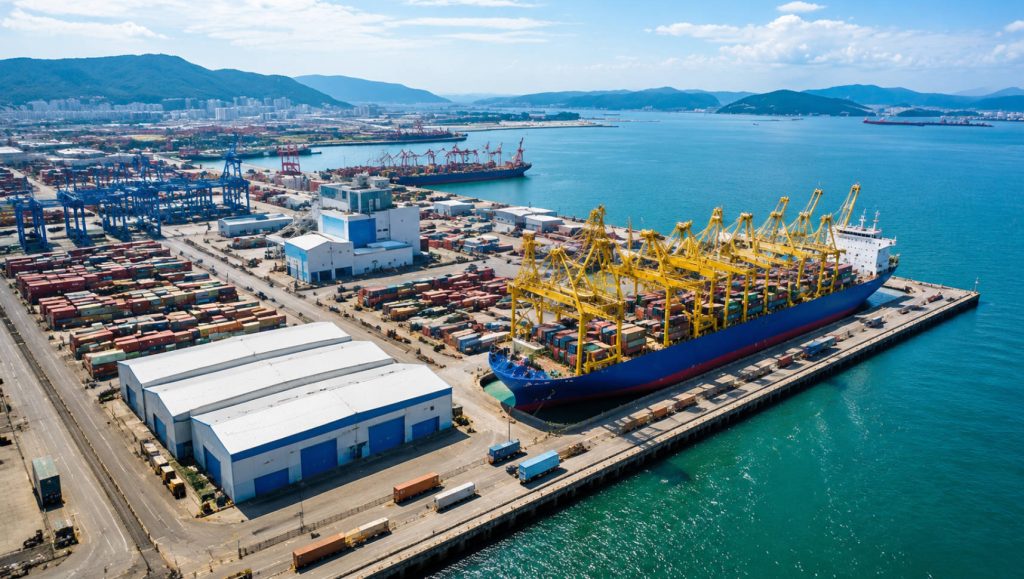
Ningbo also has a robust port infrastructure. The Meishan and Beilun terminals account for the majority of container exports and the Container Freight Stations (CFS) operating there are experienced, well-staffed and prepared to successfully manage multi-shipper LCL consolidations. The consolidation process at Ningbo generally takes 3 to 5 days from cargo receipt to container sealing and cut-off deadlines are usually set 4 to 5 days before vessel departure – a reasonable timetable once your firm has goods available.
How LCL Consolidation Works: From Factory to CFS to Vessel
Grasping the inner workings of LCL consolidation can assist you in precisely planning your shipping schedules and avoiding the most prevalent reasons for missed sailings. The process starts when your manufacturer or domestic trucking provider drops off products to the designated Container Freight Station (CFS) at or near the site of cargo handover in Ningbo port. With the CFS your cargo is measured, weighed and given a booking slot within a dedicated consolidation container. Since the container is loaded with cargo from several shippers going for the same destination, the CFS operator plans the loading sequence in order to make the best use of available space and to ensure that the items of each shipper are clearly identified, separated and documented.
For each LCL cargo, the freight forwarder or consolidation agent will issue a unique House Bill of Lading (HBL). The forwarder also holds the Master Bill of Lading (MBL) for the full container, which is the document governing the relationship between the consolidator and the ocean carrier. The HBL is the shipper’s working document. It is the document you show for customs clearance, insurance and payment terms with your bank if you are utilizing a letter of credit.
At the destination the process is reversed. The consolidated container is taken to a destination CFS (usually in proximity to the destination port) where it is unstuffed and each individual shipment is split off. This deconsolidation phase is time consuming and normally takes 3 to 5 days after vessel arrival before individual shipments are ready for customs clearance and pickup. This is the phase most often underestimated in travel time planning and is worth putting a conservative cushion around it in your delivery promises.
Total Transit Time: What to Realistically Expect
The most crucial thing to realize regarding LCL transit time from Ningbo to Alabama is that “ocean sailing time” is only part of the door-to-door voyage. There are many moving aspects to the full timeframe and all should be considered while planning for delivery.
| Stage | Typical Duration | Notes |
| Factory to Ningbo CFS (inland trucking) | 1–3 days | Depends on factory location; Zhejiang same-day to 1 day |
| CFS consolidation / cargo cut-off | 3–5 days before sailing | Cargo must arrive before the weekly cut-off deadline |
| Ningbo to US East/Gulf Coast (ocean transit) | 25–35 days | Via Panama Canal; routing varies by carrier and service |
| Destination CFS deconsolidation | 3–5 days after vessel arrival | Container is unstuffed; shipments sorted by consignee |
| US Customs clearance | 1–3 days | Can run concurrently with deconsolidation if ISF filed early |
| Trucking from port/CFS to Alabama destination | 1–3 days | Depends on entry port and Alabama delivery city |
| Total door-to-door (typical range) | 38–54 days | Excluding delays from congestion, customs holds, or weather |
The normal route for LCL goods to Alabama is Ningbo to Savannah (Georgia) or Ningbo to Charleston (South Carolina), then trucking overland to Alabama. The Port of Mobile has Alabama’s own deep-water Gulf Coast gateway and accepts container traffic directly, however the frequency of sailings from Ningbo to Mobile for LCL consolidation services is less frequent than Savannah or Charleston. For most shippers, the Savannah to Alabama truck leg is a well established efficient and cost effective one Savannah is a day’s drive to Birmingham, Huntsville and Montgomery via the interstate network
Routing of the Panama Canal is a critical variable in 2025. Some carriers are limiting drafts and adding transit delays due to ongoing drought conditions that are impacting the canal’s water levels. Shippers on the Ningbo-to-US-East-Coast lane may expect intermittent 3- to 5-day schedule delays on affected services and should cooperate with a freight forwarder that monitors vessel scheduling in real time and can reroute cargo when certain sailings are in jeopardy.
LCL Rate Structure: How Costs Are Calculated
LCL pricing is a whole different beast than FCL pricing. Instead of paying for a full container, you pay for the space your cargo fills either by cubic meter (CBM) or by revenue ton (whichever is bigger – 1 revenue ton equals 1,000 kg. or 1 CBM). Under normal market conditions in 2025, the ocean freight rate from Ningbo to US East or Gulf Coast ports for LCL is typically between $80 and $180 per CBM. However, rates do fluctuate with the season and overall market demand.
But the base rate is seldom the entire rate. LCL shipments have a number of other charges at origin and destination, and this is where the overall cost picture can get a bit complicated. Knowing the charge category before you book can avoid billing surprises and let you compare freight forwarder quotes correctly.
| Charge Category | Typical Range | Where It Applies |
| Base Ocean Freight (per CBM) | $80–$180/CBM | Origin; charged by consolidator based on sailing and route |
| Origin CFS / Handling Fee | $30–$60/CBM | Ningbo CFS; covers receiving, stuffing, and container planning |
| Origin Documentation (B/L fee, ISF) | $50–$120 per shipment | HBL issuance + ISF 10+2 filing (mandatory for US imports) |
| Bunker / Fuel Surcharge (BAF) | $15–$50/CBM | Varies with fuel index; applied by carrier to all shipments |
| Terminal Handling Charge (THC) – Origin | $20–$40/CBM | Port terminal fee at Ningbo for container operations |
| Destination THC / CFS Handling | $60–$120/CBM | US port / CFS unstuffing, sorting, and delivery order release |
| Customs Brokerage | $150–$350 per entry | US customs clearance; ISF filing sometimes bundled |
| Inland Trucking (US port to Alabama) | $500–$1,800 per shipment | Varies by entry port, shipment weight, and Alabama city |
| Cargo Insurance (optional) | 0.3%–0.5% of cargo value | Strongly recommended for commercial shipments |
Here’s a practical example: a 5 CBM shipment weighing 800 kg (so billed on CBM) from Ningbo to Birmingham, Alabama, via Savannah port might cost you something like $400-$900 base ocean freight, $300-$600 in origin and destination handling charges, $150-$350 customs brokerage, and $800-$1400 inland trucking from Savannah to Birmingham. In this case, the overall all-in cost would normally range from $1,650 to $3,250, depending on the freight forwarder, the specific carrier service, and the current market conditions. This works out at $330 to $650 per CBM door-to-door on a per-CBM basis, far below air freight alternatives, which typically approach $2,000 per CBM on this lane.
Documentation Checklist for Ningbo–Alabama LCL Shipments
With the exception of one crucial feature, LCL documentation requirements are the same as FCL for the vast majority of items: since the shipment is sharing a container with other shippers, the date for providing paperwork to the consolidator is firm and cannot be negotiated. For late documents your goods will miss the sailing and be detained for the next week’s consolidation – a seven day penalty for a paperwork delay.
For shipments entering the United States, the Importer Security Filing (ISF 10+2) must be filed with US Customs and Border Protection at least 24 hours before loading cargo on board the vessel at Ningbo. This is the duty of the shipper or their customs broker, and it’s a compliance requirement, not an optional step. Failure to comply with ISF may result in fines of up to $5,000 per violation and holds on the cargo examination upon arrival.
| Document | Prepared By | Submission Deadline |
| Commercial Invoice | Chinese exporter | Before CFS cargo cut-off |
| Packing List | Chinese exporter | Before CFS cargo cut-off |
| House Bill of Lading (HBL) | Freight forwarder / consolidator | Issued after vessel departure |
| Importer Security Filing (ISF 10+2) | US customs broker / forwarder | 24 hours before vessel loading at Ningbo |
| Certificate of Origin (if applicable) | Chinese exporter / CCPIT | Before CFS cargo cut-off; required for duty preference claims |
| Packing Declaration (for wooden pallets) | Exporter / packer | ISPM 15 compliant; required for all US-bound wooden packing |
| Product Safety / Test Reports | Manufacturer | As required by CPSC, FDA, or product-specific US regulations |
| Customs Entry (US) | US licensed customs broker | Prior to or upon vessel arrival at destination port |
One document that many shippers fail to notice is the ISPM 15 certification of timber packing materials. All wooden pallets, boxes and dunnage used in ocean freight entering the United States must be heat-treated and marked with the ISPM 15 mark. Failure to comply will result in immediate quarantine and required treatment at the importer’s cost on arrival – a costly and time-consuming interruption that is easily avoidable with the right planning.
Alabama’s Inland Logistics Network: Getting Cargo from Port to Destination
Alabama isn’t just a destination – we are an increasingly sophisticated logistics hub with infrastructure far beyond the Port of Mobile. An understanding of the nature of Alabama’s transportation network can assist importers in selecting the best port of entry and inland distribution strategy for their supply chain.
Port of Mobile and the MAX Corridor
The Port of Mobile is the only deep water coastal port in Alabama and is the state’s major international ocean gateway. The Alabama Port Authority has packaged Mobile’s multi-modal connections into a service platform called MAX — Mobile America Express — linking the port to inland Alabama and beyond via Class I rail, interstate roads and inland waterway terminals. Marine cargo activity at Alabama Port Authority terminals from 2019 to 2024 generated more than $415.8 billion in total U.S. economic value, underscoring the port’s essential position in the state’s trade infrastructure. The planned Montgomery Intermodal Container Transfer Facility (ICTF), projected to be operational in early 2027, will provide a CSX-served rail connection that greatly expands possibilities for manufacturers and distributors across central and south Alabama.
Savannah and Charleston as Alternative Entry Points
For 2025, Savannah (Georgia) and Charleston (South Carolina) remain the most practicable entry sites for most Ningbo-to-Alabama LCL cargoes. Both ports have more frequent sailings for Asia-origin LCL, more established CFS infrastructure, and well-developed transportation networks into Alabama. The Port of Savannah is the third largest container port in the US and one of the fastest expanding with continued investment at its Garden City Terminal. Savannah is 5-6 hours from Birmingham via truckload or LTL carrier, 6-7 hours to Huntsville, and 4-5 hours to Montgomery, all within a same-day trucking window.
Alabama’s Industrial and Logistics Hubs
Industrial geography in Alabama dictates the destination of the cargo when it leaves the port. The industrial base in Birmingham and central Alabama is well established, with a vacancy rate of 8.8 percent and average warehouse rents of about $7.22 per square foot per year – competitive with national standards. North Alabama’s Huntsville has turned into a magnet for automotive, aerospace and defense-related production. The Port of Huntsville is an inland port with Foreign Trade Zone status, allowing significant duty benefits for qualifying importers. The state is located at the crossroads of major interstates (I-65, I-20/59, I-10), and Alabama warehouses can reach over 60% of the US population within two days of ground shipping—a strong distribution advantage for enterprises serving the greater Southeast.
| Alabama City / Hub | Industry Focus | Key Logistics Assets | Truck Time from Savannah |
| Birmingham | Steel, industrial, distribution | Birmingham Intermodal Facility (Norfolk Southern), I-20/I-59 | ~5–6 hours |
| Huntsville | Aerospace, automotive, defense | Port of Huntsville (FTZ), Huntsville Logistics Center, I-565 | ~6–7 hours |
| Montgomery | Automotive (Hyundai), distribution | Montgomery ICTF (CSX, operational 2027), I-65 | ~4–5 hours |
| Mobile | Gulf port, chemicals, manufacturing | Port of Mobile, Terminal Railway, I-10/I-65 | ~5–6 hours |
| Tuscaloosa | Automotive (Mercedes-Benz), manufacturing | I-20/I-59 corridor | ~5–6 hours |
LCL vs. FCL: Choosing the Right Mode for Your Ningbo-Alabama Shipments
The LCL vs. FCL question is really a volume and frequency question. LCL is cheap if you’re shipping less than the economic volume of a full container, which is generally about 15 CBM for a 20 foot container (which has about 25-28 CBM of useful volume). If you take into consideration the extra handling costs associated with LCL, then pricing for LCL on a per-CBM basis will normally be more competitive than FCL at any level below that.
The other dimension is frequency. So if you are importing from Ningbo once a quarter, and in significant volumes, FCL is almost certainly the way to go. The economics heavily favor a dedicated container when you require the room. But if you are restocking on a monthly or bi-weekly basis, weekly LCL departures allow you to ship smaller amounts more regularly, and cut the working capital locked up in inventory, and quicker cycle times to respond to sales trends or changes in your production plan.
| Factor | Favors LCL | Favors FCL |
| Shipment volume | 1–15 CBM per booking | 15+ CBM (20ft) or 25+ CBM (40ft) |
| Shipping frequency | Monthly or more frequent | Quarterly or less frequent |
| Transit time priority | Acceptable 38–54 day door-to-door | Faster; fewer handling points |
| Cargo sensitivity | Robust, well-packaged goods | Fragile goods needing dedicated space |
| Budget flexibility | Pay-as-you-go; lower per-shipment cost | Predictable per-unit cost at scale |
| Supplier consolidation | Single supplier per booking acceptable | Multiple suppliers can share one container |
| Seasonal peaks | Useful to supplement FCL volume gaps | Preferred when volumes are predictable |
Many China-to-Alabama importers run a hybrid approach, using FCL for high season replenishment when volumes surge, and weekly LCL consolidation for routine mid-season restocking or testing new items before pulling the trigger on full-container numbers. A logistics partner that manages both modes under one roof – such as Topway Shipping – can assist you move between FCL and LCL as your volume needs change, without the need to manage separate freight partnerships.
How Topway Shipping Handles the Ningbo–Alabama LCL Route End-to-End
If you’re an importer who has been working with fragmented logistics — a consolidator in China, a separate customs broker in the US, a third-party trucking company for the Alabama leg — the appeal of a fully integrated provider becomes clear the first time a shipment sits because two of those parties didn’t talk. Topway Shipping has a different model: a single provider for the entire chain.
Established in 2010 and based in Shenzhen, Topway Shipping is a competent provider of cross-border e-commerce logistics solutions for more than 10 years. The founding team has more than 15 years of experience in international logistics and customs clearance with significant operational expertise on the China-US transportation route. Topway provides LCL and FCL ocean freight from the key ports in China such as Ningbo to the major US ports. We take care of the origin side consolidation, carrier booking and documentation preparation that decides whether your cargo makes its voyage or waits another week.
But Topway is not only an ocean. If you’re an importer headed to Alabama, Topway is a critical national source for warehousing and trucking (carload) services. That means when your LCL shipment arrives in Savannah, Charleston or Mobile, Topway’s US side operation handles drayage from the CFS to regional warehouses, inventory storage and domestic delivery to your Alabama plant or clients. This full-chain integration — from Ningbo CFS to Alabama door — closes the coordination gap between ocean freight and domestic logistics that creates the majority of import delays.
Supply chain reliability is not a nice-to-have for businesses delivering to Alabama’s automotive, aerospace or industrial sectors – it is a contractual obligation. In a just-in-time production system a missed delivery window has implications way beyond the freight cost. What Topway’s integrated architecture delivers in real-time visibility across the chain is the operational certainty that multi-vendor arrangements, fragmented by their very nature, just cannot.
Practical Tips for Optimizing Your Ningbo–Alabama LCL Shipments
Maximizing weekly LCL service on the Ningbo-to-Alabama corridor is a matter of discipline in three areas: packaging efficiency, document timing and supplier cooperation.
Your LCL cost is impacted by packaging efficiency. You pay for CBM. Any wasted space in your cartons is money you are paying for and not receiving any value for. Adjust the carton dimensions to be as near as possible to the product dimensions, utilize stackable pallets to allow the CFS to load your cargo effectively, and eliminate unduly big filler or void materials where they are not structurally required. A 5 CBM well-packed shipment will always be cheaper than a 7 CBM loosely-packed container with the same products.
Document timing is the most controllable aspect to avoid missed sailings. Work with your supplier to confirm cargo-ready dates at least two weeks prior to your target sailing, allow for a buffer for manufacturing delays, and submit all required documents — including the commercial invoice, packing list and ISF filing details — to your freight forwarder no later than 5 days before the cut-off. If you miss the cut-off one week, it costs you precisely one week in transit time. That sounds doable, unless you have a customer waiting.
For companies who buy from many facilities in Jiangsu or Zhejiang, supplier consolidation is a major cost lever. Instead of booking each of your LCL shipments from each of your factories, have your freight forwarder pick-up from each supplier and consolidate into one booking at the Ningbo CFS. This will reduce your per shipment documentation fees, maximize your CBM allocation efficiency, and simplify the import entry process on the US side.
Conclusion
The LCL route from Ningbo to Alabama aligns nicely with the import profile of the manufacturing industry Alabama attracts: mid-volume, frequency-driven, and operationally demanding. Weekly departures from Ningbo’s CFS network mean you are never more than a week away from the next consolidation window. And when executed with disciplined documentation and properly optimized packaging, LCL delivers a door-to-door cost structure that sits far below air freight options while offering the shipping frequency that quarterly FCL movements cannot match.
Alabama’s logistics infrastructure has seen a dramatic build-up in 2025 with the launch of the Port Birmingham warehouse in June and the continuous growth of the Port of Huntsville as an inland FTZ center and the projected Montgomery ICTF coming online in 2027. This increasing infrastructure provides additional choices in Alabama warehousing, distribution and last mile delivery for imports – making Alabama a true regional distribution center for the southeastern United States rather than just an end point.
The companies that do this route best are those who see it as an integrated system, not as a series of discrete transactions. To transfer cargo predictably and cost-effectively, ocean freight, customs clearance, US-side trucking and Alabama warehousing all need to work in unison. This is the case in dealing with a logistics partner like Topway Shipping, one that has the full-chain capabilities to handle from the Ningbo CFS all the way to the delivery door in Alabama, and the national US trucking and warehouse infrastructure to meet whatever distribution requirements may follow.
FAQs
Q: How often do LCL consolidations depart Ningbo for US East/Gulf Coast destinations?
A: Most major freight forwarders and consolidators have weekly LCL sailings out of Ningbo to the US East Coast and Gulf Coast ports. The precise day of sailing depends on the airline and service, but with a weekly frequency your cargo cut-off date will fall on around the same weekday each week. Miss one cut-off and the next consolidation will be delayed by one week.
Q: What is the realistic door-to-door transit time from Ningbo to Birmingham or Huntsville, Alabama?
A: Most shipments will be 38 to 54 days door to door, which is realistic. This includes factory to Ningbo CFS inland trucking (1-3 days), consolidation waiting time (3-5 days before sailing), ocean transit via Panama Canal (25-35 days), destination CFS deconsolidation (3-5 days), customs clearance (1-3 days) and Alabama inland trucking (1-2 days). Port congestion and conditions at the Panama Canal can increase that range.
Q: Which US port is best for LCL shipments from Ningbo destined for Alabama?
A: For most shippers, Savannah, Georgia is the most convenient entry port for LCL cargo destined for Alabama. Good CFS infrastructure, high sailing frequency from Asia-origin consolidators and efficient truck access to Birmingham (5-6 hours), Montgomery (4-5 hours) and Huntsville (6-7 hours). The Port of Mobile, Alabama’s deep-water gateway, has a lower frequency of LCL sailings from Ningbo.
Q: What is the minimum shipment size for LCL from Ningbo, and when should I consider switching to FCL?
A: LCL can be viable from 1 CBM, albeit extremely small shipments can be subject to minimum charges. The tipping point for considering FCL is usually approximately 15 CBM for a 20-foot container or 25 CBM for a 40-foot container – at these numbers, FCL is generally more cost-competitive on a per-CBM basis and enables faster, more direct travel. So, for any cargo that approaches certain criteria, your freight forwarder should model both possibilities.
Q: Can Topway Shipping handle both the Ningbo LCL ocean freight and the Alabama trucking and warehousing?
A: Sure. Topway Shipping offers comprehensive full-chain logistics services from China origin to US destination, including LCL and FCL ocean freight from Ningbo and other Chinese ports, US customs clearing, drayage, warehousing across the United States, domestic transportation (carload) and last-mile delivery. The Ningbo-to-Alabama corridor’s end-to-end capacity removes coordination gaps between maritime and domestic logistics that commonly leads to delays.