
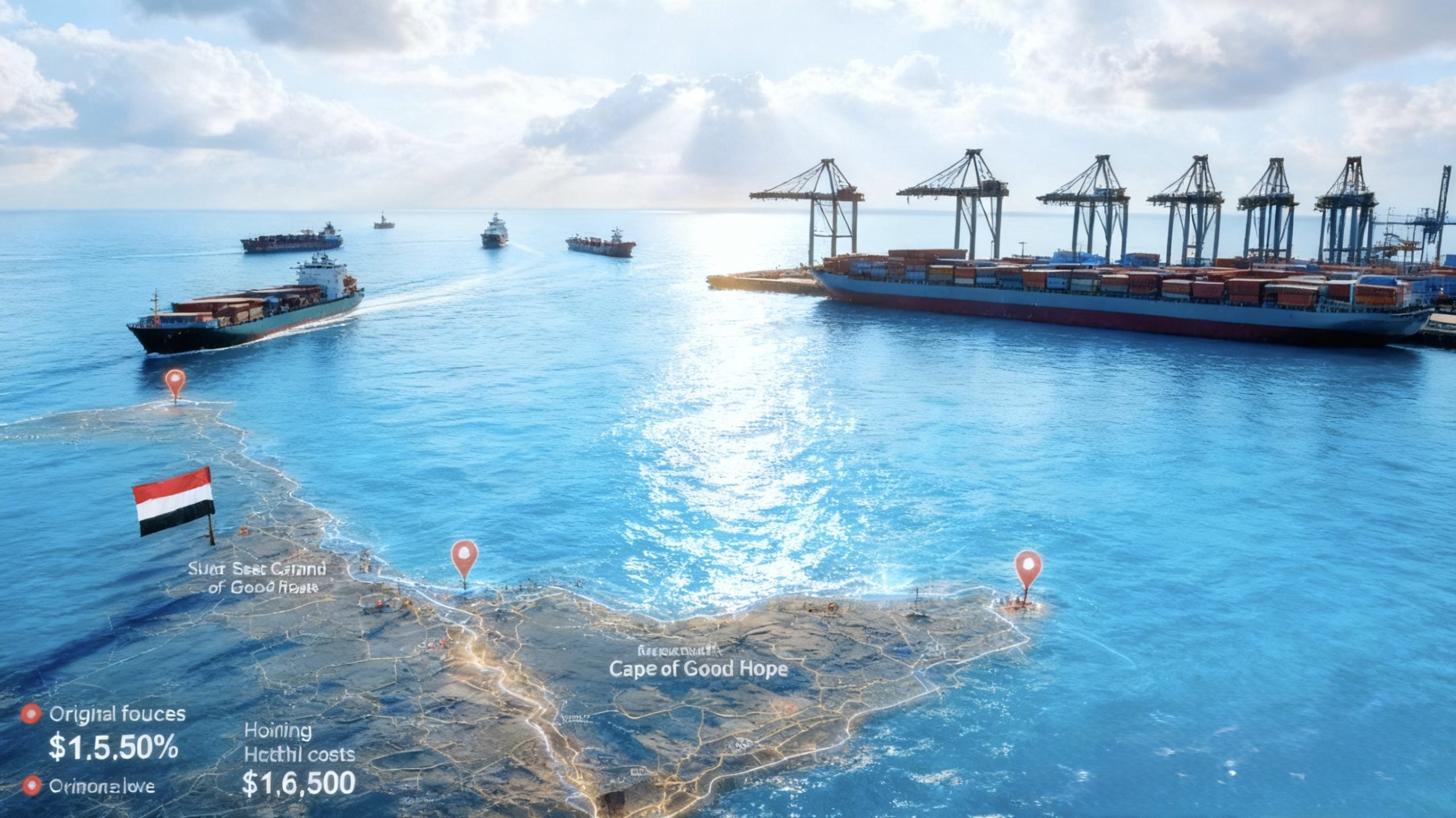
 The global logistics industry has seen a significant shift this week as Yemen’s Houthi armed group officially announced the suspension of maritime attacks on Israel-linked vessels and lifted its naval blockade on Israeli ports.
For the international shipping community—carriers, freight forwarders, NVOCCs, and global supply chain planners—this development represents a potential turning point after more than a year of unprecedented disruption in the Red Sea.
1. What Exactly Happened? — A Strategic Pause, Not a Permanent Resolution
The announcement was issued by the Houthis’ newly appointed Chief of Staff, Yusuf Hassan al-Madani, signaling a temporary halt in military operations targeting shipping routes connected to Israel.
While this reduces immediate risk, it does not equate to a stable long-term solution. The group has made it clear that any renewed Israeli aggression in Gaza would trigger a full resumption of attacks.
Industry takeaway:
✔ Current conditions = lower risk, not no risk
✔ Houthi operational capability remains fully intact
✔ Risk level is conditional on regional geopolitics
2. Impact on Global Shipping Routes: A Possible Return to Normalcy—With Caution
Since late 2023, the Red Sea crisis forced major carriers—including Maersk, MSC, CMA CGM, Hapag-Lloyd—to reroute vessels via the Cape of Good Hope:
-
+10–15 days transit time
-
+30% to +70% increase in bunker and operational costs
-
Significant congestion at alternative ports
-
Increased container imbalance
-
Higher freight rates globally
With attacks now suspended, some carriers may cautiously evaluate a gradual return to the Red Sea route. But industry experts emphasize that insurers, carriers, and large BCOs will not immediately reverse rerouting decisions.
Industry implications:
| Factor | Short-Term Impact | Long-Term Outlook |
|---|---|---|
| Transit Time | Potential reduction if carriers return | Depends on sustained stability |
| Freight Rates | Mild downward pressure | Rates remain volatile |
| Insurance Premiums | High-risk surcharges may be re-evaluated | Still influenced by political risk |
| Capacity | Possible easing of vessel shortages | Stabilization requires weeks/months |
3. How Much Has the Red Sea Disruption Cost the Industry?
Since October 2023, Houthi attacks have resulted in:
-
100+ commercial vessels attacked
-
4 vessels sunk
-
1 vessel hijacked
-
Multiple casualties among seafarers
-
Billions in rerouting and insurance costs
The rerouting also drove up:
-
Global CPI
-
Retail prices (especially Europe)
-
Inventory bottlenecks
-
Supply chain instability for automotive, electronics, textiles, and machinery sectors
The suspension brings relief but does not erase the structural damage already done to schedules and capacity planning.
4. What Should Logistics Providers and Shippers Do Now?
Even with risk declining, logistics providers must treat the situation as fluid. Based on current intelligence, here are the operational recommendations:
(1) Maintain Dual Routing Plans
Carriers may partially return to the Red Sea, but forwarders should prepare:
-
Plan A: Via Suez (if carriers resume)
-
Plan B: Cape of Good Hope (fallback in case of renewed conflict)
(2) Continue Monitoring War Risk and Insurance Premiums
Insurers typically adjust slower than geopolitics. Even with reduced risk:
-
WRI (War Risk Insurance) remains elevated
-
Premiums may drop gradually, not instantly
(3) Advise Customers Realistically
Shippers should be warned:
-
Do not expect immediate freight rate drops
-
Supply chains will take weeks to recalibrate
-
Schedules will stabilize gradually—not overnight
(4) Evaluate Contracted Rates (NAC/FAK) Carefully
If you are negotiating 2025 Q1/Q2 ocean contracts:
-
Ask carriers for an updated outlook post-suspension
-
Compare Red Sea vs. Cape routing cost assumptions
-
Expect contract rates to reflect risk-adjusted pricing
5. Industry-Wide Outlook: Reduced Tension, But Long-Term Instability Remains
Maritime security analysts emphasize that the Houthis have not lost their capabilities:
-
Missile launch sites remain operational
-
Drone and USV (unmanned surface vessel) programs remain functional
-
Command infrastructure is intact
-
Ideological and political motivations unchanged
This means:
➡ The operational risk is suppressed, not eliminated
➡ Future attacks remain a real possibility
➡ A major breach in the Israel–Hamas ceasefire could instantly escalate the situation
Thus, global supply chain managers must treat this as a temporary window of stability, not a final resolution.
Conclusion: A Positive Signal—But the Logistics Industry Must Stay Alert
The suspension of Houthi attacks represents the most encouraging development in Red Sea maritime security in over a year. It could reduce global freight prices, shorten transit times, and relieve pressure on already strained global supply chains.
However, from a logistics perspective, this is a conditional, reversible, and politically fragile improvement.
International shipping companies, freight forwarders, and global exporters/importers must keep monitoring:
-
Security advisories
-
Carrier routing decisions
-
Insurance adjustments
-
Regional political developments
In the high-stakes world of global trade, vigilance remains the only sustainable strategy.