
Ship from China to Romania: Eastern Europe’s Fastest-Growing E-Commerce Market
Romania rarely tops the list of markets Chinese sellers ask about first, yet over the last two years it has quietly become one of the more resilient and interesting e-commerce destinations in Eastern Europe. With online retail sales now sitting above €8 billion a year and still climbing, a population that has embraced online shopping despite economic headwinds, and a coastline that opens directly onto the Black Sea, Romania offers Chinese exporters a genuinely useful entry point into the wider EU market.
For freight forwarders and cross-border sellers, however, opportunity and complexity are arriving at the same time. 2026 has brought sweeping changes to how the EU treats low-value parcels, new national handling fees inside Romania itself, and a shipping market still adjusting to Red Sea disruptions and rising peak-season surcharges. This guide breaks down what is really happening in the China–Romania trade lane right now — the routes, the costs, the customs rules, and the practical decisions that determine whether a shipment lands on time and on budget.
A Market Worth Watching: Romania’s E-Commerce Boom
Romania’s online retail sector crossed roughly €8.1 billion in sales value in 2025, and most analysts expect it to edge past €8.5 billion in 2026, even as growth cools from the double-digit rates seen in previous years. Internet penetration in the country now sits above 95 percent, meaning access is no longer the barrier it once was — the story has shifted from getting people online to getting them to buy more, and more often.
Growth is not evenly spread across categories. Electronics, gadgets, and accessories have been the standout performer, with sales value climbing sharply year over year and order counts rising at a similar pace. Pharmaceuticals, sporting goods, and food products have also grown at healthy rates, while fashion — long the largest single category by revenue share — has cooled slightly as shoppers become more price-sensitive.
| Metric | 2025 | 2026 (forecast) |
| Market size | ≈ €8.1 billion | ≈ €8.5 billion |
| Growth rate | ≈ 6% | ≈ 5% |
| Internet penetration | ≈ 95% | 95%+ |
| Average online order value | ≈ €54 | ≈ €57 |
| Leading payment method | Cards (≈ 46% of value) | Cards, with BNPL rising fast |
| Dominant delivery preference | Cash on delivery (≈ 51% of orders) | COD and parcel lockers both growing |
One trend freight forwarders should not overlook: platforms based outside the EU already have a firm foothold in Romania. Roughly one in four Europeans shopped on Temu in 2025, and the platform’s monthly active user base in Romania alone reached several million — a clear signal that Romanian consumers are entirely comfortable buying directly from Chinese sellers, not just from local retailers who happen to stock Chinese-made goods.
Why China Sits at the Center of Romania’s Supply Chain
China is already one of the largest single sources of goods flowing into Romania through cross-border e-commerce, and that relationship runs deeper than marketplace shopping. Local Romanian retailers, from electronics chains to fashion platforms, source a large share of their inventory from Chinese factories, and Romanian small businesses increasingly import directly rather than buying through EU-based middlemen in order to protect their margins.
This is exactly where a reliable freight partner earns its value. Sourcing product from Shenzhen or Ningbo is the easy part; getting it through customs, onto the right vessel or train, and into a Romanian warehouse or directly to a Romanian doorstep on a predictable schedule is where most new importers run into trouble.
Main Shipping Routes and Methods From China to Romania
There is no single best way to ship from China to Romania — the right method depends on cargo volume, budget, and how quickly the goods need to arrive. In practice, importers choose between four options: ocean freight, China–Europe rail, air freight, and international express courier.
Ocean Freight via the Port of Constanta
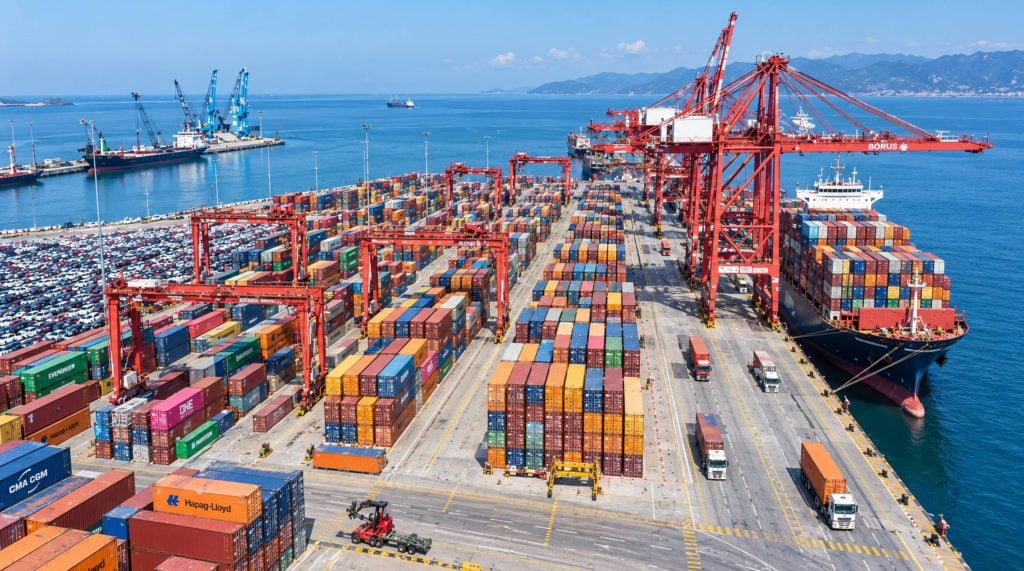
The Port of Constanta, on Romania’s Black Sea coast, is by far the country’s most important gateway for goods arriving from Asia. It is the largest port in Romania and one of the largest in Europe by throughput, handling tens of millions of tonnes of cargo every year. Its location gives it a structural advantage that ports on Europe’s Atlantic and North Sea coasts simply don’t have: cargo arriving via the Suez Canal reaches Constanta without the extra days needed to sail around Western Europe, and the port connects onward to the Danube river network, giving forwarders an inland route deep into Central Europe.
Most FCL and LCL cargo from China departs from Shanghai, Ningbo, Shenzhen, Qingdao, or Guangzhou and calls at Constanta after transiting the Suez Canal, with secondary entry options through Galați and Brăila further up the Danube. Direct services exist, but many shipments still transship through a Mediterranean or Black Sea hub port, which is worth building into your planning buffer.
China–Europe Rail Freight
Rail has become a genuinely competitive middle option for shippers who need something faster than ocean freight without paying air freight prices. Trains running the China–Europe corridor typically deliver cargo to Romania within a couple of weeks, a useful hedge during periods when Red Sea security concerns add days or even weeks to Suez-routed vessels, or during Chinese New Year and other peak seasons when ocean capacity tightens.
Air Freight and Express Delivery
For urgent, high-value, or lightweight cargo, air freight into Bucharest’s Henri Coandă Airport and international express couriers remain the fastest options, typically delivering within a week. This is the natural choice for sample shipments, fast-fashion drops tied to a specific launch date, or replenishment orders where a stockout would cost more than the extra freight spend.
| Shipping Mode | Typical Transit Time | Approx. Cost Range |
| Ocean FCL (20GP) | 25–35 days, port to port | $3,300 – $4,000 |
| Ocean FCL (40HQ) | 25–35 days, port to port | $5,300 – $6,500 |
| Ocean LCL | 26–34 days | ≈ $40 per CBM |
| Rail freight (20GP) | 12–17 days | $4,300 – $5,300 |
| Rail freight (40HQ) | 12–17 days | $6,300 – $7,700 |
| Air freight | 5–6 days | ≈ $6.5 per kg |
| International express | 5–7 days | ≈ $12 per kg |
Rates fluctuate with fuel surcharges, peak-season demand, and carrier capacity, so treat these as planning ranges rather than fixed quotes.
Customs Clearance: What Changed in Romania and the EU in 2026
Anyone shipping to Romania in 2026 needs to understand that the customs environment for low-value e-commerce parcels has shifted more in the past twelve months than in the previous decade. The EU’s long-standing €150 duty-free threshold for low-value imports was phased out on July 1, 2026. Every parcel entering the EU, regardless of declared value, is now subject to customs processing, and a temporary flat customs duty of €3 applies per product category, based on HS code, on shipments valued at €150 or less, provided VAT is handled through the Import One-Stop Shop, or IOSS, system.
Romania went a step further and introduced its own national logistics fee of roughly 25 lei, or about €5, on low-value consignments, effective from January 1, 2026 — a charge that applies on top of, not instead of, the EU-level duty and VAT. Sellers who are not IOSS-registered face a rougher path: the courier collects VAT and duty on delivery and typically adds its own service fee, often in the €10 to €25 range, which is a poor experience for the end buyer and tends to increase cart abandonment and refused deliveries.
Standard Romanian VAT still applies on top of these charges, and correctly classifying goods under the right HS code matters more than ever, since the €3 duty is charged per tariff heading rather than per parcel — a single box containing three different product types can trigger three separate duty charges. For sellers moving meaningful volume into Romania, this is pushing more businesses toward EU-based bonded or overseas warehousing, so that individual consumer parcels are replaced by fewer, larger B2B customs entries with more predictable costs.
Choosing the Right Shipping Method for Your Business
A seller moving furniture, home goods, or bulky low-margin products in large volumes should default to ocean FCL — it remains the cheapest way to move weight and cubic volume, and the cost per unit drops quickly as container utilization improves. Businesses testing the market or shipping smaller batches across several product lines are usually better served by LCL, which avoids paying for space they don’t need.
Sellers who need speed without the full cost of air freight, such as replenishing fast-moving SKUs during a sales campaign, increasingly lean on rail, particularly given how exposed ocean schedules have become to Red Sea rerouting and Suez disruptions. Air and express remain reserved for genuinely time-critical cargo: new product launches, samples for buyers, or anything where a missed delivery date carries a real commercial cost.
Common Challenges When Shipping From China to Romania
Transit reliability is the first challenge most importers run into. Ongoing Red Sea security issues continue to push some carriers toward the longer Cape of Good Hope route, and even Suez-routed services can pick up two to five days of delay from European port congestion during peak periods. Building a realistic buffer into delivery promises, rather than quoting the fastest-case transit time, saves a lot of customer service headaches down the line.
The second challenge is last-mile delivery inside Romania itself. Cash on delivery remains the payment method for roughly half of all online orders in the country, which adds handling complexity compared with prepaid EU markets, while parcel lockers are expanding quickly as an alternative that both buyers and carriers increasingly prefer. A logistics partner needs strong relationships with the right domestic couriers to offer both options smoothly.
Finally, documentation errors remain one of the most common causes of delay at Constanta and at inland customs points. Incomplete commercial invoices, mismatched HS codes, or missing packing lists can hold a container for days while paperwork is corrected, an expensive problem when a single 20-foot container is already carrying a freight bill north of three thousand dollars.
How Topway Shipping Supports Your China–Romania Supply Chain
This is precisely the kind of complexity that a specialized freight forwarder is built to absorb. Topway Shipping has been providing cross-border e-commerce logistics solutions since 2010, headquartered in Shenzhen, with a founding team that brings more than 15 years of combined experience in international logistics and customs clearance. That expertise was built originally around the demanding China–U.S. lane and is now applied across a growing network of global trade routes, Romania included.
Topway’s service covers the full logistics chain rather than a single link in it: first-leg transportation from the factory or supplier in China, overseas warehousing to stage inventory closer to the end customer, customs clearance on both ends of the journey, and last-mile delivery into the buyer’s hands. For sellers moving larger volumes, Topway also arranges flexible full-container-load and less-than-container-load ocean freight from China to major ports worldwide, including the Black Sea gateway at Constanta that Romanian importers depend on.
For a seller weighing whether to consolidate shipments into fewer commercial entries under the new EU customs rules, or trying to decide between rail and ocean for a time-sensitive order, that kind of end-to-end visibility is the difference between a shipment that clears smoothly and one that sits waiting on a customs desk. Working with a forwarder who already understands Romania’s national fees, IOSS registration, and Constanta’s operational quirks means fewer surprises on both landed cost and delivery date.
Conclusion
Romania’s e-commerce market has moved past its early hyper-growth phase, but it remains one of the more dependable growth stories in Eastern Europe, with a shopper base that has embraced both local retailers and international marketplaces. For Chinese exporters, the opportunity is real, but so is the operational complexity introduced by 2026’s customs reforms, Romania’s own handling fees, and a shipping market still working through Red Sea disruptions.
Success on this lane comes down to matching the right shipping method to the right cargo, understanding exactly what a parcel will cost once duty, VAT, and national fees are added, and partnering with a forwarder who can manage the full journey rather than just one leg of it. With more than fifteen years of logistics experience and a full-chain service model spanning first-leg transport, overseas warehousing, customs clearance, and last-mile delivery, Topway Shipping is positioned to help sellers move goods into Romania, and the rest of the EU, with fewer delays and more predictable costs.
FAQs
Q: How long does shipping from China to Romania usually take?
A: It depends on the method. Ocean freight to the Port of Constanta typically takes 25 to 35 days, China–Europe rail takes around 12 to 17 days, and air freight or express courier services usually deliver within 5 to 7 days.
Q: What is the cheapest way to ship from China to Romania?
A: Ocean freight is the most cost-effective option for large or heavy shipments, especially full-container-load cargo. For smaller volumes, less-than-container-load shipping lets you share container space and pay only for the volume you actually use.
Q: Do I still need to pay customs duty on low-value parcels shipped to Romania?
A: Yes. As of July 1, 2026, the EU’s €150 duty-free threshold was removed, and a flat €3 customs duty now applies per product category on parcels valued at €150 or less. Romania also charges its own national logistics fee of roughly €5 per low-value consignment, on top of standard VAT.
Q: What is the Import One-Stop Shop, or IOSS, and why does it matter?
A: IOSS is an EU VAT simplification scheme that lets non-EU sellers collect VAT at checkout and remit it directly, so parcels clear Romanian customs without extra charges collected from the buyer at delivery. Sellers who are not IOSS-registered risk their couriers adding clearance fees on arrival, which frustrates customers and increases refused deliveries.
Q: Which Chinese ports offer the best connections to Romania?
A: Shanghai, Ningbo, Shenzhen, Qingdao, and Guangzhou all offer regular ocean freight services to the Port of Constanta, either directly or via transshipment through a Mediterranean or Black Sea hub port.
Q: Can Topway Shipping handle both FCL and LCL shipments to Romania?
A: Yes. Topway Shipping offers flexible FCL and LCL ocean freight from China to major ports worldwide, including Constanta, along with first-leg transportation, overseas warehousing, customs clearance, and last-mile delivery to support the full journey into Romania.