
- Meta Title: 25% Truck Tariff in the U.S. | How It Affects Logistics Costs and Cross-Border Sellers in China and the U.S.
- The U.S. will start charging a 25% tax on heavy trucks and parts on November 1. Find out how this affects the cost of shipping between China and the U.S. and what vendors that sell across borders should do.
- U.S. truck taxes, 25% import tariff, China-U.S. logistics cost, cross-border sellers’ tariff impact, U.S. transportation cost, FBA truck shipment, and DDP delivery are some of the terms used. The United States
Introduction
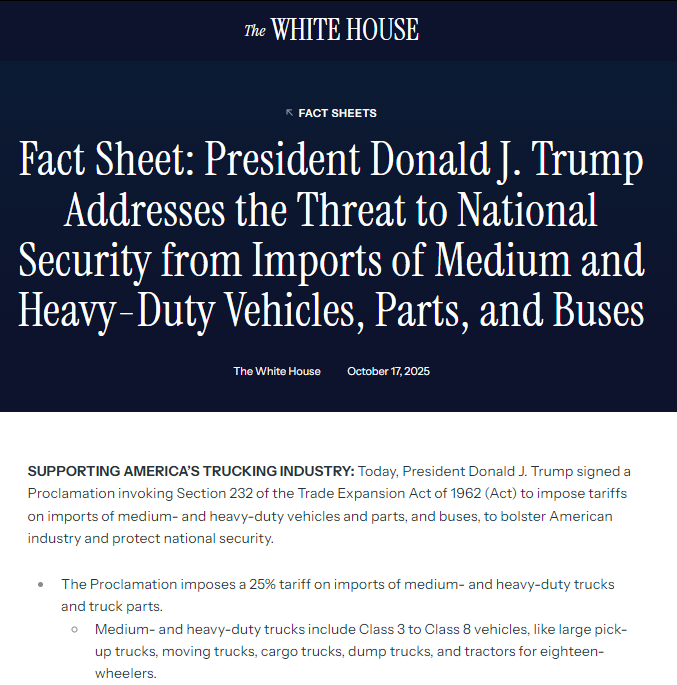
On October 17, President Trump signed an executive order that put a 25% tax on imported medium- and heavy-duty vehicles and parts starting on November 1. There was also a 10% tax on imported buses. This regulation not only hurts the car sector, but it also makes it harder for global supply chains and shipping prices between China and the U.S.
A lot of people might think, “This only affects the trucking business, right?” Changes in U.S. shipping costs will eventually affect the profit statements of all cross-border sellers.
Why is the U.S. putting a 25% tax on trucks?
The official reason is “national security,” and it worries that relying too much on imports could hurt the U.S.’s ability to make its own transportation equipment. But there are three good reasons for this move:
- Reshoring Manufacturing: The U.S. wants to bring more truck manufacturing back to the U.S. by keeping tariffs on vehicles and parts.
- Industrial Protection—giving domestic truck makers more power over prices.
- Political Calculus: Jobs and manufacturing are very important issues during an election year.
What do these tariffs entail for sellers who sell across borders?
1. The cost of transportation in the U.S. is going up.
Medium- and heavy-duty trucks are the “lifeblood” of U.S. logistics. Charges for renewing and maintaining a fleet will go up since imported trucks and parts will cost more. This will make delivery charges go up in the end.
2. Possible indirect effects on the cost of logistics between China and the U.S.
The measure is aimed at trucks, but it will have effects on supply chains from China to the U.S. Prices for services like DDP delivery and FBA truck shipping may go up because it costs more to run trucks.
3. Consumers pay the same price.
Costs of logistics are always included in the price of a product. Durable goods, furniture, and big things could feel the pressure first.
What Should Cross-Border Sellers Do About These Tariffs?
- Secure Capacity Early
Sellers should schedule China-U.S. delivery services in advance with logistics companies to avoid price increases at the last minute as Black Friday and Christmas approach. - Recalculate Profit Margins
Add “higher transportation costs in the U.S.” to profit calculations, and be sure to provide at least 5% to 10% as a buffer. - Optimize Warehousing Strategy
Spread your product out across several warehouses to prevent having it all in one place or state. This will help lower shipping costs and appointment pressures in certain areas. - Monitor Policy Exemptions
For exports of car parts, check right away to make sure they follow USMCA origin standards so you can look into possible exclusions.
Is this a change that will last for a long time or just a short time?
The U.S. government’s compensation and preferential policies will last until 2030; thus, this 25% tariff is hardly a short-term fix. Cross-border vendors need to accept this as the “new normal” and plan ahead in their long-term logistics strategy for China and the U.S.
- Contracts for logistics businesses should include “delivery cost fluctuation clauses.”
- To lower the dangers of using only one mode of transportation, sellers should look at using different modes of transportation together, like “sea freight + truck delivery” or “rail + truck delivery.”
Conclusion: Policy is the wind; logistics is the path
A tariff ruling can change the prices of millions of vehicles right away, but it can’t change the fact that people will always need transportation.
Cross-border sellers can’t wait for laws to pass; they need to understand how to be stable even as tariffs and costs go up and down.
U.S. truck tariffs are more than simply news for sellers; they affect freight prices and profitability directly. This is a chance for logistics companies to show off their knowledge and provide solutions. In the future, the people who can turn complicated policy effects into service plans that clients can understand will be the winners.

FAQ
Q: Does the 25% U.S. truck tariff affect FBA logistics costs?
Yes. The levy is aimed at trucks and parts, but higher expenses for operating trucks in the U.S. will indirectly raise the rates of FBA truck shipping and DDP delivery.
Q: How long will the U.S. truck tariff last?
The measure is not temporary; compensation and policy adjustments are planned through 2030, signaling a long-term trend.
Q: What should cross-border sellers do now?
Get logistics capacity early, change profit margins by 5% to 10%, spread out your warehousing, and keep an eye on USMCA exemptions for any cost savings.