
US Tariff Chaos Is Redirecting Chinese Exports to Europe — Ireland Benefits
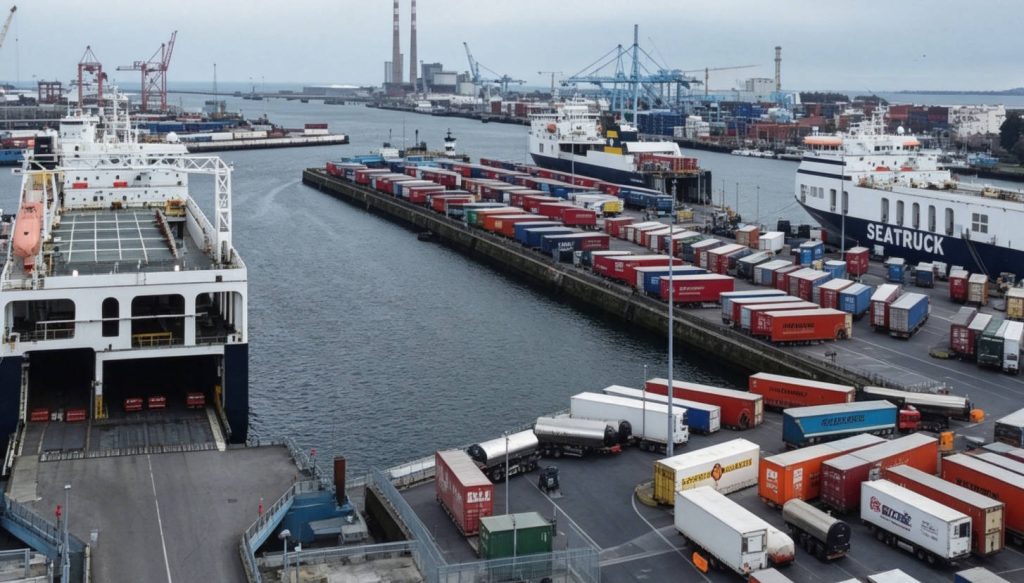
Introduction
In April 2025, the Trump administration raised tariffs on Chinese imports to as high as 145%. This caused one of the biggest changes in global trade flows in a long time. There was a big decline in Chinese freight coming into American ports, but the manufacturers in Guangzhou, Shenzhen, and Hangzhou kept going strong. The things that used to go east just turned west. Europe, especially more and more Ireland, became the main place where a huge amount of Chinese goods that were no longer welcome in the US landed.
This article looks at how that redirection works, the statistics that supports it, the special benefits Ireland has as a European logistics hub, and what the change means for businesses and freight operators that are adjusting to the new normal. It also talks about how logistics companies like Topway Shipping are helping Chinese exporters change their supply chains so that they can better serve European customers.
The Tariff Escalation That Changed Everything
The story starts with a series of back-and-forth actions that got faster and faster around early 2025. Washington’s effective tariff rate on Chinese imports went risen in steps, starting from a level that had already been raised since the 2018 trade war. By mid-2025, the rate had reached about 135% on numerous product categories. Even if a partial truce in October 2025 drove average rates down a little, US tariffs on Chinese imports were still about 34%. This is more than ten times the 2–3% rate that most Chinese exports have to pay to get into European Union markets under WTO rules.
The effects were quick and easy to see. Between January and June 2025, US imports from China fell by over 50% each month. At the same time, China’s exports throughout the world were going up, and its trade surplus reached an all-time high of $1 trillion. There was no way around the math: if the US market was really blocked, Chinese manufacturers had to find other buyers. Europe was the clear choice because it has a lot of consumers, cheap tariffs on Chinese goods, and ports that are open.
The European Commission set up an Import Surveillance Task Force on April 7, 2025, to keep an eye on trade diversion in real time. But watching policies wasn’t enough to halt the wave that was already building.
| Indicator | Pre-Tariff Escalation (2024) | Post-Escalation (2025) |
| US effective tariff on Chinese goods | ~20–25% | ~34–135% (peak) |
| EU average tariff on Chinese goods (WTO) | 2–3% | 2–3% (unchanged for most) |
| Monthly US imports from China | Baseline | ↓ ~50% |
| EU–China trade deficit | €305 billion | €359.8 billion (+18%) |
| Chinese exports to EU (full year) | Baseline | ↑ 6.4% |
| Chinese global trade surplus | ~$800 billion | $1 trillion+ |
Sources: Eurostat, Atlantic Council, Courthouse News Service, ECB Blog, 2025–2026
Europe Gets the Bill: What the Data Shows
When Eurostat, the EU’s statistics department, issued its first full-year image of trade flows in 2025, it was quite obvious. The EU brought in €559.4 billion worth of Chinese goods over the course of a year, but only sent back €199.6 billion worth of goods. This left a deficit of €359.8 billion, which is an 18% rise from the year before. EU imports from China were up by 6.4%, but EU exports to China went down by 6.5%. This means that both numbers were going in the wrong direction at the same time.
Electrical machinery, audio-visual equipment, and parts for these things were the most important things that Europe acquired from China. They made up €164.9 billion, or about 30% of all of Europe’s imports from China. At the center of this were batteries, consumer electronics, and parts. Vehicle imports were another issue. The European Commission put tariffs on Chinese-made electric vehicles in 2024, but exports of plug-in hybrids and regular hybrids from China rose fourfold to fill the gap left by EVs. These vehicles were not subject to the new tariffs.
From November 2024 to November 2025, the amount of Chinese goods sent to the EU grew by over 15% compared to the same time the year before. In certain member states, the hike was considerably bigger. For example, Italy had a rise of more than 25% in Chinese imports, which means that around a quarter of all its imports came from China.
Economists say that this rise is not just because of tariffs. Over the previous three years, China’s yuan has lost a lot of value versus the euro in real terms. At the same time, many items in China were almost deflationary while European producer costs were still high because of the 2022 energy crisis. Before the tariff fight, Chinese exporters had a structural cost advantage because of the combination. This advantage is likely to continue no matter what happens in trade talks.
Which Products Are Being Diverted — and Where They’re Going
Not all of China’s exports are going to Europe in the same way. The European Central Bank and the Centre for Economic Policy Research (CEPR) did research that showed that the trade diversion effects were true, but they were mostly seen in a small group of products that were quite exposed at first. Chinese exports to the EU surged the most in the categories of lithium-ion batteries and hybrid automobiles. Prices fell slightly as Chinese companies fought for market dominance in Europe.
Textiles, manufacturing, chemicals, and electronics are all flowing more toward European ports, in addition to batteries and electric vehicles. China now supplies 98% of the EU’s rare earth magnets, which are needed for electric vehicle motors, wind turbines, and defense systems. This shows how firmly Chinese supply chains are rooted in Europe’s industrial base.
Chinese exporters haven’t only been sending all of their diverted goods to advanced European economies. There is also considerable evidence of growth in Africa, Southeast Asia, and other emerging markets. But Europe, and especially the EU’s vast consumer market, has taken in a lot of it. And in Europe, smaller, open economies with good logistics infrastructure have gotten more than their fair share of the flow.
| Product Category | EU Import Value (2025) | YoY Change | Key Concern |
| Electrical machinery & audio-visual | €164.9 billion | ↑ Significant | Core industrial dependency |
| Plug-in hybrids & conventional hybrids | High (4x surge) | ↑ ~300%+ | EV duty circumvention |
| Vehicles (total) | €29.9 billion | Elevated | EU manufacturer pressure |
| Textiles & apparel | Rising | ↑ Moderate | Price competition |
| Batteries & components | Rising sharply | ↑ Strong | Green tech dominance |
| Rare earth products | 98% sourced from CN | Structural | Supply chain dependency |
Sources: Eurostat, CEPR, Atlantic Council, Courthouse News, 2025–2026
Why Ireland? The Gateway Advantage
Ireland is in a unique position in this new trading environment. Most EU countries are running bigger and bigger trade deficits with China, but Ireland is one of the few EU countries that has historically had a trade surplus with Beijing. That alone shows something structural: Ireland is not simply getting Chinese goods; it is also a market and a logistics center that is smart enough to take them in and send them back out.
In 2024, trade in commodities between Ireland and China was worth more than €21 billion, which is an 8.1% rise from 2023. That year, China was Ireland’s sixth-largest export market and fifth-largest source of imports. Ireland bought about €11.8 billion worth of goods from China and sold about €9.5 billion worth of goods to China. This was a 6.1% increase over the previous year.
Ireland is a great place for Chinese goods to enter Europe for a number of reasons. First, because Ireland is a full member of the EU, goods that clear Irish customs can flow freely between all 27 EU member states within the single market framework. When a cargo gets to Dublin Port or Cork Harbour, it clears customs and enters the whole European market. Second, Ireland’s locati0n at the western border of Europe, with direct shipping channels to major Chinese ports across the Atlantic that don’t get as crowded as continental hubs like Rotterdam or Hamburg, gives it a transit-time advantage on some routes. Third, Ireland’s well-developed e-commerce ecosystem, where 33% of e-commerce income currently derives from international sales, makes it a natural place for Chinese brands to test the waters before opening a digital store in Europe.
The diplomatic push makes business sense even more. In January 2024, Chinese Premier Li Qiang went to Ireland, and in February 2025, Chinese Foreign Minister Wang Yi followed. They used the trip to make a clear link between Ireland’s Shannon Free Zone, which was one of the first special economic zones in the world and was set up in 1959, and China’s own reforms. In early 2026, Michéal Martin, the Taoiseach of Ireland, went to Beijing to meet with President Xi Jinping and Premier Li Qiang. The main topics of discussion were expanding trade and working together on logistics.
IDA Ireland and shared technology funds have helped more than 40 Chinese enterprises set up shop in Ireland. The two countries have a lot of ties in agriculture, food, pharmaceuticals, aircraft leasing, and, more and more, cross-border e-commerce and logistics.
| Ireland Trade Indicator | 2024 Value / Metric |
| Total China–Ireland bilateral goods trade | ~€21 billion (+8.1% YoY) |
| Irish imports from China | €11.8 billion (+9.3% YoY) |
| Irish exports to China | €9.5 billion (+6.1% YoY) |
| Ireland’s rank among EU exporters to China | 5th largest |
| E-commerce share from international sales | 33% |
| Chinese companies operating in Ireland | 40+ |
| DHL investment in UK & Ireland (logistics) | £550 million pledged |
Sources: Ireland CSO, China-Briefing, E2G Logistics Report Q2 2025, CGTN
The Logistics Infrastructure Powering the Shift
Trade diversion of this size doesn’t just happen on its own. It needs logistics infrastructure including freight capacity, warehousing, customs knowledge, and last-mile delivery networks that can handle a big rise in volume without any problems. In Ireland, that infrastructure has been growing in order to meet this kind of demand.
One clear evidence of the investment cycle is DHL’s £550 million commitment to logistics in the UK and Ireland, with an emphasis on e-commerce and healthcare freight. It is expected that the EU logistics sector would develop at a compound annual rate of 6.6% from 2025 to 2033, reaching a market value of £513.69 billion. Ireland’s position as the first port of call for Asian commodities entering Europe provides it a big proportion of the extra freight tonnage along that path.
For Chinese exporters and people who run cross-border e-commerce, the real question is not whether to send goods through Europe, but how to do it in the best way possible. Ocean freight is still the most important part of trade between China and Europe. Shipping lines that go from major Chinese ports to European ports usually take 25 to 30 days. This is longer than the trans-Pacific route to the US West Coast, although Chinese logistics companies have been quickly expanding this route since 2024.
Another important factor is getting through customs. Ireland is a member of the EU customs union, hence it uses EU common external tariffs instead of Irish-specific charges. The EU’s Integrated Tariff (TARIC) scheme says that all items must be declared. This process is harder for Chinese exporters who are new to the European market than it is for US Customs and Border Protection. Different interpretations of HS codes, VAT recovery methods, and license needs for certain products all make it harder to follow the rules. You need to work with professional freight forwarders who know both the Chinese export side and the EU import side.
How Topway Shipping Helps Chinese Exporters Navigate Europe
Chinese exporters that want to switch from US-based supply chains to European routes have a lot to learn and make mistakes that cost a lot of money. This is where Topway Shipping comes in.
Topway Shipping was founded in 2010 and is based in Shenzhen. It has spent more than fifteen years learning how to do business between Chinese factories and international shipping. The people who started the company have more than fifteen years of real-world experience in international logistics and customs clearance, with a lot of knowledge about shipping between China and the US. When the trade environment changed in 2025 and Chinese exporters rushed to find new markets, such institutional knowledge became directly useful for China–Europe links.
Topway’s service concept includes all parts of the logistics chain. That means that on the front end, the first leg of transportation goes from factory floors in Guangdong, Zhejiang, and Jiangsu to major Chinese ports. Topway then ships full containers (FCL) and less-than-container-load (LCL) ocean freight to key ports around the world. This is a very important feature for e-commerce businesses who may not yet have enough volume to book full containers on new European routes. LCL consolidation, in example, lets smaller Chinese merchants share container capacity and lower the cost of shipping per item to levels that make prices in Europe competitive.
Topway can do international warehousing, customs clearance, and last-mile delivery in Europe. These are the three points in the chain where most mistakes and delays happen. If your business ships goods to Ireland or uses Ireland as a gateway to the rest of the EU market, having a logistics partner who can manage Irish Revenue customs declarations, TARIC classification, and VAT recovery procedures takes a lot of work off your plate. Last-mile delivery in Europe is another area where local knowledge leads to shorter delivery times and fewer returns. This is because of the many different national postal and courier networks that make up the continent.
As tariff uncertainty persists and Chinese exporters increasingly regard Europe as a primary market rather than a secondary one, the capacity to execute consistently throughout the entire logistics chain—from a warehouse in Shenzhen to a consumer in Dublin, Frankfurt, or Milan—distinguishes operators who prosper from those who merely endure the trade war’s disruptions.
Risks and Countermeasures: Europe Is Not a Free Lunch
It would be wrong to say that the trade shift from China to Europe is good for everyone. European politicians know very well that domestic manufacturers are under a lot of pressure, and they are already working on a legislative solution.
The European Commission has put tariffs of 20% to 50% on important areas like EVs, green tech, and industrial items. It is also getting ready to charge a tax on e-commerce shipments worth less than $20, which will shut the de minimis loophole that let small goods come in without paying customs. This price will start in July 2025. Ursula von der Leyen, the President of the Commission, has clearly cautioned against the implications of a “second China shock.” This is a reference to the time from 1999 to 2007 when cheap Chinese manufacturing took away jobs in Western industries. European manufacturers of steel, aluminum, machinery, and batteries are working hard to get more protection.
In the meantime, China has proved that it is not a passive player in this situation. In 2025, Beijing put tariffs of up to 42.7% on EU pork and dairy products in response to EV levies. It also limited exports of rare earths, which was a direct pressure point since Europe relies on Chinese rare earths for 98% of its advanced manufacturing. After a Trump-Xi summit in October 2025, the rare earth controls were merely relaxed, which pushed EU diplomacy to the side.
This indicates that the European potential is real for logistics companies and Chinese exporters, but they need to be careful about how they go after it. Tariff classifications are quite important; the HS code for a product might decide whether it comes in at 2% or 40%. More and more people are looking closely at supply chain transparency and certificates of origin. Exporters who construct real European warehouse and distribution infrastructure are better prepared for future changes in the law than those who see the trade diversion as a chance to make quick money.
Conclusion
The US’s higher tariffs on Chinese imports have changed the way that commerce works around the world. Chinese goods that used to flood American shelves are now progressively moving west, with Europe taking in much of the extra volume. In 2025, the EU’s trade deficit with China reached €359.8 billion, an 18% increase from the previous year. This imbalance is caused by structural factors that won’t go away no matter how the tariff talks end up. These include China’s industrial overcapacity, currency depreciation, and continued cost competitiveness.
Ireland has become a very important benefactor within Europe. Because it is an EU gateway market, has low tariffs, a burgeoning e-commerce industry, and stronger diplomatic ties with Beijing, it is a favorable place for Chinese goods to reach the European single market. Trade between China and Ireland was worth more than €21 billion in 2024, and it is apparent that it is going up.
For Chinese exporters, cross-border e-commerce operators, and freight companies working in this context, the most important thing is to get things done: they need to find reliable ocean freight capacity, be able to clear customs, and make sure that last-mile delivery works well in a complicated EU market with many countries. Logistics companies like Topway Shipping, which has been linking Chinese manufacturing to worldwide markets for more than 15 years, can help firms make that change quickly and in a way that lasts. The trip from Shenzhen to Dublin is longer than the trip to Los Angeles, but it could be more significant for business in 2026.
FAQs
Q: Why are US tariffs causing Chinese goods to flow into Europe rather than elsewhere?
A: Europe has the best combination of free markets and buying power outside of the US. Under WTO standards, most Chinese goods only have to pay 2–3% import charges at EU borders. In the US, they have to pay 34–145%. That difference in tariffs makes Europe the best place for Chinese exporters to do business.
Q: Is Ireland specifically targeted by Chinese exporters, or is it just part of the broader EU market?
A: Both. Ireland enjoys the same low EU tariffs as every other member state. However, it also has certain unique advantages, such as an English-speaking business environment, an advanced e-commerce sector, direct shipping routes over the Atlantic, and diplomatic progress with Beijing. It serves as both a destination market and a method to get goods into the rest of the EU.
Q: Will EU policymakers eventually restrict Chinese imports the way the US has?
A: The EU is already putting targeted tariffs on certain important industries (including EVs, green tech, and steel), and the de minimis e-commerce gap is getting smaller. In the near future, though, a blanket ban like the ones that exist in the US is not likely. Brussels can’t move as quickly as it would want because of the EU’s rules-based trading system and its own reliance on the Chinese market for exports.
Q: How should Chinese exporters prepare their logistics for the European market?
A: The first step is to make sure you have the right HS code under the EU’s TARIC system. Misclassifying is the most common and expensive compliance mistake. Set up a warehouse in an EU member state to speed up delivery times and make it easier to fill out import declarations. Work with freight forwarders who know a lot about both how to export goods from China and how to follow EU customs requirements. LCL ocean freight is a good way for operators who don’t have enough volume for full container bookings yet to get started.
Q: What makes Topway Shipping different from other logistics providers for this type of trade?
A: Topway Shipping has been in business since 2010. The founding team has more than 15 years of experience in international logistics and customs clearance, and the company started out with routes between China and the US. That base goes straight to operations between China and Europe. Because the company covers the whole supply chain, from first-leg transport to FCL and LCL ocean freight, overseas warehousing, customs clearance, and last-mile delivery, exporters only have to deal with one source instead of trying to piece together several different ones.